Trump’s anti-voting order may backfire, damaging DOJ’s voter roll campaign
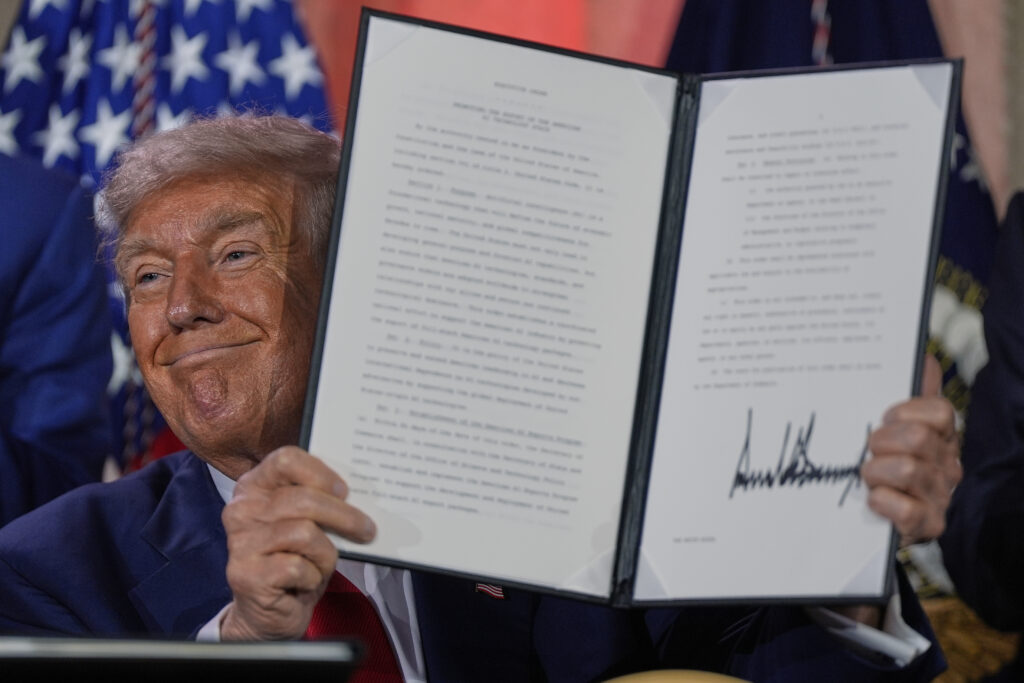
President Donald Trump’s executive order on mail voting is highly likely to be declared unconstitutional and blocked by courts. But it might also screw up the Department of Justice’s (DOJ) 30 ongoing lawsuits for state voter rolls.
Legal experts say the voter suppression diktat may be as strategically foolish as it is doomed.
“The only real legal effect of this executive order might be to kill the remaining DOJ lawsuits seeking to seize voter data,” said David Becker, executive director of the Center for Election Innovation and Research and a former trial attorney in the DOJ’s Voting section.
The executive order Trump signed Tuesday purports to restrict mail-in ballots to just voters on a list of verified U.S. citizens, which would be compiled by the Department of Homeland Security. A coalition of Democrats quickly challenged the order as unconstitutional, and several more lawsuits have since poured in.*
Get updates straight to your inbox — for free
Join 350,000 readers who rely on our daily and weekly newsletters for the latest in voting, elections and democracy.
The judge assigned to hear the Democrats’ case, U.S. District Judge Colleen Kollar-Kotelly, presided over a nearly identical lawsuit challenging Trump’s previous anti-democratic executive order. Kollar-Kotelly blocked that order just weeks after it was signed, suggesting a similarly swift injunction is likely here.
But the order could still have a very real legal impact — just not one the Trump administration will like.
The DOJ has demanded unfettered access to almost every state’s unredacted voter registration rolls. While 17 Republican-led states have complied — potentially violating state and federal privacy laws — the rest have so far refused. So, currently, the DOJ is suing 29 states and Washington D.C. for the records.
In those lawsuits, the DOJ has claimed it needs millions of voters’ private sensitive data in order to ensure the states are complying with federal laws that require states to take steps to ensure accurate rolls. But outside of court, DOJ officials like Assistant Attorney General Harmeet Dhillon have undermined that claim by boasting that the state voter records they’ve already obtained have been used to verify citizenship status using the Department of Homeland Security’s (DHS) Systematic Alien Verification for Entitlements (SAVE) program.
A federal judge alluded to those extrajudicial statements when he ruled against the DOJ’s demands for California’s records.
“The Court is not required to accept pretextual, formalistic explanations untethered to the reality of what the government has said outside of the courtroom,” District Court Judge David O. Carter wrote. “The Court does not take lightly DOJ’s obfuscation of its true motives in the present matter. Congress passed the [National Voter Registration Act], Civil Rights Act, and [Help America Vote Act] to protect voting rights. If the DOJ wants to instead use these statues for more than their state purpose, circumventing the authority granted to them by Congress, it cannot do so under the guise of a pretextual investigative purpose.”
Since then, DOJ attorneys arguing in other cases have repeatedly asserted that the DOJ wasn’t a stalking horse for DHS’s immigration databases.
“I need to say definitively for the record, I thought it was pretty unequivocal that there is not going to be a national voter registration database,” DOJ attorney James Tucker told a federal judge in Maine. “The Department’s position is it is not creating a nationwide voter registration database. These are particularized states, the data is going to be kept separate from other states. It’s being used solely for the purposes that we’ve stated in the letters, to assess compliance with both HAVA and the NVRA.”
But those statements are belied by Trump’s executive order, which directs DHS to create a nationwide voter registration database.
“There’s no federal justification for creating a national voter list, and as DOJ lawyers have gone into court and tried to assure the court that they were not creating a national voter list,” said Becker. “This seems to confirm what the court was concerned about all along.”
Along with Dhillon’s statements and Trump’s orders, the DOJ’s courtroom attestations have been impeached repeatedly. Last week, CBS reported that DOJ and DHS were working to formalize a data-sharing agreement for the voter rolls. And on the same day Tucker was assuring a federal judge that the DOJ wouldn’t share state records with DHS, Eric Neff, acting chief of the DOJ’s Voting Rights Section, admitted to another judge in Rhode Island that they, in fact, would.
Numerous audits by state election officials and independent studies all have shown that noncitizen voting is a virtually nonexistent problem. By Dhillon’s own estimates, all of this legal work has so far uncovered only “dozens” of noncitizens improperly registered to vote.
Legal experts have widely derided the DOJ’s litigation strategy in the voter roll cases, which have been riddled with typos, blown filing deadlines, and other mistakes.
To date, the Trump administration has lost three cases, and had a fourth dismissed without prejudice for being filed in the wrong jurisdiction. The DOJ has since refiled that case and is appealing the losses.
*Democratic plaintiffs in this case are represented by the Elias Law Group (ELG). ELG Chair Marc Elias is the founder of Democracy Docket.