In latest blunder, Trump DOJ spent months emailing the wrong address demanding Oklahoma’s voter rolls
 Prefer us on Google
to see more of our voting rights news coverage when you search.
Federal officials in the Trump Justice Department spent months following up on a voter roll demand that Oklahoma election officials never received — because they were emailing the wrong address.
The Office-style blunder raises questions about whether a department that appears to struggle with email can be trusted to keep safe the sensitive personal data of millions of American voters.
Get updates straight to your inbox — for free
Join 350,000 readers who rely on our daily and weekly newsletters for the latest in voting, elections and democracy.
For months, the DOJ thought Oklahoma was ignoring its demand for the state’s voter database. But in reality, Oklahoma had never seen the request.
Documents show that DOJ officials repeatedly emailed a misspelled address while trying to obtain Oklahoma’s complete voter registration list — part of the Trump administration’s escalating campaign to seize voter rolls across the country.
The episode — revealed in internal correspondence between federal lawyers and Oklahoma election officials, which were released as part of a public records request by the nonprofit MuckRock — reads less like a high-stakes federal oversight effort and more like a bureaucratic comedy of errors.
And it’s the latest example of the same sloppy execution that has already plagued the department’s nationwide voter roll crusade since the beginning.
In December, DOJ officials demanded that Oklahoma turn over its complete statewide voter registration list, including highly sensitive personal data. The department argued it needed the database to evaluate how the state maintains its voter rolls.
The letter itself contained a basic factual mistake, addressing Paul Ziriax as Oklahoma’s “Secretary of State.”
Though Ziriax is the state’s chief election official, he actually serves as secretary of the Oklahoma State Election Board — a different position entirely. Ziriax has never been the secretary of state.
After sending the letter and not hearing anything back, DOJ officials began following up.
One message from Voting Section acting chief Eric Neff asked Oklahoma officials about the status of the request.
Weeks later, another follow-up went out asking again for an update.
“Following up again here,” Neff wrote. “Please contact me asap for an update.”
There was just one small problem. The emails were never delivered.
The confusion came to light on Jan. 28, when Oklahoma officials finally received the messages — and immediately realized what had happened.
“I regret to inform you that we did not receive the emails you sent on December 10, December 19, and January 13,” Oklahoma election official Misha Mohr wrote in a reply. “Today, January 28, 2026, is the first time we have seen these communications. The email address was misspelled on the previous correspondence.”
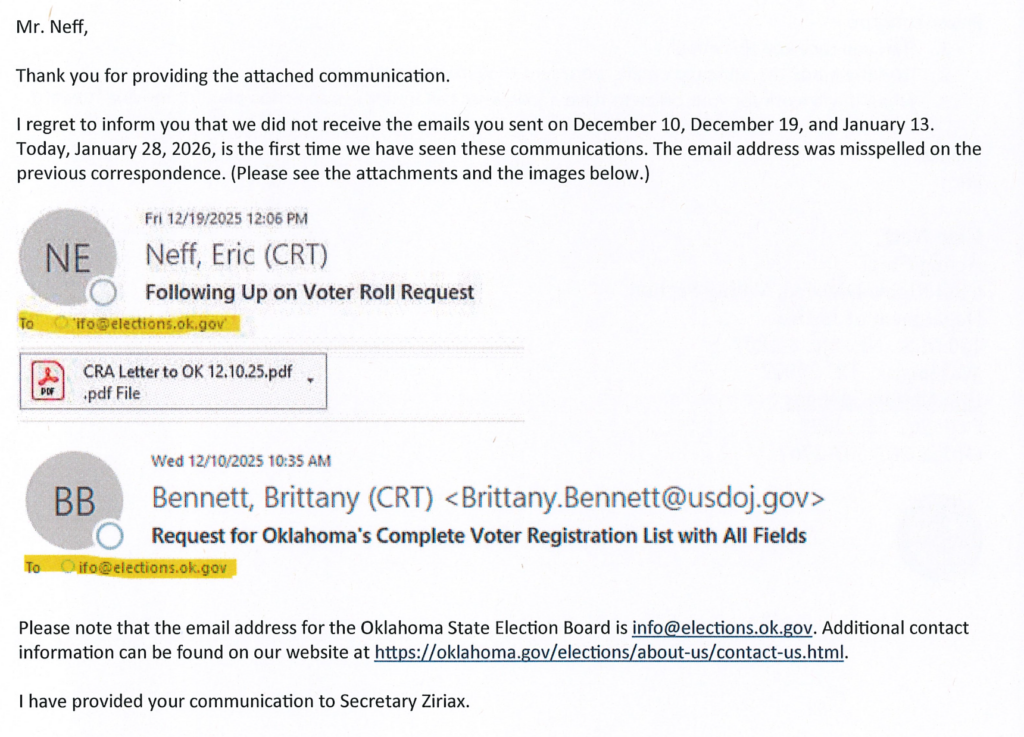
In other words, federal officials had spent weeks sending ghost emails that Oklahoma never received, and chasing a response.
Once the error was sorted out, Oklahoma officials said they would review the DOJ’s request with legal counsel — but warned that state law limits what information can be shared.
The Oklahoma mix-up comes as the DOJ intensifies its campaign to obtain voter rolls from states across the country.
Last month, the department sued five additional states — including Oklahoma — bringing the total number of jurisdictions targeted to 30.
Federal judges have already dismissed lawsuits against Michigan, Oregon and California — rejecting the department’s argument that it has sweeping authority to demand statewide voter rolls.
The department has appealed those decisions.
The Oklahoma email debacle offers another revealing glimpse into how that campaign is unfolding behind the scenes.
It’s the latest in a continuing string of embarrassing missteps in the Trump DOJ’s nationwide voter roll campaign.
DOJ lawyers have sent demand letters to the wrong officials, cited laws that do not exist and even filed court documents that still contained internal editing comments. In one case, DOJ attorneys left visible notes to themselves in a filing questioning whether key evidence existed and reminding colleagues to “fix” unresolved issues before submitting it to a federal court.
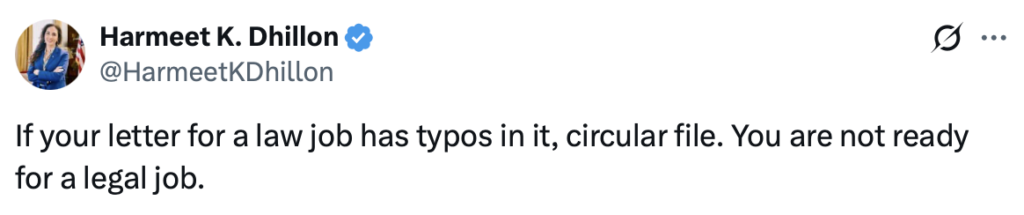
For a department arguing it must take custody of sensitive voter data to ensure election integrity, the pattern has raised uncomfortable questions about whether it can even manage its own work first.