Two more lawsuits challenge Trump order that ‘threatens to disenfranchise eligible voters’
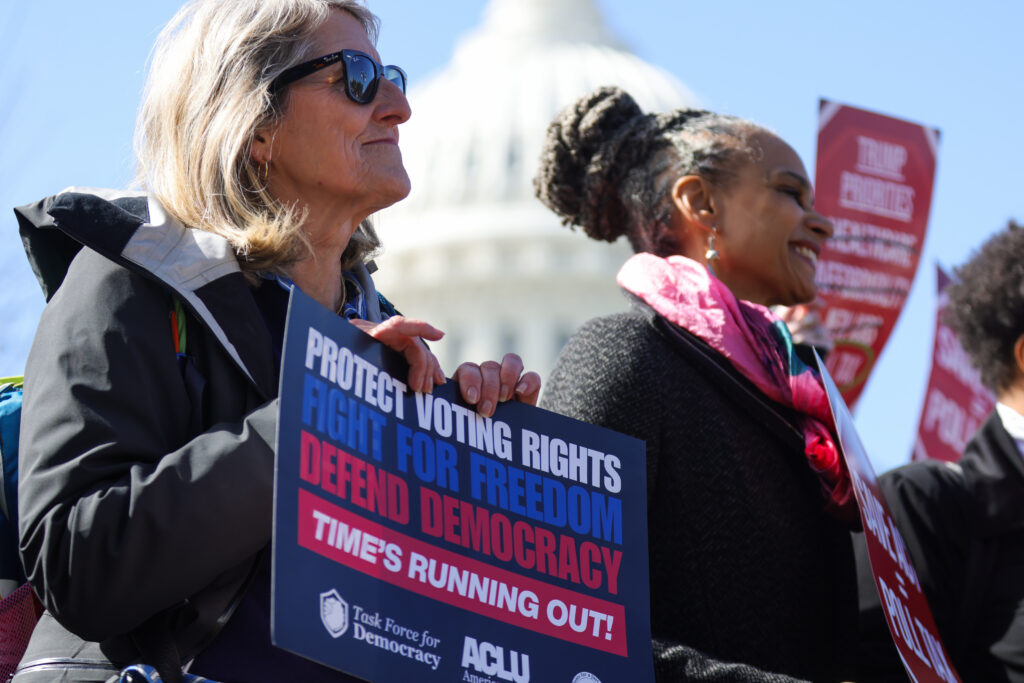
At least two separate lawsuits were filed by pro-voting organizations Thursday against President Donald Trump’s executive order targeting mail-in voting.
The lawsuits, which warn that Trump’s order would allow the administration to keep ballots from reaching eligible voters. escalate the legal fight over Trump’s attempt to reshape voting ahead of the 2026 midterm elections.
The lawsuits come a day after Democrats filed a separate legal challenge* to the same executive order.
Get updates straight to your inbox — for free
Join 350,000 readers who rely on our daily and weekly newsletters for the latest in voting, elections and democracy.
Both lawsuits contend that the order, issued by Trump Tuesday, is a sweeping expansion of presidential power into an area the Constitution explicitly reserves to states and Congress.
“This case challenges an extraordinary and abusive assertion of executive power over the administration of federal elections,” one complaint states. “The U.S. Constitution assigns authority over federal elections to the states and Congress — not the President.”
One of the new lawsuits, filed by the League of Women Voters and other voting advocacy groups, focuses on one of the order’s most controversial provisions: directing the U.S. Postal Service (USPS) to determine which voters can receive mail ballots.
“In effect, the Order seeks to interpose a federal screening regime between voters and the ballot box by empowering a federal mail carrier to withhold certain voters’ ballots,” the complaint reads. “In doing so, the Order displaces the roles that the Constitution and federal law assign to the states and Congress to regulate elections and to USPS as a neutral, nondiscriminatory carrier of the mail.”
The groups argue that the directive would fundamentally transform the role of the Postal Service — from delivering mail ballots to deciding who gets to vote.
Plaintiffs say the changes could have immediate consequences for voters who rely on mail ballots, including military service members, citizens living overseas and elderly voters.
“In directing USPS to refuse to deliver lawful mail ballots, the Order threatens to disenfranchise eligible voters,” the complaint alleges. “The Order denies the right to vote to scores of qualified citizens who will be excluded from those lists.”
The lawsuit also raises concerns about the order’s requirement that federal agencies compile citizenship data to share with states, warning the information could be incomplete or inaccurate and lead to eligible voters being excluded.
A second lawsuit, brought by the League of United Latin American Citizens (LULAC), the Secure Families Initiative and the Arizona Students’ Association, similarly challenges the order as unconstitutional and unlawful.
That complaint similarly takes aim at the order’s creation of a federal “mail-in and absentee participation list,” arguing it would force USPS to refuse delivery of ballots to voters not included — in violation of its legal obligation to serve all users neutrally.
It also raises privacy concerns over the order’s directive to compile a nationwide citizenship database by merging federal records, stressing that the data is likely to be incomplete or inaccurate and could wrongly exclude eligible voters — including newly naturalized citizens, students and military families.
Plaintiffs in both cases further argue the order pressures states to change their election systems or risk disruptions to ballot delivery.
“This executive order is an illegal and dangerous attempt to eliminate accessible voting options and subvert our democracy by seizing control of election administration from the states and Congress,” plaintiffs in the League of Women Voters case said in a statement separate from the complaint. “Far from improving elections, this executive order would create chaos for election officials, erode public confidence in our elections, and block Americans from exercising their most fundamental right — voting.”
The groups in both lawsuits are asking the courts to block the order before it can take effect.
*Democratics plaintiffs in this case are represented by the Elias Law Group (ELG). ELG firm chair Marc Elias is the founder of Democracy Docket.