New DOJ blunder: Voter roll case in chaos after missed deadline, false claims allegation
 Prefer us on Google
to see more of our voting rights news coverage when you search.
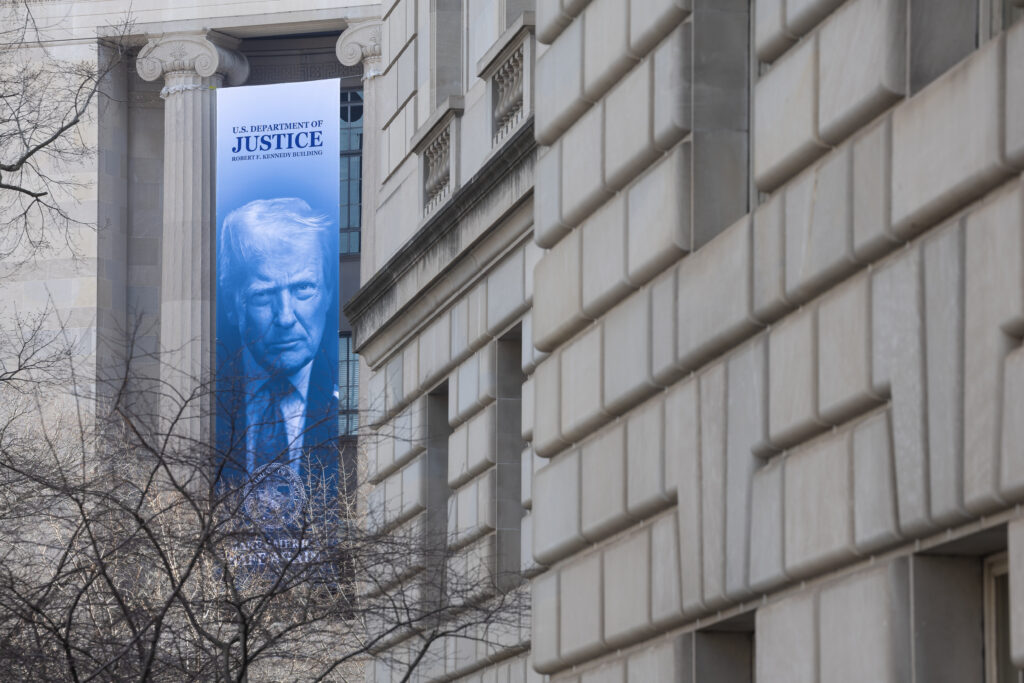
The Trump administration’s crusade for voter rolls hit another snag in Washington state this week after the Department of Justice (DOJ) fumbled basic legal procedures.
A federal judge is now demanding answers about why the department failed to properly serve their lawsuit, missed a critical deadline and appeared to mislead the court — turning what should have been a routine procedural step into a litigation disaster.
The amateurish blunders are just the latest example of incompetence undermining the department’s shambolic quest for voter’s unredacted personal data.
Get updates straight to your inbox — for free
Join 350,000 readers who rely on our daily and weekly newsletters for the latest in voting, elections and democracy.
The DOJ’s case against Washington began like dozens of others in its nationwide campaign, demanding in December that Secretary of State Steve Hobbs turn over the state’s unredacted voter rolls.
But more than three months later, the government still hadn’t properly notified Hobbs that he was being sued — a basic legal requirement known as “service of process.”
“We would expect the U.S. Department of Justice to know how to properly file a lawsuit in federal court,” Hobbs’ office told Democracy Docket in December. “We would also expect them to follow official procedures of serving the complaint prior to reaching out to media outlets, considering the important nature of voter data.”
A federal judge had to step in, ordering the DOJ last week to either prove it had served Hobbs or explain why the case should not be dismissed.
“The Complaint in this matter was filed on December 2, 2025. To date, no proof of service of process upon Defendant has been filed,” Judge S. Kate Vaughan wrote on March 10. “Plaintiff shall file proof of timely service upon Defendant or show cause as to why this matter should not be dismissed.”
The department didn’t comply.
Instead, days later, it filed paperwork claiming it had served Hobbs by leaving the lawsuit with a woman identified only as “Mia Doe” at what it described as his “residence.”
There was just one problem: the address wasn’t Hobbs’ home.
“800 Fifth Avenue is the address of the Washington Attorney General’s Seattle Office; it is not the residence or usual place of abode of Secretary Hobbs,” the state’s lawyers told the court.
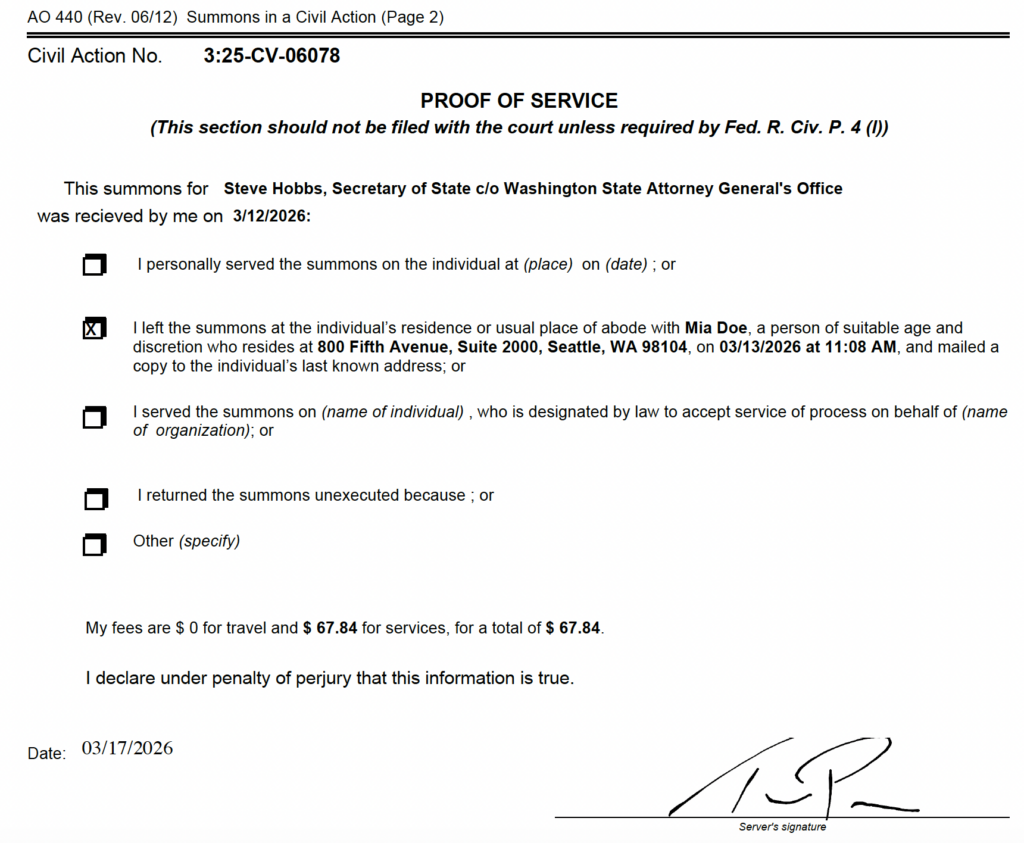
Under federal rules, leaving legal papers at the wrong location — especially somewhere that is not a person’s home or with an authorized agent — generally does not count as valid service at all.
But the confusion didn’t stop there.
A day before that botched service attempt, Hobbs’ legal team had already agreed to waive service entirely — a routine step that allows a case to move forward without formal delivery.
“I represent Secretary Hobbs in the above referenced matter. Attached is Secretary Hobbs’s waiver of service,” Deputy Solicitor General Tera Heintz wrote in an email.
That should have resolved the issue, but, instead, it revealed a deeper problem: The DOJ’s own lawyers did not appear to be coordinating with — or even aware of — each other.
Days later, a different DOJ attorney — who had not previously appeared in the case — emailed the state attempting to serve Hobbs again, ignoring the waiver and even insisting it did not count.
“Please note that we require an Acknowledgement of Service and cannot accept a Waiver,” Assistant U.S. Attorney Kristin Johnson wrote.
That statement directly contradicted federal rules, which explicitly allow defendants to waive service to avoid unnecessary costs and delays.
By that point, the Trump DOJ was taking three conflicting positions at once: telling the court it had already served Hobbs, telling the state it still needed to serve him and disregarding the fact that service had already been waived.
The court was not amused.
“It is now clear that Plaintiff did not timely serve Defendant,” Vaughan wrote in a sharply worded order. “It remains unclear whether service of process on Defendant has actually been effected and how.”
The judge ordered the department to explain “why it made an inaccurate representation to this Court” — referring to its claim that the Attorney General’s office was Hobbs’ residence.
She added a pointed aside in a footnote, noting that the unidentified “Mia Doe” who accepted the papers likely does not live there either.
The DOJ now faces a March 23 deadline to explain its conduct, including why it ignored the court’s earlier order and failed to request additional time.
And the consequences could be significant.
If the court is not satisfied with the department’s explanation, it could dismiss the case entirely and impose sanctions.
The Washington debacle is the latest episode undercutting the credibility of the department’s sweeping campaign — led by Assistant Attorney General Harmeet Dhillon — to obtain sensitive voter data under the guise of “election integrity.”
In Oklahoma, the department spent months emailing election officials at the wrong address, repeatedly following up on a request the state had never received. In other cases, DOJ lawyers have cited laws that do not exist, sent demands to the wrong officials and even filed court documents containing internal editing notes.