In hopeful sign for mail-in voting, court fast tracks bid to block Trump order
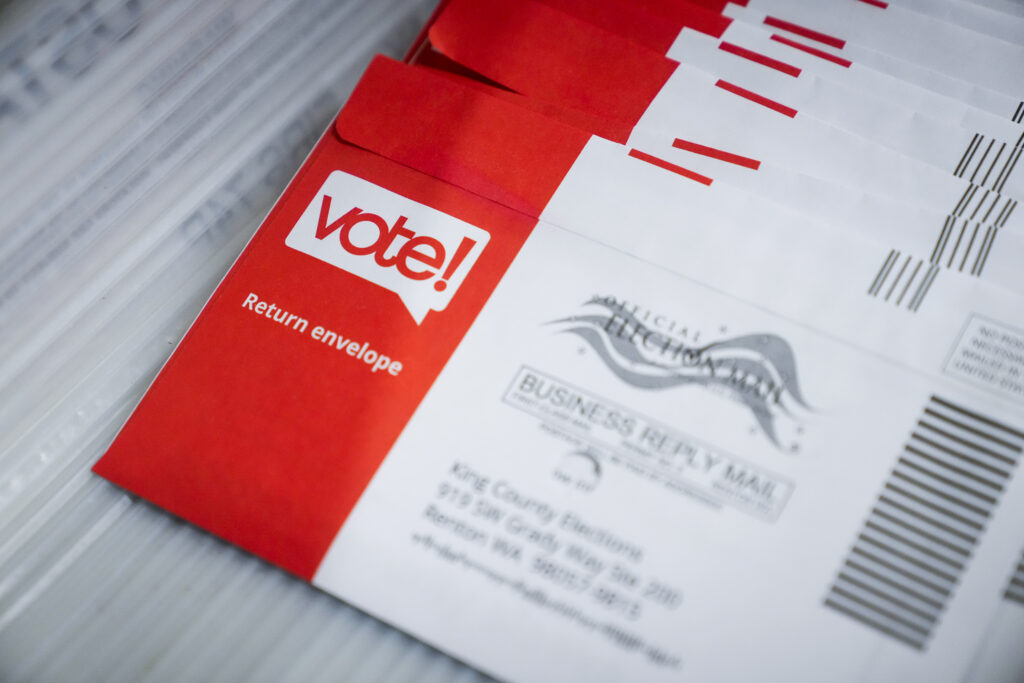
A federal appeals court Thursday expedited a bid to block President Donald Trump’s sweeping attack on mail-in voting, a hopeful procedural sign for voters as the administration pushes ahead with plans that could upend how mail ballots are cast for the 2026 midterms.
The D.C. Circuit Court of Appeals granted a request by Democratic plaintiffs* to speed up their appeal of a lower court ruling that left Trump’s anti-voting order in place last month.
Get updates straight to your inbox — for free
Join 350,000 readers who rely on our daily and weekly newsletters for the latest in voting, elections and democracy.
Under the new schedule, the Democratic plaintiffs’ opening brief is due June 17. The Trump administration and Republican states defending the order must respond by June 29, and the Democratic plaintiffs’ reply is due July 6.
The court also said oral arguments will be heard by the same three-judge panel: Circuit Judges Patricia Millett and Robert Wilkins, who were appointed by former President Barack Obama, and Gregory Katsas, who was appointed by Trump.
Katsas would have denied the motion to expedite.
Thursday’s motion does not immediately stop Trump’s order. But it moves the case on an urgent track at a moment when the administration is actively working to implement key pieces of the order — and, in recent days, appears to have shifted some of its plans in ways that could affect the legal challenge.
Trump’s order, signed in March, directs the Department of Homeland Security to work with the Social Security Administration to create lists of verified U.S. citizens eligible to vote in each state. It also directs the U.S. Postal Service to restrict delivery of mail-in and absentee ballots based on approved lists submitted by states.
Voting rights advocates, Democrats and state officials challenging the order have warned that it could disrupt election administration, wrongly block eligible voters from receiving ballots and give the president power over elections that the Constitution gives to states and Congress.
The appeal comes after U.S. District Judge Carl Nichols, a Trump-appointee, declined last month to issue a preliminary injunction — an emergency ruling that would have paused Trump’s order while the lawsuit continues. Nichols held that the challenge was premature because, at the time, federal agencies had not yet taken enough concrete steps to implement the order.
But those next steps began arriving almost immediately.
After Nichols’ ruling, the Postal Service issued a proposed rule to implement part of Trump’s order. The proposal would require states to provide information about voters receiving mail-in or absentee ballots, attach unique barcodes to ballot envelopes and submit information through a federal ballot-mail portal. The Postal Service proposal says it would not apply to primary elections or ballots covered by the federal law protecting military and overseas voters.
The agency’s rulemaking was central to Nichols’ decision not to block the order.
Nichols held that, because the Postal Service had not yet finalized a rule, the plaintiffs had not yet shown the kind of direct, imminent harm needed for emergency relief. But he also left the door open for renewed challenges if the administration moved forward.
The administration is also moving — and recalibrating — on Trump’s demand for new citizenship-related voter data.
In a court filing last week, the Department of Justice disclosed that DHS had approved a plan to create a federal voter citizenship verification system for state voter rolls, including a system expected to be operational by June 30. The filing also said DHS was exploring the use of Postal Service data to monitor mail-in ballot activity.
Days later, the administration filed a new notice that appeared to walk back part of that plan. The updated filing said DHS would work on data-sharing agreements with the Postal Service rather than directly integrate “USPS datasets” into its system. It also said those data-sharing agreements “are not directed by [the executive order]” and would depend on whether the Postal Service finalizes a rule, what that rule says and future policy and legal decisions.
For voting rights advocates, the moving pieces only heighten the stakes.
The administration is no longer merely defending a speculative order in court. It is trying to build systems that could affect which voters receive mail ballots, how those ballots are tracked and how state election officials administer voting ahead of the midterms.
“Mail voting helps millions of Americans participate in our democracy, including seniors, voters with disabilities, military families, students, caregivers, and working people,” Marcia Johnson, chief of activation and justice for the League of Women Voters, said last week. “No president has the authority to unilaterally rewrite election rules or dictate how states administer their elections.”
The D.C. Circuit is not the only court that could act soon.
In Massachusetts, U.S. District Judge Indira Talwani, an Obama-appointee, is considering separate requests from voting rights groups and Democratic-led states to block the order. During oral argument last week, Talwani appeared concerned about whether the federal government could create an accurate voter list in time for the midterms and whether eligible voters could be left off.
“What’s the harm if I say no one can use this list for the November election?” Talwani reportedly asked.
A ruling from Talwani could come before the D.C. Circuit briefing schedule plays out. That means Trump’s mail-in voting order is now facing pressure on multiple fronts: an expedited appeal in Washington, D.C., a pending ruling in Massachusetts and growing scrutiny of the administration’s attempts to implement the order through federal agencies.
For now, Trump’s executive order remains in effect. But Thursday’s appeals court order gives pro-voting challengers a faster path to block it.
*The Democratic plaintiffs in this case are represented by Elias Law Group (ELG). ELG firm chair, Marc Elias, is the founder of Democracy Docket.