This week at Democracy Docket: All the news on the fight over Trump’s mail voting order. Plus — we revealed another election denial activist at DHS
Democracy Docket was created to track the legal battles over voting rights more closely than any other news outlet — offering up-to-the-minute information on where things stand for Americans’ access to the ballot.
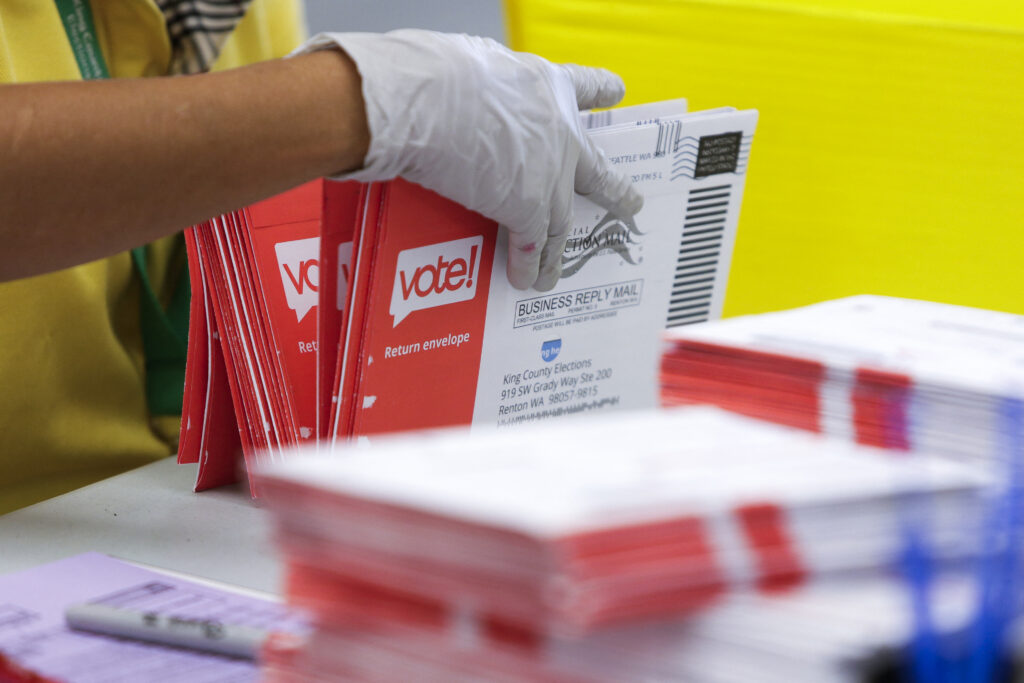
That’s why this week we published 16 separate news stories by seven different reporters on the court fight that’s shaping up as the single most important legal conflict in determining voting access for the midterms: the challenges to President Donald Trump’s March executive order restricting mail voting.
Get updates straight to your inbox — for free
Join 350,000 readers who rely on our daily and weekly newsletters for the latest in voting, elections and democracy.
It’s easy to get lost in the weeds of the legal procedure: the preliminary injunctions, the temporary restraining orders, the supplemental complaints. Honestly, sometimes we do, too! But here’s what you need to know about what happened this week:
On Monday, Jacob Knutson and Jim Saksa reported that the Supreme Court’s conservative majority — over an impassioned dissent from Justice Ketanji Brown Jackson that warned about the “chaos” the move would unleash — lifted U.S. District Judge Indira Talwani’s block on the order, ruling that the block had been premature because no harm had yet occurred when it was requested.
Two days later, a U.S. Postal Service (USPS) rule aimed at implementing part of the order, requiring states to submit their mail ballot designs for approval, officially went into effect. That meant arguments over timing were no longer relevant, and the order’s opponents could bring challenges on the merits.
They quickly did so, arguing both that the USPS rule was illegal under federal law, and that Trump’s directive itself was an unconstitutional usurpation of the states’ and Congress’ power to run elections. Lawyers for the Trump administration, called on to defend the substance of the order for the first time, countered that in fact the rule was “modest.”
Meanwhile, state election officials were telling Democracy Docket’s Alexandra Hutzler — who just joined us from ABC News — that they can’t effectively implement the order in the short window before the midterms.
On Thursday, North Carolina’s election board told Jen Rice that the state — which starts mailing ballots September 4, before any other state — had submitted its envelopes to the postal service for approval. That made it the first known state to comply with the USPS rule.
Hours later, Talwani issued another temporary hold on the order, finding that the Democratic states and voting rights groups challenging it are likely to succeed on the merits, and face irreparable harm if it stays in effect.
Finally, on Friday, U.S. Department of Justice lawyers asked a federal appeals court to lift the hold, which would put the order back into effect.
But our reporters also took time to explain the big picture. And here’s one major takeaway:
The Supreme Court is likely to have the final say about whether Trump’s order is in effect this fall. But with the clock ticking down, the confusion among voters and election administrators caused by the uncertainty over the order’s fate is likely to have a suppressive effect of its own. And for Trump and his team, that’s clearly part of the point.
But despite covering the executive order fight more closely than any other news outlet, our reporting team found time for more crucial reporting on other fronts of Trump’s war on voting.
Natalie Hausmann noted the troubling trend of GOP candidates calling for law enforcement or immigration officers to show up at the polls this fall. This week, Rick Jackson, the Republican nominee for governor of Georgia, said the state would “get the National Guard” to monitor voting. That follows similar comments from statewide candidates in Michigan and Maine.
As Natalie wrote: “It’s a troubling escalation in lockstep with President Donald Trump’s calls to ‘take over’ elections.”
Finally, Matt Cohen and Yunior Rivas broke some big news when they reported Friday that the Department of Homeland Security (DHS) has hired a leading election denial activist, Karen DiSalvo, to a senior position. DiSalvo is a close associate of Heather Honey, the Pennsylvania anti-voting crusader who last year, we revealed, was hired by the same DHS office. Matt and Yunior used some cyber-sleuthing to figure out that it was DiSalvo who drafted the DHS letter, published online this week, that threatened states with losing security funding if they don’t adopt the administration’s preferred elections policies.
We uncovered that story because we’re keeping a closer eye than anyone else out there on the policies and people behind Trump’s attack on access to the ballot. And with the midterms almost here, we’re not letting up.