Jackson slams Supreme Court majority for injecting ‘chaos’ into midterms as voting advocates blast mail ballot ruling
 Prefer us on Google
to see more of our voting rights news coverage when you search.
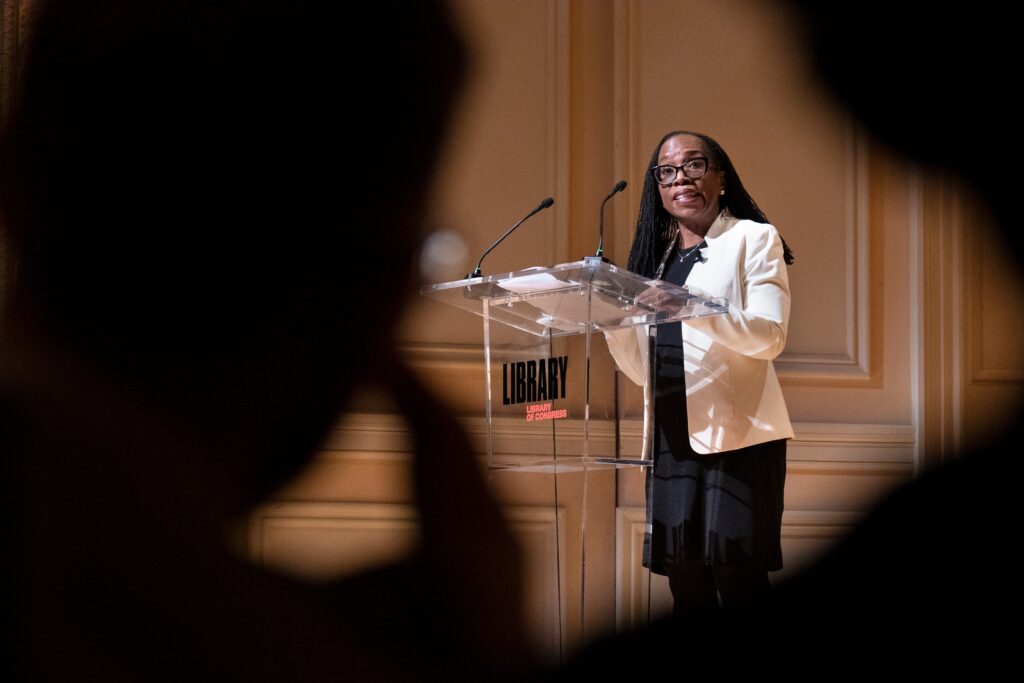
Justice Ketanji Brown Jackson accused the Supreme Court’s conservative majority of injecting “chaos and uncertainty” into the 2026 midterm elections Monday after the Court lifted one injunction blocking President Donald Trump’s anti-mail voting executive order, even as a separate nationwide block remains in place.
In a blistering dissent, Jackson warned that the Court’s emergency ruling lets the Trump administration continue pursuing changes to state-run mail voting systems even though “no judge or Justice” has concluded that Trump’s order is constitutional.
“This ruling violates well-established precedents concerning this Court’s equitable discretion and needlessly injects chaos and uncertainty into the upcoming midterm elections,” Jackson wrote. “It also lets another shoe drop in the Kafkaesque nightmare that our precedents have been steadily creating for certain plaintiffs who seek to bring election-related challenges.”
Get updates straight to your inbox — for free
Join 350,000 readers who rely on our daily and weekly newsletters for the latest in voting, elections and democracy.
The Supreme Court’s order paused a lower court injunction that had blocked key provisions of Trump’s March executive order in 23 Democratic-led states and Washington, D.C. But the ruling did not decide whether Trump’s order is lawful, and another nationwide injunction against the U.S. Postal Service’s mail ballot rule is still in effect.
Jackson, one of three liberal justices who dissented, said the decision creates a new bind for states and voting rights groups seeking to challenge last-minute election changes. They can be told they sued too early before a final rule is issued, only to later risk being told they sued too late as Election Day approaches.
“The Court has held for a while now that even valid election-related legal claims can come too late,” Jackson wrote. “Today’s revelation is that such claims can also come too early — never mind that an election is looming and related harms are presently occurring.”
She added that the federal government, “which controls the timing of proposed and final rules,” can “easily game the system.”
The ruling marked a major, but potentially temporary, victory for Trump’s broader effort to exert federal control over mail voting ahead of the midterms. The majority concluded that the Democratic-led states sued too soon because, at the time they filed the case, the executive order had not yet resulted in a final agency rule imposing concrete obligations on them.
The Court stressed that its decision did not settle the legality of Trump’s order.
“The Court’s disposition of this application does not mean that any measure taken by the Government to implement the Order will necessarily be lawful,” the majority wrote. “On that score, time will tell.”
But Jackson said the decision could force states to litigate Trump’s mail voting restrictions even closer to the election, compounding the exact kind of confusion the Court has previously warned against in election cases.
“States administering elections and the voting public that relies on them to do so deserve clarity, not caginess or confusion,” Jackson wrote. “The Court does a disservice to all concerned by distorting Article III standing and ripeness principles to issue a ruling that contributes to pre-election chaos instead of quashing it.”
Jackson was especially critical of the administration’s posture before the Court, accusing the government of arguing that its planned mail voting changes were too speculative for states to challenge while also claiming it needed immediate emergency relief to implement those same changes before November.
“Taking its eye off the ball, the majority misses the Government’s actual objective: to secure our imprimatur for its effort to foment chaos ahead of the November elections,” Jackson wrote. She added that the administration’s argument appeared “tailor-made to weaponize this case as a means of destabilizing the nation’s vote-by-mail systems through court-assisted procedural maneuvers.”
Democrats, voting rights advocates denounce majority ruling
Democrats and voting rights advocates quickly seized on the dissent, casting the ruling as a dangerous but temporary setback in the fight over Trump’s executive order.
“Let this ruling be a reminder that democracy is never, ever, guaranteed,” NAACP President Derrick Johnson said in a statement. “We have to fight for it, we have to fight to keep it, and we have to protect the rights we do have within it.”
“Trump’s order has nothing to do with election integrity,” Johnson added. “It has everything to do with maintaining power at all costs.”
Campaign Legal Center President Trevor Potter said the decision was “purely about the timing of court challenges — not the merits of the president’s case.”
“Americans everywhere should know that the president still has no constitutional or legal power to change our election rules, nor does this ruling mean that his second executive order on voting will ultimately be held lawful by the courts,” Potter said.
Potter added that the ruling “does not remove anyone from the voter rolls” and that Americans can still vote by mail under their state laws. He said Campaign Legal Center would “immediately challenge any and all actions” by the federal government to carry out the order, including the USPS rule expected to be published this week.
Democratic state officials also vowed to keep fighting.
Colorado Secretary of State Jena Griswold said she was “disappointed that the Supreme Court’s conservative majority did not stop the Trump administration’s attempt to exert federal control over state-run elections.”
“Make no mistake: when the federal government attempts to implement this unlawful Executive Order, Colorado and other states across the country will fight back,” Griswold said. “This is not the end of this fight. Americans will have their voices heard in the 2026 midterm election.”
Nevada Secretary of State Cisco Aguilar, chair of the Democratic Association of Secretaries of State, said Democratic election officials would “continue challenging this executive order and using every tool available to defend voting rights and the Constitutional authority of states to administer elections.”
“The Supreme Court should protect those fundamental principles,” Aguilar said. “Instead, it has allowed a president to reshape the electorate for his own political benefit.”
Senate Minority Leader Chuck Schumer called the ruling “a disgrace,” writing on social media that the Court had allowed Trump “to put a dagger into the heart of our democracy.”
“Trump’s malicious effort to stop mail-in voting is nothing but election interference in broad daylight,” Schumer wrote. “He wants to make it harder for Americans to vote so they don’t hold him accountable.”
New York Attorney General Letitia James, who helped lead the Democratic-led coalition challenging the order, called the decision “a painful setback,” but said “it will not be the final word.”
“This fight is far from over,” James said. “We are exploring our legal options.”
Jackson ended her dissent with a similar warning about what the ruling could unleash in the weeks before November.
“Denying this stay request preserves the status quo in the fraught period ahead of a national election,” Jackson wrote. “Granting it, on the other hand, risks significant harm, including continued affronts to the Plaintiff States’ sovereign interests, a strain on their pocketbooks, and the possibility that last-minute rule changes will cause confusion on the ground, jeopardizing the public’s interest in a fair and orderly election cycle.”