Supreme Court lifts injunction blocking Trump’s attack on mail voting before midterms
 Prefer us on Google
to see more of our voting rights news coverage when you search.
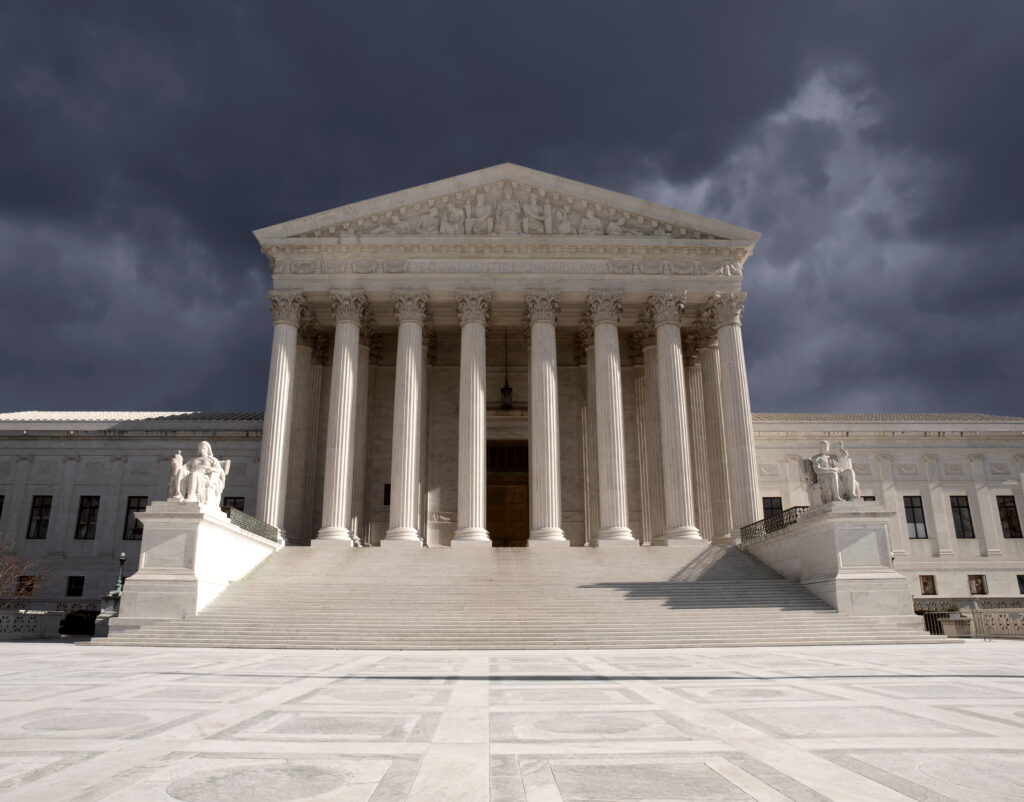
In a victory for the White House, the U.S. Supreme Court has allowed President Donald Trump’s sweeping attack on mail voting to go forward, bolstering his long-running effort to restrict voting access ahead of the 2026 midterm elections.
The Court Monday granted emergency appeals filed by the Department of Justice (DOJ) and a dozen Republican-led states against a lower court’s order blocking the implementation of the president’s March executive order, which sought to increase federal control over mail voting.*
The decision brings the Trump administration one step closer to implementing the order ahead of November’s midterm elections. However, the Court only stayed one of the two court orders restricting the government from effectuating Trump’s decree, a permanent injunction applying to 23 Democratic-led states and Washington, D.C. A separate, nationwide injunction remains in place.
The Court’s three liberal justices dissented, with Justice Ketanji Brown Jackson writing that the Court’s decision could wreak havoc on the upcoming elections, which are less than three months away.
“This ruling violates well-established precedents concerning this Court’s equitable discretion and needlessly injects chaos and uncertainty into the upcoming midterm elections,” she wrote.
Get updates straight to your inbox — for free
Join 350,000 readers who rely on our daily and weekly newsletters for the latest in voting, elections and democracy.
Trump’s executive order directed the U.S. Postal Service (USPS) to only deliver ballots to voters on pre-approved lists maintained by the federal government. Democratic states sued to block the order, arguing that it did them harm by forcing them to prepare for its implementation.
The Court’s conservative majority disagreed, concluding that the states had not suffered any discrete harms yet because the policy was still unimplemented. They agreed with the DOJ that the lower court issued the injunction prematurely.
But the legal battle is not over. On Friday, USPS posted a finalized rule set to be published Wednesday to implement the order. If that rule harms the states, they could again seek to block it in court, as the opinion noted.
“The Court’s disposition of this application does not mean that any measure taken by the Government to implement the Order will necessarily be lawful,” the majority wrote. “On that score, time will tell.”
In its emergency docket decision Monday, the Court highlighted the speculative nature of the states’ harms before the final rule had been promulgated.
“The true ‘source of any injury’ to the States would be the downstream action that the Secretary ‘might take in the future’ to implement [the order]. Emphasis on might,” the per curiam majority wrote. “‘Any prediction how the Executive Branch might eventually implement’ [the order] while balancing feasibility and lawfulness ‘is no more than conjecture’ at this time.”
The final rule posted Friday, however, makes clear that states will incur significant costs carrying out the executive order, which the DOJ has not attempted to defend on the merits against arguments that it is patently unconstitutional.
The order directs states to design new envelopes for mail ballots with mandatory barcodes tying the ballot to the voter, submit those envelopes to USPS for approval, and then use them ahead of November’s elections. The printing costs alone will likely run in the millions. Many states start sending mail ballots 45 days ahead of Election Day, in mid-September, which is a few weeks away.
Moreover, a separate court’s preliminary injunction issued in a related lawsuit remains in effect. The administration had asked in a supplemental brief for the Court to also lift that broader roadblock, which applies nationwide — not just in the Democratic states — but the majority declined. The DOJ has not yet appealed that district court decision to the 1st Circuit Court of Appeals.
Democratic officials from 23 states and Washington, D.C. had urged the Court not to lift the block, characterizing Trump’s restrictions on mail voting as “extraordinary threats to our democracy.”
In her blistering dissent, Jackson agreed.
She said the DOJ’s argument that it was harmed by the lower court’s injunction “appears tailor-made to weaponize this case as a means of destabilizing the nation’s vote-by-mail systems through court-assisted procedural maneuvers. And the Government seems well on its way to accomplishing that tactical objective.”
Voting rights organizations quickly decried the Court’s decision.
“Let this ruling be a reminder that democracy is never, ever, guaranteed,” NAACP President Derrick Johnson said in a statement. “Those in power know full well that they are unpopular and will lose in a free and fair election, and so they are trying to do everything they possibly can to make it difficult for you to vote. Trump’s order has nothing to do with election integrity. It has everything to do with maintaining power at all costs.”
Trump has long blamed mail voting for his 2020 electoral loss, calling for a significant curtailing of the practice ever since, despite voting by mail himself.
Monday’s decision is just the latest in a series of “shadow docket” rulings in which the Court’s Republican-appointed majority has sided with the Trump administration on emergency appeal.
This is a breaking news story that has been updated.
*Democratic organizations that filed an amicus brief in this litigation are represented by the Elias Law Group (ELG). ELG Chair Marc Elias is the founder of Democracy Docket.