Democrats renew bid to block Trump’s ‘unlawful’ anti-mail voting order
 Prefer us on Google
to see more of our voting rights news coverage when you search.
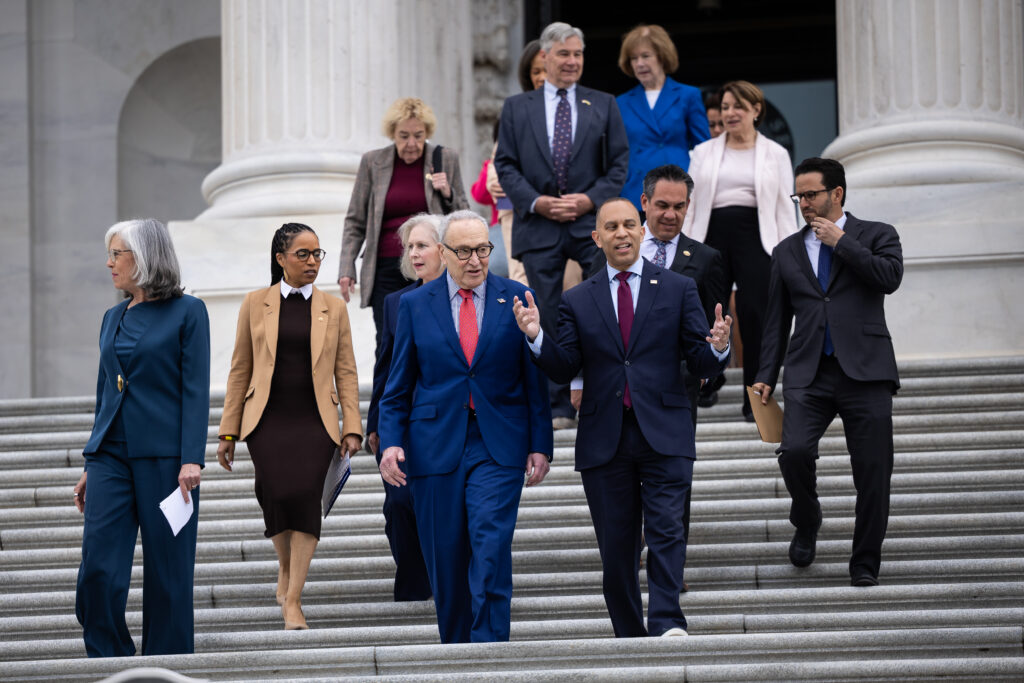
Democrats renewed their bid Tuesday to block President Donald Trump’s anti-mail voting executive order, arguing that a newly finalized U.S. Postal Service (USPS) rule has eliminated the concerns that led a judge to reject their first injunction request as premature.
The filing — which argues that the USPS lacks the authority to regulate who receives a mail ballot — is the first litigation to challenge the order on its merits. It marks the start of the next phase in the heated legal battle over Trump’s anti-voting directive.
The Democratic Senatorial Campaign Committee (DSCC), Democratic Congressional Campaign Committee (DCCC), Democratic National Committee, Democratic Governors Association, Senate Minority Leader Chuck Schumer and House Minority Leader Hakeem Jeffries* filed the proposed supplemental complaint in their Washington, D.C., lawsuit challenging Trump’s March executive order.
The plaintiffs also filed a renewed motion for preliminary injunction. They asked the court to hear the motion on or around Sept. 4.
Democrats argued that they are are “severely harmed by the President’s unlawful attempts to upturn the electoral playing field in his own favor and against his political rivals.”
Get updates straight to your inbox — for free
Join 350,000 readers who rely on our daily and weekly newsletters for the latest in voting, elections and democracy.
The move comes one day after the U.S. Supreme Court lifted an injunction that had blocked key parts of Trump’s order in 23 Democratic-led states and Washington, D.C., ruling that the state-led challenge was premature because the order itself had not yet concretely harmed the states.
But the Democratic Party plaintiffs say their case is different because USPS has now issued a final rule directly affecting mail voting nationwide.
In May, U.S. District Judge Carl Nichols, a Trump appointee, denied the Democrats’ first request to block the order, ruling that their challenge was not yet “ripe” because USPS had not issued a final rule.
At the time, Nichols said the ripeness of their claims depended on “whether the Postal Service issues a notice of proposed rulemaking, what that proposed rule says, what changes occur through notice and comment, whether a final rule issues, and how that final rule affects voters, States, or Plaintiffs.”
The Democratic plaintiffs now argue that those questions have been answered by USPS’ final rule.
The rule requires ballot mail envelopes for federal elections to comply with new design requirements, requires state election officials to submit voter-identifying information and barcodes to USPS through an online portal and allows USPS to refuse to transmit ballot mail that does not comply with the new requirements, according to the filing.
“This rule is disastrous for Plaintiffs DSCC, DCCC, Democratic National Committee, and Democratic Governors Association, their candidate members, House Minority Leader Jeffries, and Senate Minority Leader Schumer, forcing all of them to compete for electoral victories on an illegally structured playing field and revamp campaigns and electoral efforts just days before voting begins,” the plaintiffs wrote.
The rule requires ballot mail envelopes for federal elections to comply with new design requirements, requires state election officials to submit voter-identifying information and barcodes to USPS through an online portal and allows USPS to refuse to transmit ballot mail that does not comply with the new requirements, according to the filing.
They also argue the rule could especially harm Democratic candidates because Democratic voters disproportionately rely on mail voting. The filing cites 2024 data showing that 44% of Democratic candidates’ voters cast ballots by mail or absentee, compared with 26% of Republican candidates’ voters.
The plaintiffs warn that voters could be disenfranchised if their names are not included on USPS’ mail ballot list or if their ballots are delayed or rejected because of new envelope requirements. They argue voters have no way to enroll themselves on USPS’ list or check whether they are on it before it is too late.
The renewed motion marks the latest front in the rapidly escalating legal fight over Trump’s attempt to reshape mail voting before the 2026 midterms.
Trump’s March executive order directed USPS to propose new rules for mail ballots and instructed the Department of Homeland Security to create state citizenship lists, part of what Democrats originally called an effort to “upturn the electoral playing field in his own favor and against his political rivals.”
In their original lawsuit, Democrats argued that Trump’s order would restrict mail voting access and insert federal agencies into election administration — a role the Constitution reserves for states and Congress.
They are now making the same core argument against the final USPS rule, contending that the Postal Service has no statutory authority to become a federal gatekeeper for mail ballots.
“The merits of Plaintiffs’ claims, which have received little attention to date, including from Defendants themselves, are clearcut: the Ballot Mail Rule is flagrantly unlawful,” the plaintiffs wrote.
The plaintiffs argue USPS is authorized to deliver mail, not regulate who receives mail ballots, maintain lists of mail voters or reject otherwise valid ballot mail. They also contend the rule violates the Constitution’s separation of powers because election administration authority belongs to states and Congress — not the president or USPS.
The plaintiffs are asking Nichols to issue a preliminary injunction before the rule can affect the midterms, arguing that once an election happens, “there can be no do over and no redress.”
A separate nationwide injunction against USPS’ mail ballot rule remains in place in Massachusetts, though the Trump administration has already asked that court to lift or stay it following Monday’s Supreme Court ruling.
But in the D.C. case, Democrats argue the existence of another injunction does not prevent Nichols from acting, especially because that order “may be overturned or limited at any time.” They also note that the government has made clear “it is no secret” it wants to implement the USPS rule for the Nov. 3 election “if possible.”
*The Elias Law Group (ELG) represents the plaintiffs in this case. ELG Firm Chair Marc Elias is the founder of Democracy Docket.