Taking cues from Trump, GOP candidates push for law enforcement at polls
 Prefer us on Google
to see more of our voting rights news coverage when you search.
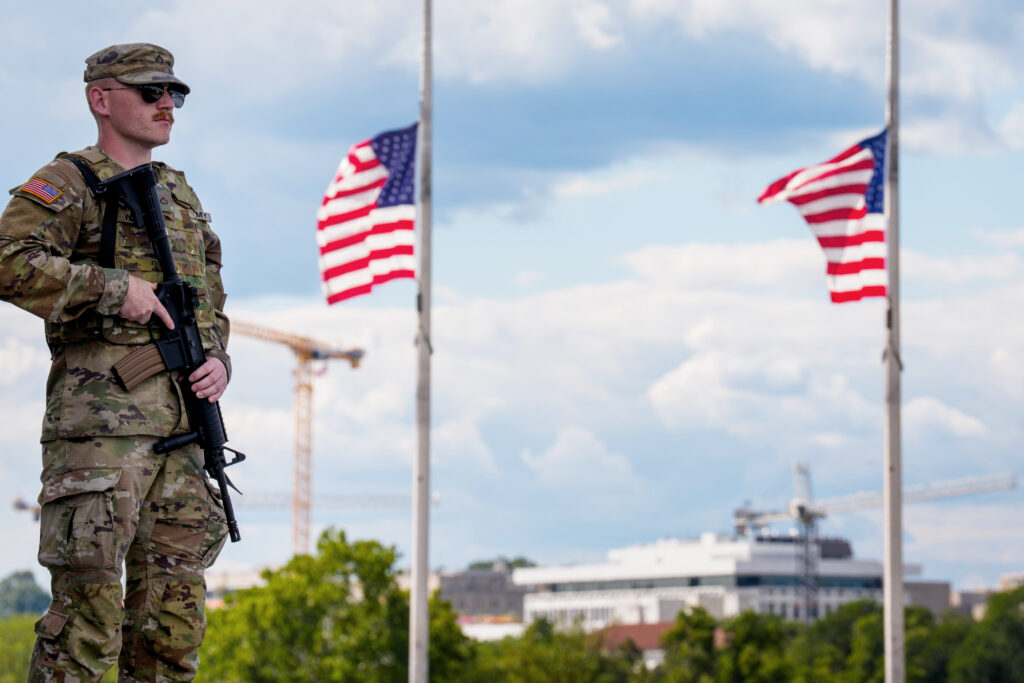
GOP candidates in crucial swing states want to send law enforcement to the polls in November.
It’s a troubling escalation in lockstep with President Donald Trump’s calls to “take over” elections and stop voting fraud he’s repeatedly failed to prove exists.
Leaked audio reveals candidates in Georgia, Maine and Michigan have made cryptic, at times outright threatening, suggestions to deploy everything from retired cops to ICE agents to polling places in the name of secure elections.
Republican Rick Jackson, the Trump-endorsed billionaire who’s the GOP nominee for governor of Georgia, told a supporter earlier this month he was confident Gov. Brian Kemp (R) would deploy the National Guard at polling places, according to audio obtained by the Atlanta Journal-Constitution this week.
“Well, we’ll get National Guard — Gov. Kemp is going to watch it for us,” Jackson said as he responded to a question about calling up Trump for federal troops at polls. “Yes, he’s going to get the National Guard.”
Get updates straight to your inbox — for free
Join 350,000 readers who rely on our daily and weekly newsletters for the latest in voting, elections and democracy.
In a press release Thursday, the Georgia voting rights group Fair Fight noted that federal law forbids federal troops and armed agents from polling sites, except in certain circumstances.
“A governor can deploy the National Guard for election support such as cybersecurity and logistics, but sending Guard members to polling sites would break sharply with precedent and risk intimidating Georgians who are turning out to vote,” Fair Fight CEO Lauren Groh-Wargo wrote in a statement.
Kemp’s office did not respond to specific questions from Democracy Docket, but provided the following statement, asserting there will be no changes from past election administration:
“We’ve proven for multiple cycles now that it’s easy to vote and hard to cheat in Georgia elections. The same will be true this cycle,” a spokesperson for Kemp’s office wrote. “We are approaching this upcoming election the exact same way we have in the past.”
Most recently, Maine gubernatorial nominee Bobby Charles said he wants ICE agents and U.S. Marshals to stand guard at polling sites in November. In audio first obtained by the Bangor Daily News, Charles said he plans to call Trump’s border czar Tom Homan, his “friend,” to make the request in the lead-up to election day.
“I’m gonna ask Tom, I’m going to actually — three or four weeks before the election, maybe three — I’m going to make an appeal for ICE and marshals to be at our voting booths,” Charles said at an event for the Maine Young Republicans.
Charles later justified his comments, saying he wanted to fend against intimidation and violence while in the same breath claiming the move would scare off non-citizens from voting.
And in Michigan, GOP candidate Mike Rogers said he wanted to get retired or off-duty cops to serve as poll watchers and “intimidate” voters.
“We’re trying to find them,” Rogers said in an audio recording published by The Detroit News in May. “I mean, they wouldn’t be able to wear their uniforms, but they would, you know, all you got to do is open your jacket and you see the badge on the belt, right?”
Rogers dug his heels in with a follow-up statement to the local paper, saying people, including retired law enforcement, should “step up to the plate and volunteer to ensure Michiganders have elections they can count on.”
The Trump administration has encouraged the idea.
In his confirmation hearing in March, Department of Homeland Security Secretary Markwayne Mullin refused to rule out ICE at the polls, saying he’d be willing to send agents for a “specific threat.”
U.S. Attorney General Todd Blanche repeated this sentiment at his confirmation hearing, but said he would “follow the law, no matter whatever it includes.”
And Trump himself has refused to rule out sending troops to polls, doubling down on claims that Republicans should “take over the voting” in February.
After years of claiming fraud in elections, the Republican Party now faces a problem of its own making. GOP candidates must reassure their voters that elections will be secure so that they’ll turn out despite a deeply unpopular president.
Maine’s Secretary of State Shenna Bellows (D) said scaring off people who already cannot and do not vote in U.S. elections is a threat that seeks to lower turnout. This kind of intimidation is illegal under federal law.