Explainer: The battle over Trump’s bid to restrict mail voting hits a pivotal point. Where things stand and what comes next
Update: Since this story was published, the U.S. Supreme Court has lifted the injunction blocking Trump’s executive order from being implemented in 23 Democratic-led states and the District of Columbia. A second, nationwide injunction remains in place. Please see our reporting for more on this development.
President Donald Trump wants to interfere with mail voting during the upcoming midterm elections, and he’s betting the U.S. Supreme Court will let him.
Over the weekend, his administration published a finalized U.S. Postal Service (USPS) rule to implement his executive order that lower courts have repeatedly called unconstitutional. The Department of Justice (DOJ) followed with legal arguments in support of that move, part of a coordinated effort to overcome court-ordered blocks to the order.
If enacted, the new USPS rule would require states to redesign ballot envelopes used by millions, allowing the Postal Service to track who voted by mail. And its rushed implementation — just over two months remain before Election Day — could inject havoc into an enormously consequential vote.
Ultimately, the Supreme Court will likely have the final say on whether the administration can change how Americans cast ballots so close to the election.
How we got here
Despite being a frequent mail voter himself, Trump blames vote-by-mail for his 2020 electoral loss.
In March, he went on the attack and issued an executive order directing the Department of Homeland Security and the Social Security Administration to compile citizenship lists for states. These states would be required to send their lists of eligible voters who requested mail or absentee ballots to USPS.
The order directs the USPS not to deliver ballots from voters who aren’t on the lists.
A slew of lawsuits challenging the order soon followed, each noting that the Constitution empowers states to prescribe the “Times, Places and Manner” of holding elections and Congress the ability to pass laws altering those regulations. The president has no role in the matter.
In two of those cases brought in Massachusetts, U.S. District Court Judge Indira Talwani blocked the government from working on the executive order. First, Talwani granted a permanent injunction against the order’s implementation in 23 Democratic-led states (and Washington, D.C.) that had sued.
Get updates straight to your inbox — for free
Join 350,000 readers who rely on our daily and weekly newsletters for the latest in voting, elections and democracy.
A few weeks later, Talwani also granted a preliminary injunction in a lawsuit brought by a group of pro-voting organizations led by the League of Women Voters of Massachusetts. Unlike the order in the Democratic States case, this injunction applies nationwide.
The 1st Circuit Court of Appeals upheld the decision in the Democratic states’ case, leading the DOJ to file an emergency appeal with the Supreme Court in late July.
In all of its appeals, the DOJ has not attempted to defend the executive order itself. Instead, it has focused on a procedural argument: that the lawsuits challenging the order were premature, because the order hadn’t been implemented enough yet for courts to consider whether or not it really violates the Constitution.
But the entire time the DOJ’s attorneys have contended that, the government’s other lawyers have been busy turning the executive order’s dictates into reality.
Over the summer, the DOJ told judges that the administration hadn’t implemented the order, despite officials testifying otherwise outside the courtroom. USPS published a rule proposal over the summer to further Trump’s order, and DHS followed that with its own implementation memos.
In a supplemental brief the DOJ filed after Talwani’s second injunction, the DOJ repeatedly emphasized that USPS had only promulgated a proposed rule. “[T]he claims remain unripe until the USPS issues a final rule,” the DOJ wrote, urging the Court for a stay.
What’s in the new rule?
But on Friday, USPS posted a final rule purporting to take immediate effect — pending a decision by the Supreme Court. That appears to violate Talwani’s two injunctions.
Ostensibly, the rule only updates regulations on the kind of envelopes needed for mail ballots, likening them to other kinds of dangerous or sensitive items ferried by mail carriers. “Although ballot mail does not present precisely the same operational issues as cremated remains or replica explosives, it is unquestionably sensitive mail that raises unique operational considerations,” the rule states.
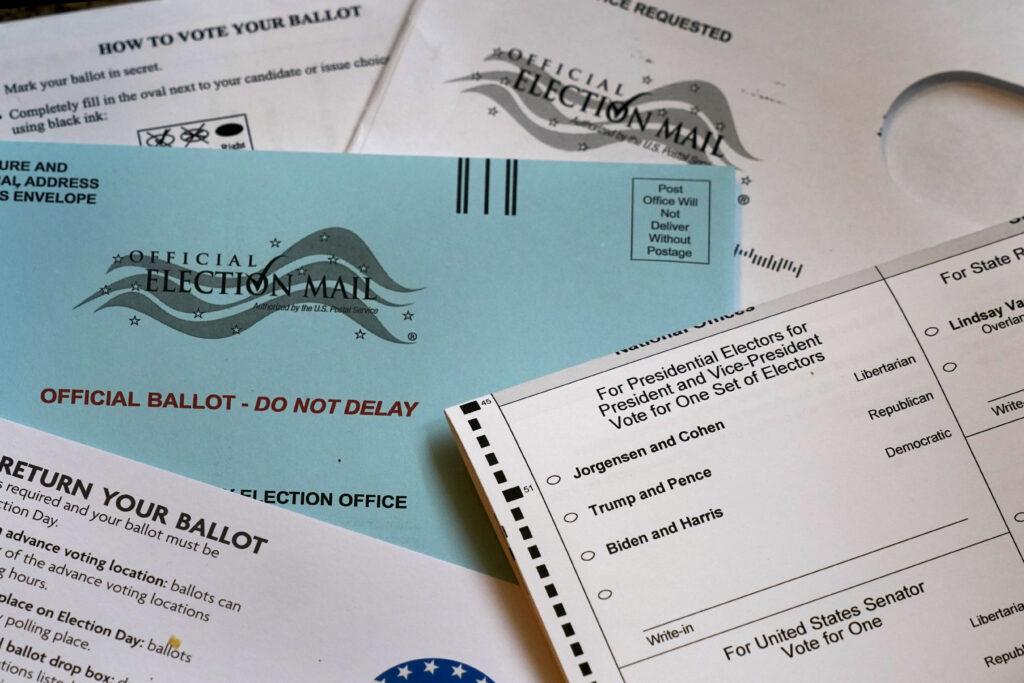
The rule specifies that mail ballot envelopes must display the official Election Mail logo and unique barcodes indicating it’s a ballot and providing the voter’s zip code.
But with less than 90 days before the election, the rule would require states to design these new envelopes, submit them for USPS approval, and then print and distribute them to millions of mail voters.
State election officials have repeatedly warned that the executive order’s new requirements would confuse voters and overwhelm administrators even with ample time to prepare. The consequences of that chaos could be enormous: Nearly 47 million Americans — or roughly 30% of voters — cast their ballots by mail in the 2024 general election.
What now?
The DOJ claims the final rule does not violate the two injunctions, stating in a notice filed in the district court that it wouldn’t actually take effect unless the injunctions were first lifted. The pro-voting groups responded Saturday with a motion asking Talwani to enforce her preliminary injunction. The DOJ replied Sunday morning, asking Talwani for more time because, in its view, there was no “emergency, nor any violation of any court order.”
But in an order Sunday evening, Talwani disagreed, directing the DOJ to file its response by Tuesday morning.
“Defendants … oppose the expedited briefing scheduling, objecting to ‘only two business days to respond,’ despite USPS creating the emergency by issuing a rule on a Friday evening after the courts were closed,” she wrote.
Meanwhile, the DOJ turned again to the Supreme Court Monday morning, filing a second supplemental notice in the Democratic states lawsuit begging the high bench to rescue it.
While claiming to be limited to just the procedural ripeness arguments, the DOJ’s brief slips in a few merits-based arguments to suggest the USPS rule is constitutional — whatever the executive order directed to the contrary.
“For example, the Postal Service will not refuse to transmit ballots from individuals who were not included on a state-submitted list, as Section 3(b)(iii) of the Order contemplated,” the DOJ wrote. “Yet, the injunction nonetheless precludes the rule’s implementation as to the November 2026 federal election in the respondent states based on the court’s assessments of the Order’s proposals and potential implementation, not the contents or application of a rule actually in effect.”
In a press release accompanying their filings, the plaintiffs led by the League of Women Voters of Massachusetts accused the administration of sowing chaos and undermining the midterm elections.
“A federal district court issued a preliminary injunction less than two weeks ago to stem the chaos caused by this executive order. By issuing this final rule, the Trump administration has flouted the court’s injunction. The final rule threatens further chaos for voters, civic organizations, and election officials by seeking to impose last-minute changes to mail voting rules,” the plaintiffs wrote. “Enforcement of the court’s preliminary injunction is necessary to hold this administration accountable for its unlawful action and make clear that voters can confidently cast their mail ballot free from federal interference this November.”
Adeline Tolle contributed to this report.