DOJ appeals court order temporarily blocking Trump’s attack on mail voting
The Department of Justice (DOJ) asked an appellate court to revoke the temporary restraining order (TRO) issued by a federal judge in Massachusetts preventing the U.S. Postal Service (USPS) from implementing President Donald Trump’s anti-mail voting executive order.
The DOJ filed notice Friday it was appealing U.S. District Court Judge Indira Talwani’s decision Thursday to grant a 14-day TRO.
The notice is the latest development in a court saga that could help determine whether some voters can cast their ballots by mail in the upcoming midterm elections this November.
Given their inherently interim nature, TROs can only be appealed in rare circumstances — for example, when one operates functionally like a preliminary injunction and there’s potential the defendant will suffer an “irreparable harm” unless it’s lifted.
Talwani granted the TRO to allow time for her to consider granting a preliminary injunction. She will likely decide whether to grant the injunction shortly after a hearing scheduled for Thursday.
Given that she has now issued three orders against Trump’s decree, most observers expect her to do so again.
Get updates straight to your inbox — for free
Join 350,000 readers who rely on our daily and weekly newsletters for the latest in voting, elections and democracy.
A 1st Circuit Court of Appeals panel previously affirmed a permanent injunction Talwani issued in this litigation. But the U.S. Supreme Court reversed that decision Monday, agreeing with the DOJ’s arguments that the executive order had not been implemented enough for courts to assess its legality.
That changed when USPS finalized its rule carrying out Trump’s anti-voting edict.
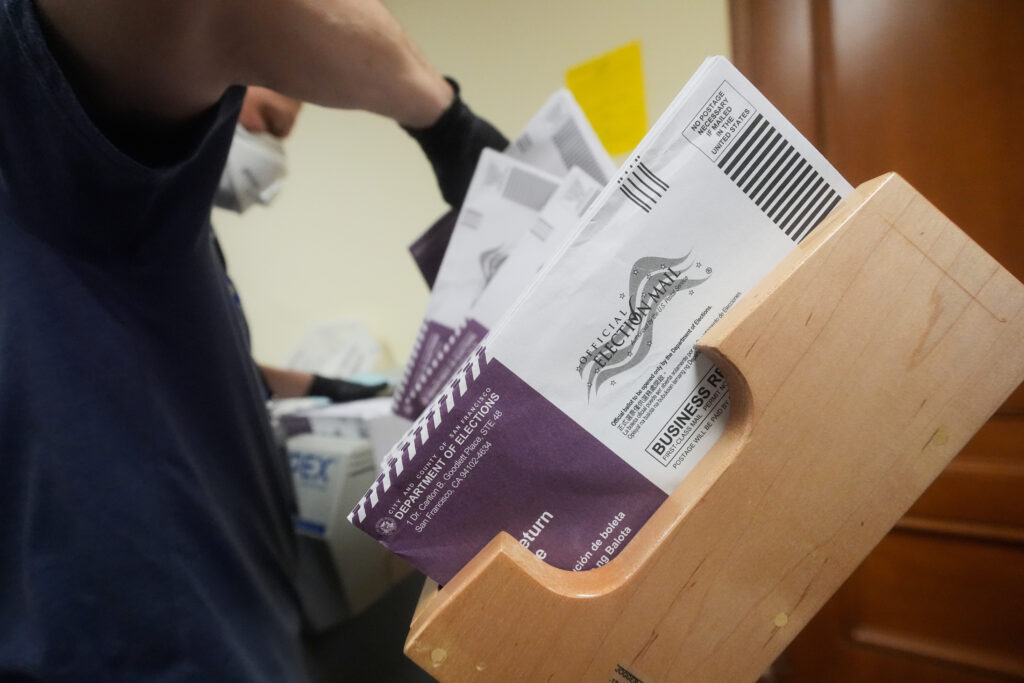
The rule requires election offices to use barcode-equipped envelopes for mail ballots that USPS must preapprove. States must also submit lists of eligible mail voters in advance. If state or local officials fail to get USPS’s approval for their envelope design or don’t upload their voter data, then mail carriers won’t deliver mail ballots.
As Talwani noted in her order granting the TRO requested by a coalition of Democratic-led states, the Constitution clearly empowers states and Congress to regulate elections, not the president. And that the administration could not point to a single statute explicitly authorizing Trump’s order or USPS’s rule. Talwani, who was appointed by President Joe Biden, emphasized how little time remained before the election.
“In light of the State election officials’ unrebutted declarations that compliance with the Final Rule at this late date is impossible, the risk of irreparable harm to voters in those jurisdictions is grave,” she wrote.
The DOJ’s appeal comes just three weeks before election officials must send mail ballots to overseas and military voters as required by federal law.
In a separate lawsuit challenging the executive order, DOJ lawyers urged the judge there, U.S. District Court Judge Carl Nichols, to move less quickly than Talwani.* Nichols directed the lawyers in that suit to finish briefing the case by Sept. 8, a day before some states begin sending out mail ballots.
The DOJ’s request that Nichols pump the brakes on the case reveals what the administration’s real aim is with the executive order and the litigation over it.
There is little doubt among legal scholars that Trump’s order and the steps taken to enact it are unconstitutional. By stalling, the administration hopes to run out the clock before the judiciary can settle that issue decisively before the midterm elections.
As Justice Ketanji Brown Jackson contended in her dissent Monday, “sowing chaos is the Government’s ultimate goal,” despite the administration’s claims to the contrary.
With Election Day less than 70 days away, it’s too late for officials to take the steps necessary to comply with Trump’s order or the final rule ahead of the midterms, said David Becker, executive director of the Center for Election Innovation & Research.
“I get the question a lot: When does it become too late to implement this executive order?” Becker told reporters Friday. “The answer was many months ago.”
“By the time this gets back to the Supreme Court, who knows how many thousands or even millions of mail ballots will have already been mailed out,” he added.
Rick Hasen, a University of California, Los Angeles law professor and director of the Safeguarding Democracy Project, criticized the DOJ’s duplicitous timing arguments in a blog post Thursday.
“For months the US argued that it was premature to seek relief because USPS and DHS had not yet issued their final rules. USPS waited until just weeks before ballots go out to put out their final rule, and even today they have no timetable for getting the portal up for states to submit the required information,” Hasen wrote.
He also noted that the DOJ had opposed the TRO “because appellate review in the ordinary course would come too late for the 2026 midterms.”
Allowing the USPS rule to go forward would affect some states more than others. In Washington, Oregon, Hawaii, Colorado and Utah, more than 90% of the electorate votes by mail. If USPS refused to authorize the mail ballot envelopes used in those states, it would effectively cancel the election.
When Talwani issued her TRO, Washington’s Secretary of State Steve Hobbs said it provided “important relief.”
“Every eligible voter has the right to cast a ballot, including by mail,” Hobbs said in a press release. “These new federal requirements are an unnecessary distraction from the work election officials need to be doing right now: administering a secure and accessible election.”
Even if officials scrambled to set up polling places in time, the chaotic administration of the vote would undoubtedly confuse and disenfranchise voters, as Talwani noted in her order Thursday.
“Plaintiff States face irreparable harm where they are required to comply with a likely unconstitutional regulation for which compliance is practically impossible as to the 2026 midterm elections, now little more than two months away,” she wrote. “If Plaintiff States are unable to comply with the Final Rule, an outcome that seems unavoidable given the timeframe, they will violate their obligations under the Constitution and State laws to administer elections. Defendants and Intervenor-Defendants offer no reply to Plaintiff States’ assertion that compliance for the 2026 midterm elections will be impossible for many of them.”
Some states have decided to attempt to comply with the order, even as they fight it in court. North Carolina submitted its mail ballot envelopes for USPS approval, the State Board of Elections revealed Thursday. However, Talwani’s TRO explicitly forbids USPS from reviewing envelopes for the time being.
Meanwhile, USPS officials have not said when election officials might be able to access the data portal for transmitting their eligible voter lists.
This story has been updated.
*Democratic plaintiffs in this litigation are represented by the Elias Law Group (ELG). ELG Chair Marc Elias is the founder of Democracy Docket.