Missouri map mess forced the Supreme Court to clarify Purcell principle and highlight shadow docket flaws
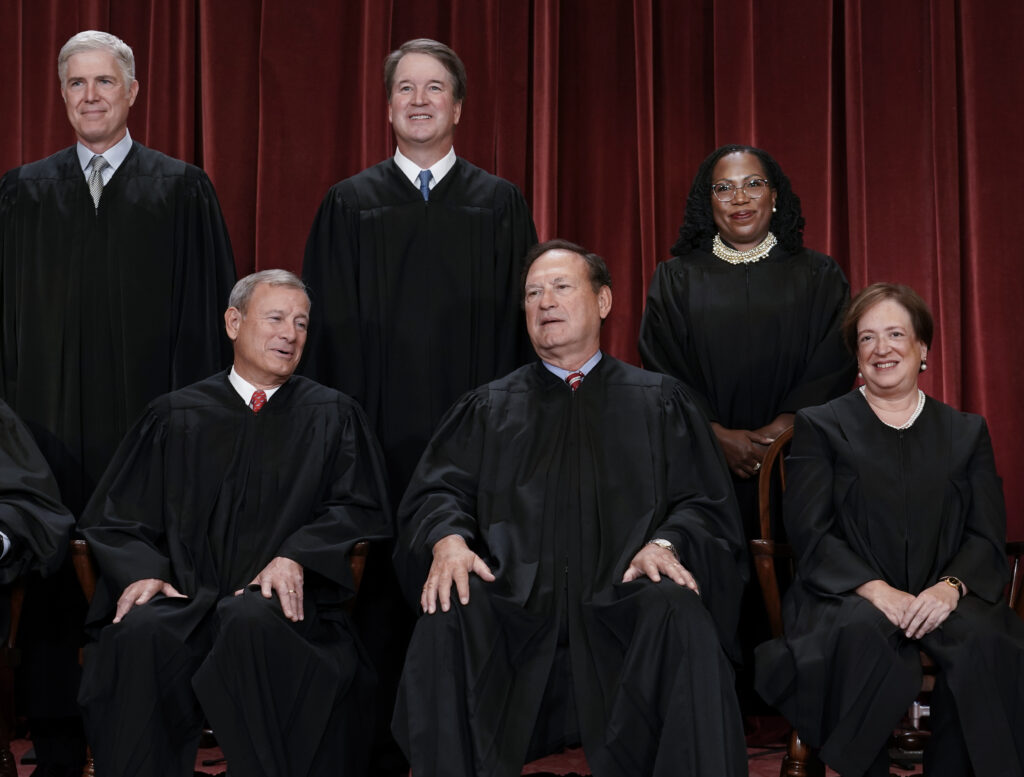
The U.S. Supreme Court’s decision Friday slapping down a Republican gerrymandering scheme in Missouri was the third time the high bench weighed in on the redistricting saga this month.*
But it was also the first time in this repetitive drama that the Supreme Court decided to explain itself. In doing so, the Court clarified one of its most controversial legal doctrines while inadvertently proving one of the primary criticisms of its “shadow docket” practices.
After the Missouri Supreme Court ruled that a gerrymandered 2025 congressional map that would have eliminated a safe Democratic seat in Kansas City never took legal effect — the Show Me State lets voters challenge new laws via referendum, suspending their implementation unless a majority approves — Republicans asked a federal district court to suspend the ruling, while also rushing an appeal directly to the U.S. Supreme Court.
That request was summarily rejected by Justice Brett Kavanaugh, who was assigned to oversee emergency appeals from Missouri and other states in the 8th Circuit Court of Appeals’ jurisdiction. Kavanaugh could have, but did not, refer the matter to the full Court. Nor did he provide any written explanation for his order, suggesting he saw it as an obvious, clear-cut decision that did not require further discussion.
But shortly after Kavanaugh tried to wave the case away, the federal district court judge granted the stay of the state Supreme Court order sought by Rep. Bob Onder (R). This time, the plaintiffs trying to block the gerrymandered map rushed to the U.S. Supreme Court, and again Kavanaugh issued a decision in their favor without bothering to explain his reasoning.
That, however, did not settle the dispute. Eleven days later, the 8th Circuit essentially ordered Missouri to use the 2025 map in the 2026 general election — even though mail ballots using a 2022 map had already been sent to voters — using dubious legal reasoning that experts quickly ripped apart.
That decision seemed to annoy the justices, who dryly noted in Friday’s 5-page decision that, “[g]iven this Court’s two prior orders in this litigation, our conclusion that [8th Circuit’s ruling] was error should come as no surprise.”
But as critics of the shadow docket have noted, the Court has no one but itself to blame for the 8th Circuit’s antics. “Had the justices provided even a sentence or two about why they were staying the district court’s TRO… it would have been harder for the Eighth Circuit to manufacture any wiggle room and justify its remand here,” Georgetown University law professor Steve Vladeck wrote.
Justice Ketanji Brown Jackson endorsed the reprovals of the Court’s penchant for unexplained emergency orders in recent public remarks. While saying the Justices had recently “began to explain more,” in their emergency application orders, they were “still not the full kind of explanation” she would prefer.
“If we’re not careful, the emergency docket can and will become an end-run around the standard review process,” Jackson added, speaking at a law school in Washington.
After finally being forced to explain itself in Friday’s unsigned shadow docket decision, the Court expounded on the Purcell Principle, a contentious concept that’s drawn its own fair share of opprobrium. The doctrine stems from another unsigned, shadow docket decision in 2006 where the justices warned that “[c]ourt orders affecting elections… can themselves result in voter confusion and consequent incentive to remain away from the polls. As an election draws closer, that risk will increase.”
In the two decades since Purcell v. Gonzalez, the Court has repeatedly invoked it to set aside lower federal court orders that had blocked state election rules for violating federal laws or the U.S. Constitution when those injunctions were issued “on the eve of an election.”
Get updates straight to your inbox — for free
Join 350,000 readers who rely on our daily and weekly newsletters for the latest in voting, elections and democracy.
In a string of decisions over the last few years, the Supreme Court has had a fungible understanding of what counts as “the eve of an election.” The Court used Purcell to save a Texas gerrymander in December 2025, citing the upcoming March primaries. But then, after gutting the Voting Rights Act in Louisiana v. Callais, the Court fast-tracked the decision’s implementation, allowing Louisiana to redraw its congressional maps even after voting in its primaries had already begun.
A few weeks later, the Court also allowed previously blocked gerrymandered maps in Alabama to be used just days before its primary election. “The Court has extended ‘the eve of an election’ to nearly a year when staying relief sought by minority plaintiffs, yet found no Purcell obstacle to its own rulings wiping away lower-court decisions and clearing the way for last-minute changes to congressional districts in Louisiana and Alabama,” Vladeck wrote shortly thereafter.
In those cases, the Court appeared to contort Purcell’s logic to favor the Republican Party’s favored outcomes. Friday’s decision ends that streak of partisan results.
And until now, it wasn’t settled whether Purcell applied only to federal courts or if it covered all kinds of late-breaking judicial intervention. In an amicus brief, Republican attorneys general from 20 states urged the Court to adopt that broader understanding. “While Purcell has most often been applied to the orders of ‘federal courts,’” they argued, “its animating principles — preventing voter confusion and loss of election integrity — apply equally to state court rulings.”
In its decision, the 8th Circuit blamed the Missouri map mixup on the state Supreme Court, saying its September 3 decision to block the 2025 map caused the last-minute chaos. But the U.S. Supreme Court didn’t buy that.
“The Eighth Circuit’s application of Purcell was incorrect,” the Court held. “Even though ‘federal courts should not impose changes close to an election, States are free to decide for themselves whether last-minute changes to an election are in their best interests’—subject, of course, to certain limited constraints imposed by federal law.”
That reading also supports understanding Purcell as a principle of federalism, echoing the U.S. Constitution’s investment of the power to determine the “Times, Places and Manner” for holding elections primary with “each State by the Legislature thereof,” subject to congressional supervision.
Friday’s shadow docket ruling also further buries the independent state legislature (ISL) theory, a doctrine the Court killed off in Moore v. Harper in 2023, but the 8th Circuit attempted to subtly resurrect here.
“The Constitution provides that state legislatures—not federal judges, not state judges, not state governors, not other state officials — bear primary responsibility for setting election rules,” the appellate court wrote, quoting a concurrence Justice Neil Gorsuch wrote in 2020.
But six of Gorsuch’s peers disagreed with that view three years later in Moore. “The Elections Clause does not insulate state legislatures from the ordinary exercise of state judicial review,” Chief Justice John Roberts wrote for the majority.
Friday’s order from the Supreme Court necessarily reaffirmed that holding, making clear that it would not question the ability of a state court to set aside a state electoral law for violating the state’s constitution.
Questions over Purcell’s scope and limits remain. It’s still unclear whether the Supreme Court sees it as limiting all federal courts — including itself — or just district and appellate orders. And Friday’s decision did little to explain just how far back the “eve of an election” goes.
*The Elias Law Group (ELG) represents the pro-voting parties in this case. ELG Firm Chair Marc Elias is the founder of Democracy Docket.