Federal judge revives Missouri GOP gerrymander right after Supreme Court rejects state’s emergency bid
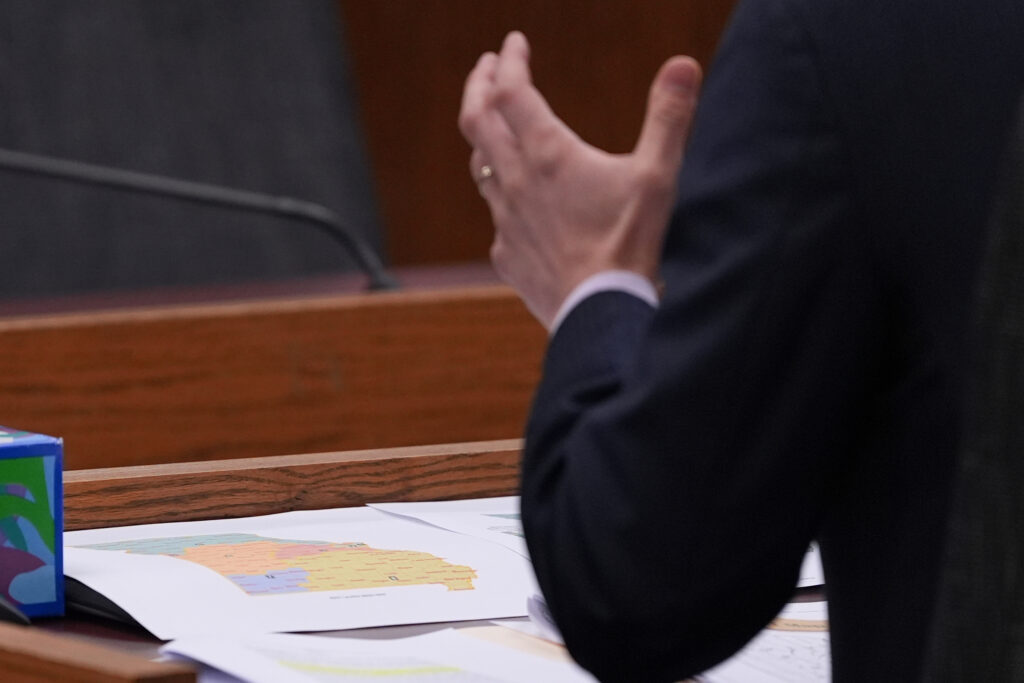
A federal judge Tuesday revived Missouri Republicans’ congressional gerrymander for the 2026 midterms, just after Supreme Court Justice Brett Kavanaugh rejected the state’s separate emergency effort* to restore the map.
Chief U.S. District Judge Stephen Clark granted a temporary restraining order (TRO) requiring Missouri to conduct the November congressional elections under House Bill 1 (HB 1), the GOP-drawn map that the Missouri Supreme Court ruled last week had never legally taken effect.
Clark’s order bars Secretary of State Denny Hoskins (R) and officials working with him from “implementing, using, publishing, distributing, or mandating the use of any congressional district map other than the HB 1 map” for the Nov. 3 general election.
The order will remain in effect for 14 days while the court prepares to consider a longer preliminary injunction.
Missouri Attorney General Catherine Hanaway said the state would comply with Clark’s order and use the HB 1 map in November, while reiterating the state’s argument that switching congressional maps between the primary and general election would be unworkable and unfair to voters.
“Missouri is prepared to follow and comply with Chief Judge Clark’s order,” Hanaway wrote, adding that the state maintains such a mid-election map change is “simply not feasible and profoundly unjust to Missouri voters.”
Gov. Mike Kehoe (R), who signed the gerrymander into law, praised Clark’s ruling as providing “much-needed clarity” for voters and election officials, saying the state will use the HB 1 map in November because Tuesday marked the deadline for changes to the general-election ballot.
“Voters and candidates deserve consistency, certainty, and not to have the rules changed between elections,” Kehoe wrote.
Meanwhile, the legal fight was already moving again.
Clark’s ruling had been appealed to the 8th U.S. Circuit Court of Appeals.
Get updates straight to your inbox — for free
Join 350,000 readers who rely on our daily and weekly newsletters for the latest in voting, elections and democracy.
The ruling came in a separate federal lawsuit filed Friday by Republican congressional candidates challenging the state Supreme Court’s decision.
Earlier, Kavanaugh denied Hoskins’ emergency application asking the U.S. Supreme Court to stay the Missouri ruling. Clark explicitly noted Kavanaugh’s denial in his order.
The state Supreme Court unanimously ruled last week that Missouri voters lawfully invoked their constitutional referendum power against HB 1 when opponents submitted more than 300,000 signatures last December. Because the referendum petition was valid and timely, the court held that HB 1 “is not the law and has never been the law” and ordered officials to use Missouri’s 2022 congressional map unless voters approve the new districts in November.
Hoskins then raced to the U.S. Supreme Court, arguing that switching maps after Missouri had already conducted its Aug. 4 congressional primaries under HB 1 would violate federal law and throw the general election into chaos.
Kavanaugh denied that request Tuesday.
But the Republican candidates’ parallel federal lawsuit produced the relief Hoskins could not obtain from the Supreme Court.
Clark notably rejected their Elections Clause theory, finding that Missouri’s referendum power is a lawful part of the state’s legislative process. Clark concluded that the GOP plaintiffs were unlikely to prevail on their claim that congressional redistricting cannot be subjected to Missouri’s referendum process.
Instead, Clark based the TRO principally on two different federal constitutional claims stemming from the fact that Missouri already held its primary under HB 1.
The judge found the plaintiffs have a “high probability of success” on their claim under Article I, Section 2 of the Constitution, reasoning that changing congressional districts between the primary and general election could effectively nullify some voters’ primary ballots by moving them into districts where they had no opportunity to help select the nominees.
Clark likewise found the plaintiffs likely to succeed on an Equal Protection Clause claim, reasoning that a map switch would create different classes of voters — those who remain in the same district they voted in during the primary and those who are reassigned to a different one — as well as similarly situated groups of candidates.
The court also embraced what Clark described as a “Purcell in reverse” argument.
The Supreme Court’s Purcell principle generally cautions federal courts against changing election rules shortly before voting. But Clark concluded that the principle favored intervention here because the TRO preserves the congressional districts Missouri used during its primary rather than requiring another map change weeks before the general election.
“Issuing a TRO here would preserve, rather than disturb, the election rules that candidates, election officials, and voters have relied on,” Clark wrote.
The result leaves Missouri’s congressional elections in an extraordinary posture. The state’s highest court has held that the 2022 map is the only map legally in force under Missouri law, while a federal judge is now prohibiting state officials from using that map for the November congressional election.
*The Elias Law Group (ELG) represented the challengers to the gerrymander in the U.S. Supreme Court. ELG Firm Chair Marc Elias is the founder of Democracy Docket.