Missouri Supreme Court blocks GOP gerrymander, gives voters final say
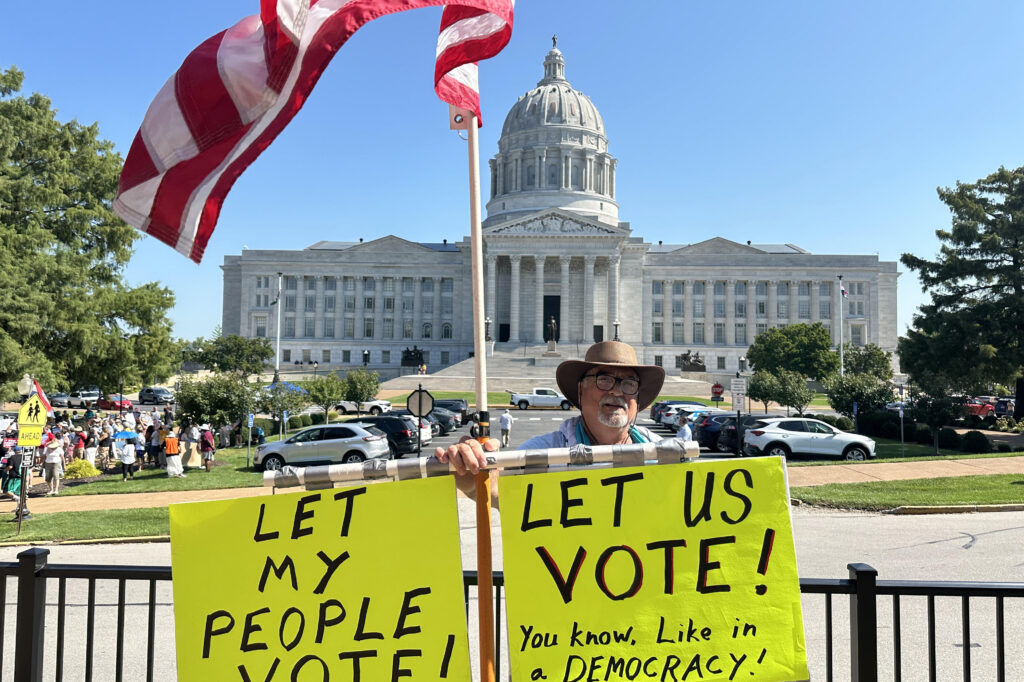
The Missouri Supreme Court blocked state officials from using Republicans’ new congressional gerrymander in this year’s November midterms, after a grueling, nearly year-long battle by voters to have the final say on a map drawn up at President Donald Trump’s request.
Missouri Attorney General Catherine Hanaway said the state will immediately ask the U.S. Supreme Court to intervene, arguing that the ruling “violates federal law.” Gov. Mike Kehoe (R), a supporter of the gerrymander, said he will continue to stand behind it as “the legal process moves forward.”
Chuck Hatfield, an attorney for the plaintiffs, blasted Hanaway for challenging the judgment of the state’s highest court.
“I think that that is a fool’s errand, given the strength of this opinion,” Hatfield said, calling it unprecedented for a Missouri attorney general to question a ruling of the state Supreme Court.
“A lot of these things are controversial,” Hatfield said. “This one was not.”
Rep. Emanuel Cleaver (D), who represents the Kansas City district targeted by the gerrymander, said of Thursday’s ruling: “Democracy prevails.”
“Despite the cynical and deeply shameful attempt to silence many of our neighbors, the people fought back and won,” Cleaver said in a statement. “This reaffirms that the people should choose their politicians, not the other way around.”
House Minority Leader Hakeem Jeffries (D-N.Y.) praised the ruling as a victory for Missouri voters and accused Republicans of trying to manipulate the midterm map. He also pointed to the U.S. Supreme Court’s decision earlier this year to leave in place a Virginia Supreme Court ruling in a separate redistricting dispute, saying Democrats would be watching to see whether the justices apply the same standard in Missouri.
“The people are now empowered to decide what the congressional map should look like in November, not Donald Trump and corrupt Republicans,” Jeffries said.
Trump, meanwhile, blasted the Missouri Supreme Court’s decision and argued that reverting to the prior map so close to the general election would disrupt the election process.
“Missouri must be able to use the map that was in effect just a couple of months ago, in the Primary,” Trump wrote. “This is a Dark Day for ‘Justice’ in Missouri!”
Last fall, GOP lawmakers in Missouri answered Trump’s call to redraw congressional district lines ahead of the 2026 midterms.
Voters responded by submitting more than 300,000 signatures to put the GOP gerrymander to a statewide referendum vote. Under the Missouri Constitution, voters have the right to veto state legislation. While the law includes some exceptions, it does not list congressional redistricting plans among them.
But that didn’t stop Missouri Secretary of State Denny Hoskins (R) from attempting to thwart referendum organizers at every turn.
Get updates straight to your inbox — for free
Join 350,000 readers who rely on our daily and weekly newsletters for the latest in voting, elections and democracy.
Historically, Missouri secretaries of state have halted the disputed legislation once voters submitted the signatures, putting those measures on hold until voters have the opportunity to approve or reject them at the polls. But in this case, Hoskins broke with precedent and claimed the new gerrymander was already in effect, regardless of the referendum effort underway.
For months, he then refused to acknowledge that referendum supporters had submitted enough signatures to qualify for the ballot. On the last possible day, he rejected the referendum, claiming that redistricting maps are not subject to referendum votes.
People Not Politicians, the group leading the referendum effort, filed a lawsuit asking the courts to reverse Hoskins’ decision.
However, Cole County Circuit Judge Daniel Green agreed with Hoskins, ruling that, under state and federal law, voters do not have the authority to veto congressional redistricting maps, in part because the Missouri Constitution does not clearly state that congressional maps are subject to the referendum.
The state Supreme Court, which had warned lower courts to speed the process, bypassed the appellate court and directly took up the referendum case on its own order.
The Supreme Court rejected Hoskins’ reading of the state Constitution, pointing to the broad language of Article III, Section 49, which reserves to the people the power to approve or reject by referendum “any act of the general assembly, except as hereinafter provided.”
The court noted that it has previously held that congressional redistricting by the General Assembly is a “legislative act,” undercutting the secretary’s contention that congressional maps fall outside the referendum power.
The justices also pointed to other provisions of the Missouri Constitution that expressly exempt certain redistricting plans drawn by independent bipartisan citizens commissions from referendum. Those specific exemptions, the court reasoned, further reinforce that legislation drawing congressional districts — for which the Constitution contains no comparable exemption — remains subject to the people’s referendum power.
More broadly, the court held that the referendum and initiative power in Article III, Section 49, “like the Governor’s veto power” elsewhere in the state Constitution, is an essential part of Missouri’s lawmaking process. The court reaffirmed its precedent in Maggard and concluded that because the referendum petition was lawful, sufficient and timely, HB 1 never took effect and was referred to voters as of Dec. 9, 2025.
That means the congressional districts enacted in 2022 remain in effect for the November 2026 general election, and HB 1 will not take effect unless and until voters approve it in November.
The court also brushed aside Hoskins’ warnings about the confusion, expense and practical difficulties that could result from not using the new map in the 2026 election. Those concerns were “particularly misplaced,” the court wrote, because the secretary’s own delay had created the very “confusion, expense, and practical difficulties of which he complains.”