In SAVE ruling, Supreme Court signals path to weaken key protection against last-minute purges
 Prefer us on Google
to see more of our voting rights news coverage when you search.
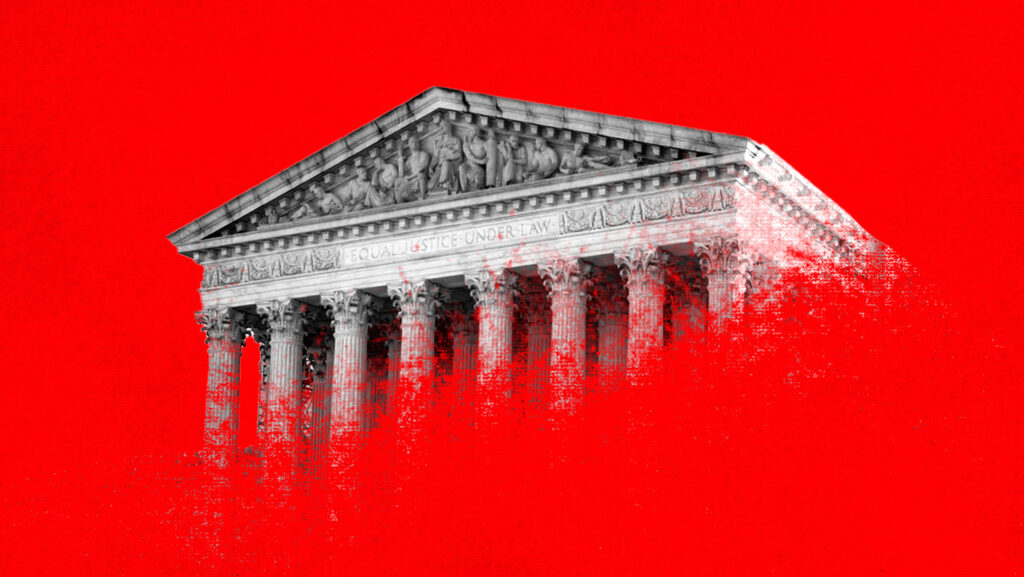
The Supreme Court’s decision Friday to revive the Trump administration’s expanded SAVE database for the midterms also suggests the justices may be eager to weaken one of federal law’s most important safeguards against last-minute voter purges.
In its ruling, the Court acknowledged that the National Voter Registration Act (NVRA) prohibits states from conducting “systematic” voter removal programs during the quiet period — the 90 days before a federal election. The majority said that restriction “limits the potential impact” of restoring the administration’s SAVE database weeks before the midterms.
But the majority noted that “individualized inquiries” remain permissible during the quiet period. And the Court relied on the government’s inability to conduct those inquiries, as long as use of the SAVE database remained blocked, as one reason the administration was entitled to emergency relief.
Now, a crucial voter protection could hinge on whether the Supreme Court wants to narrow the definition of “systematic” as applied to purges. And there’s reason to fear that it does.
Get updates straight to your inbox — for free
Join 350,000 readers who rely on our daily and weekly newsletters for the latest in voting, elections and democracy.
The distinction is particularly notable because the Court itself described the Trump administration’s expanded Systematic Alien Verification for Entitlements (SAVE) program as now allowing “state and local authorities to conduct bulk searches of multiple individuals at once.”
Friday’s ruling does not explicitly hold that states can run thousands of voters through SAVE and then evade the NVRA’s quiet period by treating each resulting citizenship challenge as an “individualized” inquiry.
But it does raise the question: If the federal government or a state uses a bulk database search to flag thousands of voters, then removes each person separately, will the Court allow that as an individualized process, rather than barring it as a systematic purge?
The majority said the parties in Friday’s SAVE case had not asked the Court to resolve that question and that it “need not decide it here.” But the Trump administration has already argued that it should.
In litigation seeking Georgia’s statewide voter file, the Department of Justice argued this summer that the 90-day quiet period does not prevent a state removing voters en masse if the federal government does the systematic work first and then alerts the state that particular people may be ineligible.
That argument is part of a broader legal theory DOJ has advanced in its nationwide voter roll litigation. It has argued that the NVRA’s 90-day restriction bars states from conducting systematic removal programs, but does not necessarily prevent the federal government from doing the systematic screening itself and then sending states a particular list of names to remove “one by one.”
In the Georgia case, DOJ said the quiet period “poses no barrier” to nonsystematic removals and would not stop the state from acting in an “individualized fashion” if the federal government alerted it that specific voters might be ineligible.
DOJ has lost 25 straight district court cases in its campaign to force states to turn over unredacted statewide voter files, with judges repeatedly rejecting the department’s case that it has the authority to obtain those records. No court so far has compelled states to hand over their unredacted voter rolls. But those rulings did not directly address DOJ’s quiet-period theory.
DHS officials made the theory even more explicit in an August meeting with Nevada election officials.
Federal officials said DHS had “kind of already completed the systematic part” by comparing Nevada voter data against federal records. Nevada could then review individual names identified through that process.
“This is not a systematic process. This is an individualized process,” a DHS official told the state. And the Supreme Court will soon confront how robust the quiet period’s protections against last-minute disenfranchisement truly are.
In a footnote, the majority pointed directly to Republican National Committee v. Mi Familia Vota, a case the Court will hear in December over whether the NVRA prevents states from implementing programs during the 90-day period to cancel the registrations of voters believed to be noncitizens.
Friday’s opinion establishes that the majority sees individualized inquiries as a potentially meaningful carveout even during the 90-day period — and relied on the loss of those inquiries in concluding that the government was being harmed by the lower court’s order.
Election law professor Rick Hasen highlighted the unresolved tension after the ruling.
He noted that the NVRA should limit the decision’s immediate effect on the midterms because mass purges remain restricted during the quiet period, while states can still make individualized determinations using SAVE. But he also raised the possibility that some states could attempt mass removals of alleged noncitizens and effectively test whether the Supreme Court would permit them.
The stakes are only heightened by the Court’s own recognition that SAVE can incorrectly flag lawful voters.
In finding that the groups challenging SAVE had standing to sue, the majority pointed to a Louisiana voter whose Social Security Administration records do not accurately show that she is now a naturalized citizen. The Court acknowledged that if SAVE remained operational, she likely would have been required to take additional steps to prove her citizenship and be barred from voting if she did not provide them.
Yet when the majority later balanced the potential harms of restoring the database, it focused on the government’s inability to use SAVE and did not separately analyze the danger to voters incorrectly identified as noncitizens.
Justice Ketanji Brown Jackson made the same criticism in a blistering dissent joined by Justices Sonia Sotomayor and Elena Kagan.
Jackson wrote that the majority “only looks at one side of the scale,” overlooking findings by the lower court that errors had already affected lawful voters. One voter in Texas had her registration revoked without her knowledge, according to the dissent, while two others were required to produce proof of citizenship to remain registered.
The quiet period was designed to limit precisely the dangers created by large-scale “list maintenance” close to an election, when eligible voters wrongly caught in a purge have less time to discover and correct errors.
Courts have long recognized a distinction between prohibited systematic programs and genuine investigations based on voter specific information.
What remains unsettled is how that distinction applies when modern databases allow governments to screen enormous numbers of voters simultaneously and then take action against the resulting names one at a time.
Friday’s decision did not answer that question.
But by restoring a system specifically built for bulk citizenship searches while emphasizing that “individualized inquiries” remain permissible during the quiet period, the Supreme Court placed that distinction squarely at the center of the fight over last-minute voter removals.
And with Mi Familia Vota already on the Court’s docket, the extent of the NVRA’s 90-day protection will soon come into much sharper focus.