Supreme Court’s Alabama redistricting ruling marks brazen reversal of its previous stance
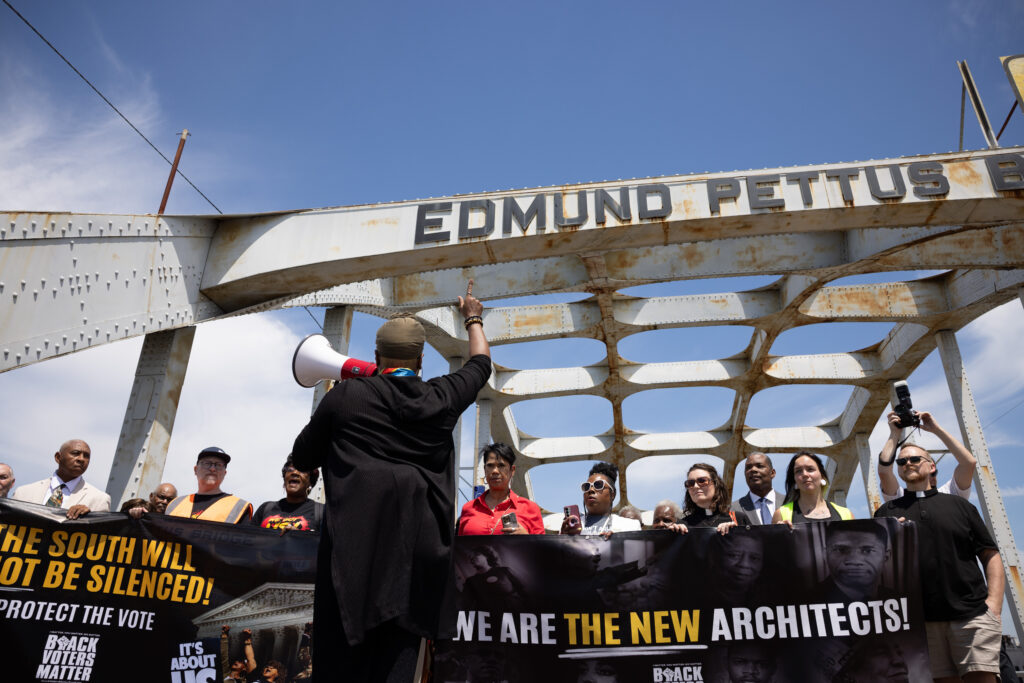
The U.S. Supreme Court’s Republican-appointed majority erased all doubts about the sweeping nature of its recent voting rights jurisprudence Tuesday night with a shadow docket ruling that effectively reverses the Court’s own decision in the same matter just three years ago.
The unsigned emergency order in Allen v. Milligan goes beyond the court’s recent Louisiana v. Callais decision, which merely nullified the Voting Rights Act’s (VRA) prohibition on unintentional racial discrimination, to also make it all but impossible for judges to strike down a map as intentionally discriminatory.
It does so by essentially flipping its own 2023 ruling in the same case.
In dissent, Justice Sonia Sotomayor excoriated that decision to go down the “path” that “disregards both democratic values and the rule of law, leading to “a chaotic election, held under a never-before-used congressional map that intentionally discriminates against Black Alabamians, that Alabama adopted in unashamed defiance of a prior court order directly affirmed by this Court, and that will require officials to change the voter registrations of hundreds of thousands of voters in just days at best, a task that Alabama previously represented would take months.”
Sotomayor noted that Tuesday’s decision was the third time Alabama’s congressional map had found its way before the high bench, lamenting that “[e]ach turn reveals just how unconscionable the Court’s action is today.”
It was the Supreme Court’s surprising decision to uphold Section 2 of the VRA in Milligan just three years ago that gave civil rights groups and voting advocates some glimmer of hope that it might truly preserve the law again in Callais.
Get updates straight to your inbox — for free
Join 350,000 readers who rely on our daily and weekly newsletters for the latest in voting, elections and democracy.
Immediately after Callais came out in late April, Alabama asked the Supreme Court to vacate the lower court’s injunction blocking it from using the congressional map it enacted in 2023 — the map the Supreme Court ultimately rejected in Milligan as VRA violation.
The court granted that wish and remanded the case down to the district court, which then entered another injunction, saying the map was “tainted by intentional race-based discrimination.”
But on Tuesday, the Supreme Court vacated again, saying the lower court failed to “heed the presumption of legislative good faith… because it interpreted the State’s legal disagreement with the court’s earlier remedial order as proof of discriminatory animus.”
The Supreme Court explained that the plaintiffs failed to show that their alternative map performed “‘just as well’ with respect to all of the State’s constitutionally permissible redistricting criteria,” as required by Callais.
“Yet, the District Court found a violation even though the plaintiffs’ alternative map would not perform just as well as to the State’s constitutionally permissible criteria of keeping together the Gulf Coast community of interest and avoiding the pairing of incumbents,” the majority held.
But, as the Guardian’s Sam Levine noted on social media Tuesday night, the court came to the exact opposite conclusion in the very same dispute just three years ago.
“Alabama argues that the Gulf Coast region in the southwest of the State is such a community of interest, and that plaintiffs’ maps erred by separating it into two different districts,” Justice Brett Kavanaugh wrote for the majority in 2023. “We do not find the State’s argument persuasive.”
That inconsistency belies Justice Samuel Alito’s claim in Callais that the Court was not striking down Section 2 of the VRA, but instead merely “properly constru[ing]” it, as UCLA Law professor Rick Hasen noted.
“[T]here’s now practically an unrebuttable presumption that a legislature is acting in good faith and therefore is not acting in a racially discriminatory way so long as the state can assert some pretextual nonracial reason for enacting its plan,” Hasen wrote after the decision’s publication. “So in these cases, plaintiffs will need to meet an impossible standard to prove effect, just as in a post-Callais Section 2 case, a standard which simply ignores the fact that when (white) Republicans discriminate against Democrats in the south, they are discriminating against Black voters.”
“More and more, this Court shows itself to be little more than a partisan tool engaged in results-oriented jurisprudence, despite protestations to the contrary,” he added.
Sotomayor’s dissent, which the court’s other two Democratic appointees joined, highlighted the majority’s hypocrisy and the chaos it unleashed.
“Now the Court is squarely faced with a record of the turmoil it has caused and the harm it has wrought,” Sotomayor wrote. “Yet just as Alabama doubled down on racial discrimination, the Court today doubles down on chaos.”
In December, the Supreme Court set aside a district court’s finding that Texas intentionally used race to redraw its congressional maps last year, emphasizing that, consistent with its shadow docket order in Purcell v. Gonzalez, “that lower federal courts should ordinarily not alter the election rules on the eve of an election.”
But now, seven months later, the majority decided to do just that, Sotomayor noted, saying it has unleashed “havoc,” and “tramples on that principle of restraint,” established in Purcell.
“To switch to the 2023 Redistricting Plan now, however, county elections officials will have to reassign hundreds of thousands of voters across the State to new congressional districts,” Sotomayor wrote. “Three of Alabama’s counties will be particularly hard hit because they are split across two congressional districts. These counties have about 600,000 registered voters between them (roughly 15% of the State’s total number of registered voters).”
In the order, the majority seems to suggest that Purcell only applies to lower courts, not the Supreme Court, by emphasizing “lower” federal courts, rather than just federal courts.
But, as Columbia Law School professor Jamal Greene noted, Justice Kavanaugh said otherwise in 2022’s Moore v. Harper, where he agreed with denying plaintiff’s request for “an order from this Court requiring North Carolina to change its existing congressional election districts for the upcoming 2022 primary and general elections.”
“It is too late for the federal courts to order that the district lines be changed for the 2022 primary and general elections,” Kavanaugh wrote.
Kavanaugh went on to cite his recent concurrence in Merrill v. Allen — the first time Alabama’s congressional map appeared before the court. In that order, issued in February 2022, the Supreme Court vacated the lower court’s injunction of the map’s use, saying it was too close to the election.
“In addition to being wrong on the merits, the Court’s decision inflicts two grave harms on the public,” Sotomayor wrote. “It debases the democratic process by upending Alabama’s entire election in the name of permitting Alabama to discriminate against Black Alabamians. It also corrodes the rule of law by rewarding Alabama’s gamesmanship and outright defiance of court orders.”
Ashley Cleaves contributed to this report.