Missouri again ordered to use gerrymandered map for midterms — Supreme Court likely to decide
 Prefer us on Google
to see more of our voting rights news coverage when you search.
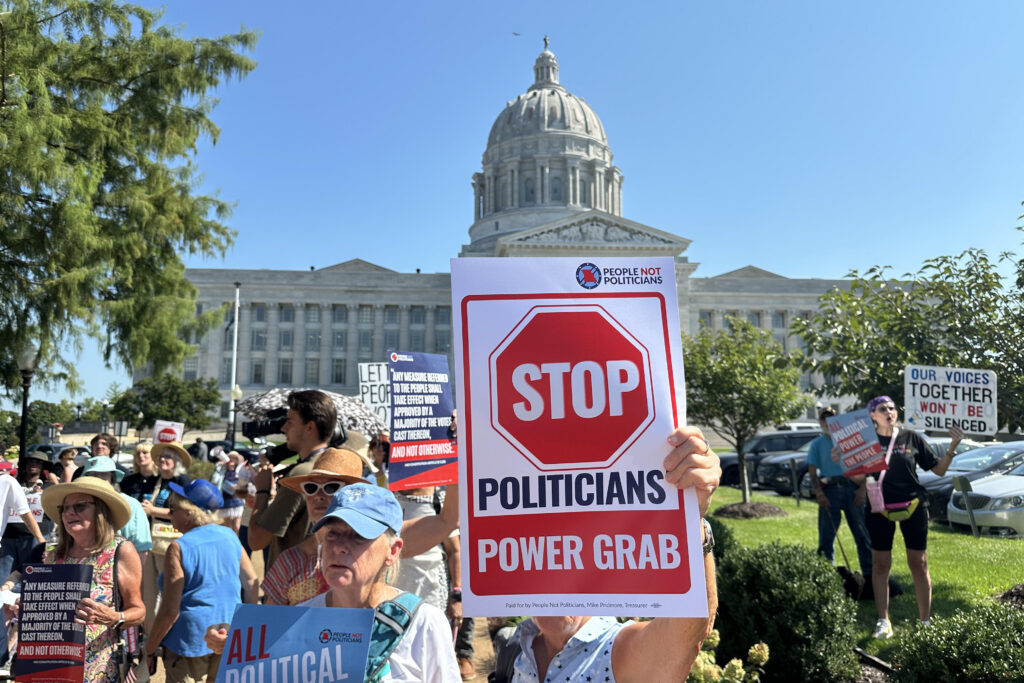
A federal appeals court on Monday ordered Missouri to reinstate a gerrymandered map that eliminates a Democratic district in Kansas City, even though the state has already distributed ballots.*
The shock decision likely means the U.S. Supreme Court (SCOTUS) will be asked to make a final ruling on Missouri’s redistricting battle.
“This Court holds that Missouri’s current plan to use the 2022 map in the November 2026 general election violates the Constitution,” the decision said. “Only use of the 2025 map complies with the Constitution and federal law. We affirm the district court and remand for entry of a permanent injunction.”
The 8th Circuit Court’s decision is in direct conflict with a Missouri Supreme Court ruling blocking the gerrymander, setting up a last-minute rush to SCOTUS, whose stay motion against the map remains in effect.
Get updates straight to your inbox — for free
Join 350,000 readers who rely on our daily and weekly newsletters for the latest in voting, elections and democracy.
The court issued a permanent injunction that won’t go into effect until Sept. 28, allowing time for SCOTUS review.
“If the Supreme Court has not stayed or otherwise altered the permanent injunction by that time, Secretary Hoskins and all others bound by this judgment must fully implement the 2025 map for the November 2026 general election,” the order said. “The Court trusts that the Missouri Supreme Court will respect this Court’s decision under the Supremacy Clause.”
The court reasoned that, even though Tuesday is the deadline for the state to mail ballots to voters, it’s still not too late to change maps.
“Absentee ballots may be requested and cast beginning on September 22, 2026,” the judges wrote. “That deadline has not yet arrived, and thus general absentee voting has not yet begun. Accordingly, the September 22, 2026, absentee ballot commencement date does not moot this case.”
The court’s central constitutional holding was that congressional voters must remain in the same constituency throughout the primary and general election. Because Missouri used the 2025 map in August, the judges concluded that switching to the 2022 districts for November would leave some voters participating in the primary for one district and the general election for another.
“Article I, Section 2’s right to participate in the procedure of choosing a member of Congress requires continuity in the constituency throughout all stages of a single election,” the court wrote. “Changing district lines between the primary and general election prevents an affected voter from participating in either district’s complete procedure of choice.”
The panel pointed to estimates submitted by the conservative Club for Growth that roughly 1.4 million Missourians live in different districts under the two maps and about 284,000 people who voted in the August primary would receive a general-election ballot for a different district. The court said that would deprive affected voters of an equal role in choosing their congressional representatives.
The ruling injects even more confusion into a year-long battle over which map the state will use for the general election.
The appeals court also rejected the referendum proponents’ argument that the Supreme Court’s Purcell principle — which generally warns federal courts against changing election rules close to an election — barred intervention this late in the process.
Instead, the judges characterized the 2025 map as the practical “status quo,” pointing to the candidates who filed and campaigned under it and the more than 1.2 million voters who cast primary ballots under those districts. The court said the Missouri Supreme Court, not the federal courts, caused the late change when it blocked the map earlier this month.
“Using the 2025 map also will lead to the least amount of confusion for voters subjected to a string of changes this month,” the panel wrote, adding that “any confusion stems from the last-minute decision by a state court to switch the congressional map.”
The panel did not decide the Republican plaintiffs’ separate Equal Protection or Elections Clause claims. Although it called the lower court’s Equal Protection analysis “compelling,” the 8th Circuit said its Article I ruling was enough to decide the case and declined to reach the other constitutional theories.
People Not Politicians said it will seek emergency Supreme Court review of the decision. Executive Director Richard von Glahn maintained that the 2025 gerrymandered map cannot become law unless voters approve it and emphasized that election administration under the 2022 map is already underway.
“Ballots have been printed, and Missourians have already voted. Thousands more will vote before this order seeks to take effect,” von Glahn said in response to the 8th circuit’s ruling. “Officials should stop wasting taxpayers’ money on pointless legal action and instead focus on administering our elections. Missourians are already voting and will continue to vote no on Proposition A through November 3.”
In 2025, Missouri Republicans redrew the state’s congressional map at President Donald Trump’s urging, hoping to increase the GOP’s odds of holding onto the U.S. House of Representatives. But the map has been mired in legal battles for over a year, after voters secured enough signatures to force a referendum vote on it during the midterms.
Despite Missouri Secretary of State Denny Hoskins (R) dragging out the process at every step in a bid to run out the clock on legal challenges, the Missouri Supreme Court ultimately ordered him to use the 2022 election map for the general election — even though voters cast ballots under the gerrymandered map for the primary.
After that ruling, a group of Republican candidates filed a separate lawsuit in federal court demanding the state continue using the gerrymander for the general election. After a federal judge barred Missouri from using any map other than the gerrymander for the general election – conflicting with the Missouri Supreme Court’s ruling – the U.S. Supreme Court stepped in.
The justices halted use of the gerrymander until a federal appeals court could review the decision and the justices themselves could decide whether to review the case.
*The Elias Law Group (ELG) represents pro-voting parties in this case. ELG Firm Chair Marc Elias is the founder of Democracy Docket.