SCOTUS Missouri gerrymander ruling praised by pro-voter groups, attacked by GOP officials
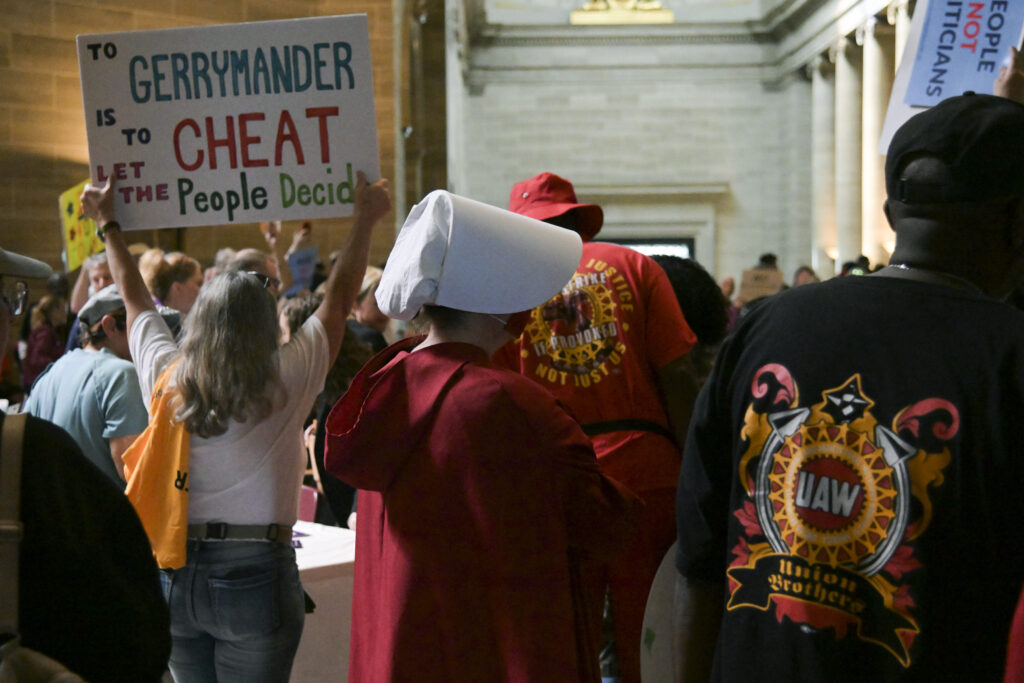
The controversial plan to gerrymander Missouri’s congressional map to help Republicans has finally been squashed by the U.S. Supreme Court (SCOTUS), which on Friday ruled against it. It was the Court’s third time rejecting it in two weeks.
Missouri voters behind a petition to have voters decide the fate of the gerrymandered map praised the ruling because it gives voters the final say on whether the Republican-drawn map reflects their political interests.
“We are done with corrupt politicians trying to force their map into effect outside the process outlined in the Missouri Constitution,” People Not Politicians, the organization backing the petition, said. “We have said from the beginning: People, not politicians, will be the final deciders on this DC power grab.”
Get updates straight to your inbox — for free
Join 350,000 readers who rely on our daily and weekly newsletters for the latest in voting, elections and democracy.
The Missouri Constitution allows voters to collect signatures to turn any bill passed by the state legislature into a ballot referendum. People Not Politicians cleared that threshold with more than 300,000 signatures to block a law passed in September 2025 by Republicans that cut a Democratic district out of the state’s congressional map and added a GOP-friendly district.
Missouri voters will now decide on the Republican’s map in this fall’s midterm election.
While two federal courts ruled the map could go into effect before the November ballot referendum, both the Missouri Supreme Court and the U.S. Supreme Court agreed the bill for the gerrymander never became law and therefore could not be used this year.
“The gerrymandered map passed in 2025 in Missouri was never law, and yet self-interested, partisan politicians, and now two lower federal courts, have repeatedly attempted to impose it on voters for the 2026 midterms,” Mark Gaber, the senior director of redistricting at Campaign Legal Center, said in a statement. “This case should never have reached the Supreme Court three times, but we’re glad that the final outcome of these cases is Missourians having the opportunity to vote under a lawful map this fall.”
The Campaign Legal Center filed several briefs in support of blocking the gerrymandered map along with the ACLU of Missouri and the ACLU Voting Rights Project. In those briefs, the pro-democracy organizations argued that Missouri Secretary of State Danny Hoskins’ decision not to certify the signature petition — after delaying the decision for months — caused the legal fight to drag out longer than needed.
“Politicians and elected officials have unleashed unnecessary but intentional chaos on Missouri voters, not for the benefit of their constituents but for themselves and the state actors in D.C. who designed and demanded these maps solely for partisan power grab,” ACLU of Missouri director of litigation and policy Gillian Wilcox said.
The U.S. House seat dropped from the gerrymandered map is currently held by Rep. Emanuel Cleaver (D), who’s held the seat for nearly twenty years as one of two African-American congressmen representing the state. His district consists of large swaths of Black voters in Kansas City who would’ve been broken up and moved to districts where they would’ve been severely outnumbered by Republican voters under the gerrymandered map.
After yesterday’s SCOTUS ruling, Cleaver told NBC News that “the manufactured chaos” was finally over, and that he’s ready to move on.
“For more than a year, state officials have spent precious time, energy, and resources on an effort to silence the voices of Missouri voters and steal a congressional seat,” Cleaver said yesterday. “Tonight, after more than 305,000 Missourians demanded a say, the Supreme Court has put this shameful and unlawful scheme to rest. Power to the people.”
Republican elected officials in Missouri, meanwhile, expressed disappointment that the map they tried to push through without voters’ consent can no longer stand for this year. One of their main arguments in court has been that the gerrymander should be used because it’s the one that voters used in the primaries earlier this year.
“It is disappointing that today’s decision by the United States Supreme Court means Missouri will conduct its November general election under a different congressional map than its primary election,” Missouri Gov. Mike Kehoe said. “Nevertheless, Missouri will follow the Court’s order.”
However, that gerrymandered map was only used in the primary election because Hoskins incorrectly declared that redistricting was exempt from ballot referendum votes. The Missouri Supreme Court held Hoskins in contempt for directing local election officials to use the gerrymandered map, and several organizations have sued Hoskins for this misguidance.
Hoskins claimed, perhaps disingenuously, that the courts weren’t clear enough about which map to use. The ruling from SCOTUS yesterday included perhaps its most precise language to date to officially rule the gerrymandered map dead for 2026.
“While today’s SCOTUS ruling is a disappointing blow to representative democracy, I appreciate the final clarity,” Hoskins said. “My Office will of course comply with the law. I have every confidence in our local election authorities and that they will administer a seamless general election.”
Some elected Republican officials blamed the Missouri Supreme Court for any map confusion, claiming that its rulings against the gerrymander “disenfranchised” voters who used that map in the primaries.
“The responsibility for this chaos rests first and foremost with the Missouri Supreme Court,” Missouri State Sen. Rick Brattin (R) said. “With the stroke of a pen, it overturned a congressional map passed by the people’s elected legislature and signed by the Governor after that map had already been used to conduct the primary election. Missouri voters are now being forced to live with the consequences.”
But SCOTUS rejected those arguments, instead pinning the blame squarely on Hoskins for forcing the deployment of an unauthorized map, and also for delaying the certification of the petition when it was more than sufficient to trigger a ballot vote.
Other conservatives claimed the defeated gerrymander was the result of a “leftist” agenda imposed to stop Republican election integrity efforts.
“Missouri is mired in a full blown Constitutional crisis,” former Missouri Speaker of the House Tim Jones said, “[C]aused by a leftist fueled & funded reckless rage mob initiative system & aided & abetted by an out of control unelected judiciary that acknowledges no constitutional check by either the elected executive or legislative branches.”
Five of the Missouri Supreme Court’s justices were appointed by Republican governors, and six of the U.S. Supreme Court justices were appointed by Republican presidents.
Three of those SCOTUS justices were appointed by Trump, including Brett Kavanaugh, who wrote the primary order detailing why the gerrymandered map was unauthorized for 2026. The SCOTUS ruling from Friday came per curiam, meaning all nine of the justices were likely in agreement.
It is rare for a SCOTUS ruling to have this kind of alignment among its conservative and liberal wings, especially for voting rights cases. However, as elections expert Rick Hasen wrote yesterday: “If there’s one thing that can override the usual divergent ideological leanings of the Justices, it is a lower court that disobeys the Court’s earlier orders or looks for sneaky ways around them.”