In big win for voters, Supreme Court won’t revive Missouri gerrymander before midterms
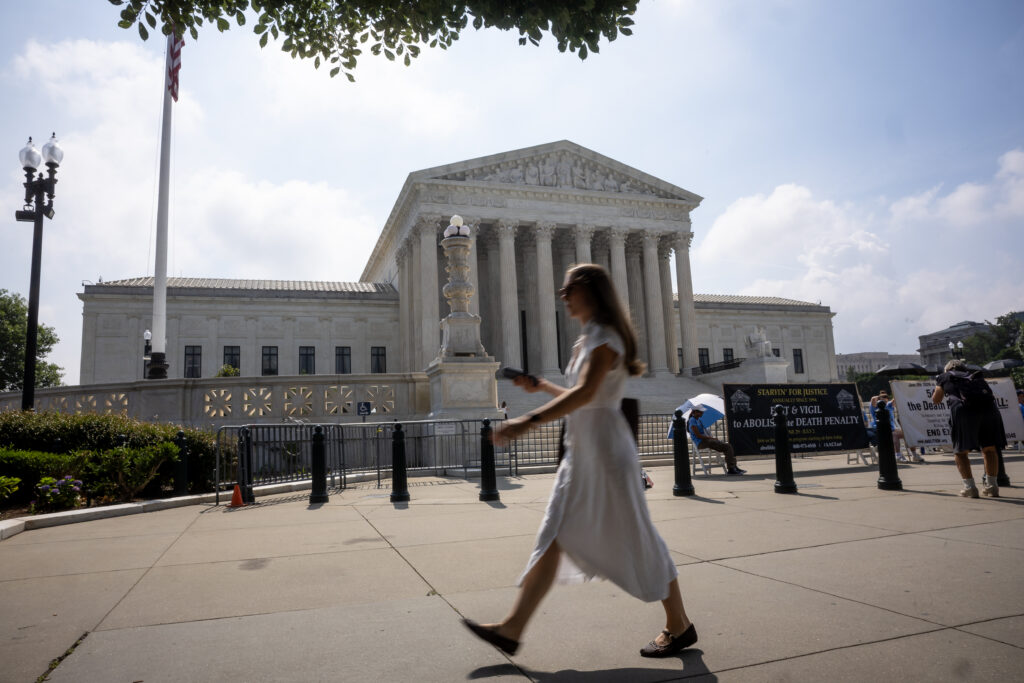
Missouri cannot use its gerrymandered map for the upcoming midterm elections after the U.S. Supreme Court refused to wade into a purely state matter.
Justice Brett Kavanaugh Tuesday denied Missouri Republicans’ appeal of a state supreme court order barring state officials from moving forward with the GOP’s new congressional gerrymander in this year’s election.
Kavanaugh’s denial ends a year-long bid by Missouri Republicans to grab another congressional seat this fall and is a major win for voters and Democrats.
The Missouri Supreme Court last week barred the state from using its new congressional map for the general election, even though it had used those districts during the primary. The redrawn maps had eliminated the Kansas City district currently held by Rep. Emanuel Cleaver (D).
However, shortly after the Supreme Court declined to intervene, a federal District Court judge revived the gerrymandered map, saying switching maps between the primary and the general election would likely violate the Constitution’s equal protection clause.
Get updates straight to your inbox — for free
Join 350,000 readers who rely on our daily and weekly newsletters for the latest in voting, elections and democracy.
Kavanaugh rejected the appeal outright, without referring it to the full Court. He did so as the justice assigned to oversee 8th Circuit Court of Appeals — the appeals circuit Missouri is in. He did not offer legal analysis for his decision.
“Today the law won,” Richard von Glahn, executive director of People Not Politicians Missouri and the plaintiff in the case, said in a statement.
“The Missouri constitution is clear as was the Missouri Supreme Court,” von Glahn added. “Over 305,000 Missouri voters, Republicans, Democrats and Independents took action to block this political power grab last fall. Today’s victory belongs to them. People, not politicians, will have the final say when they vote NO on Proposition A this November.”
Pro-voting groups* had challenged the gerrymander, fighting to put a referendum on the ballot to overturn the partisan map.
The state supreme court agreed, ruling the Missouri constitution gives voters the power to overturn any legislative act by a referendum vote, including redistricting. Under the state constitution, if citizens gather enough signatures to put a veto measure on the ballot, legislation can’t go into effect unless voters greenlight it.
The U.S. Supreme Court has historically been deferential to state supreme courts when interpreting their own constitutions. It would have been highly unusual for the high court to overrule a state supreme court in this area.
The decision ends a year-long battle over the new district maps, which were redrawn at President Donald Trump’s urging. People Not Politicians spearheaded the battle to get the referendum on the November ballot.
Secretary of State Denny Hoskins (R) had resisted the effort at every turn, slowing down the process, then arguing the state didn’t have time to revise its ballots before the midterms. Missouri’s ballots needed to be finalized by Sept. 8.
This story has been updated with additional information throughout.
*The Elias Law Group (ELG) represents pro-voting parties in this case. ELG Firm Chair Marc Elias is the founder of Democracy Docket.