Supreme Court smacks down Denny Hoskins for creating Missouri’s redistricting mess
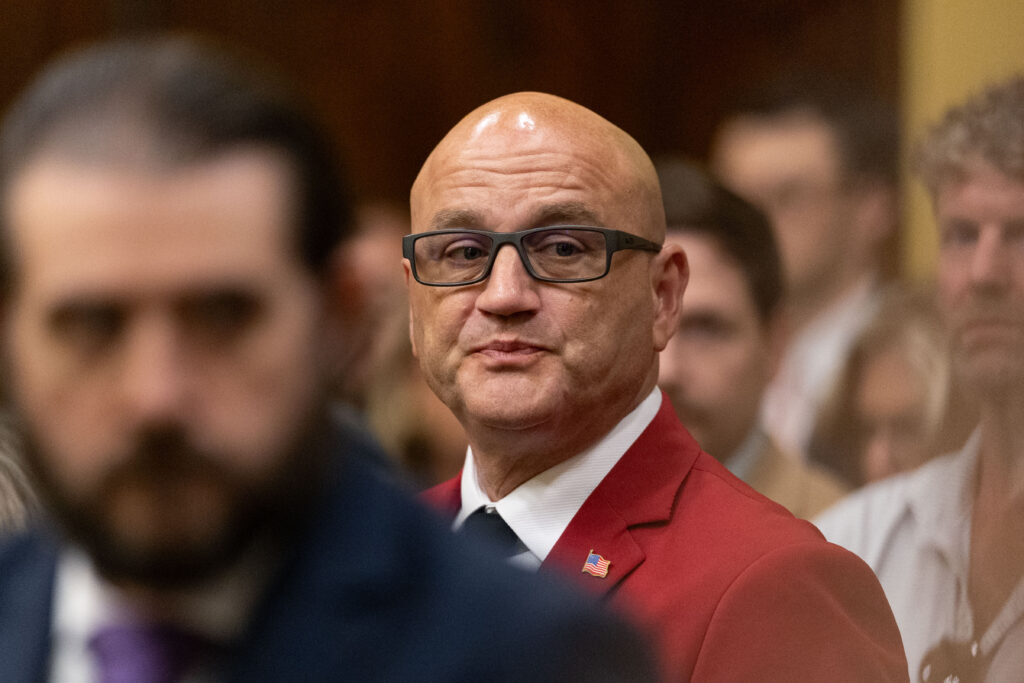
In an effort to protect the GOP’s gerrymander, Missouri Secretary of State Denny Hoskins (R) argued that changing congressional maps after the primary would plunge the state into electoral chaos.
On Friday, the U.S. Supreme Court delivered a blunt response: Hoskins knew that risk existed before the primary and chose to run the election under the disputed map anyway.
“In the several-month period before the August primary election, the Missouri Secretary of State was well aware that conducting the August primary election with the 2025 map carried significant risks,” the Court wrote. “The Secretary nonetheless chose to proceed with the 2025 map for the primary.”
That finding is an especially rough ending to a redistricting saga in which Hoskins repeatedly tried to preserve Missouri Republicans’ 2025 congressional gerrymander — only to be rebuked by the state Supreme Court, held in contempt, sued by voters and ultimately shut down by the nation’s highest court.
The basic problem was one Hoskins had months to see coming.
Get updates straight to your inbox — for free
Join 350,000 readers who rely on our daily and weekly newsletters for the latest in voting, elections and democracy.
Republican lawmakers enacted the new congressional map in 2025, targeting a Democratic Kansas City-based district. Opponents of the gerrymander responded by collecting enough signatures to force a statewide referendum on the map.
Under Missouri law, the state Supreme Court ultimately held, a measure subject to a valid referendum petition does not take effect unless and until voters approve it. The court concluded that the 2025 map “is not the law and has never been the law,” leaving the state’s 2022 congressional districts in place for November.
But Hoskins waited until Aug. 4 — the final day permitted by state law and the same day Missouri held its congressional primary — to formally reject the referendum petition. The Missouri Supreme Court later noted that he could have issued his certification much earlier and blamed his delay for the very “confusion, expense, and practical difficulties” he later cited in trying to keep the 2025 map alive.
The U.S. Supreme Court’s third ruling in the dispute Friday effectively endorsed that basic chronology.
The justices pointed out that Missouri’s high court had warned as early as May that the new map might not take effect if the referendum qualified. In other words, the possibility of different maps governing the primary and general elections was not some unforeseeable calamity that suddenly materialized in September.
Hoskins knew. He proceeded anyway.
And the consequences piled up
After the Missouri Supreme Court barred use of the 2025 map on Sept. 3, Hoskins asked Justice Brett Kavanaugh to stay the ruling. Kavanaugh denied the request.
Later, after a federal judge issued a conflicting order requiring the 2025 map, Hoskins directed local election officials to use it — despite the Missouri Supreme Court’s injunction telling him not to.
That landed Missouri’s top election official in a contempt hearing before the state’s highest court.
The Missouri Supreme Court found that Hoskins “was in contempt” for directing election officials to use the 2025 map, though it found he purged the contempt after reversing course and instructing officials to use the 2022 districts.
Then came the lawsuits.
Voters have filed proposed class actions accusing Hoskins of causing harm through his handling of the referendum. One seeks damages on behalf of referendum signers; another was brought by voters who participated in the August primary under congressional districts different from those that will govern their November ballots.
The latter lawsuit, which names Hoskins in both his official and individual capacities, specifically alleges that he deliberately delayed his referendum decision until the disputed districts had already been used in the primary. Those allegations have not been adjudicated.
Republicans tried to blame the Missouri Supreme Court
Despite that clear history, Republicans spent much of September trying to pin the election mess on the Missouri Supreme Court.
State officials told the U.S. Supreme Court that the state court’s Sept. 3 ruling “virtually guaranteed” that an orderly election would be impossible and blamed it for “substantial election-related chaos.”
Republican candidates made similar arguments, while the 8th Circuit Court of Appeals faulted the Missouri Supreme Court for a supposedly “late-breaking” decision.
The U.S. Supreme Court was not persuaded.
“Moreover, in this case, the Missouri Supreme Court was not responsible for the late-breaking changes,” the Court wrote.
The 8th Circuit went so far as to invoke the Supreme Court’s Purcell principle — which generally cautions lower federal courts against changing election rules close to voting — against the state Supreme Court.
“The Eighth Circuit’s application of Purcell was incorrect,” the Court wrote Friday. It reiterated that while federal courts should generally avoid imposing late election changes, states remain free, within federal limits, to determine whether late changes are appropriate.
And rather than blaming Missouri’s justices for the timing problem, the Supreme Court pointed directly back to Hoskins’ decision to proceed with the primary despite months of warning.
The Court was equally unimpressed with the 8th Circuit’s attempt to revive the 2025 map after the justices had already stayed an earlier order requiring its use.
Its conclusion that the appeals court erred, the Supreme Court wrote, “should come as no surprise.”
That line may be the most fitting epitaph for Missouri’s monthlong map debacle.
Hoskins spent weeks arguing that the state was trapped by a crisis created by judges. By the end, he had been held in contempt, faced lawsuits from voters over the fallout and watched both the Missouri and U.S. Supreme Courts point back to decisions he made before the crisis ever arrived.
The map fight is now over for the 2026 midterms. The mess Hoskins helped create may take a little longer to clean up.