Supreme Court blocks gerrymandered Missouri map for midterms
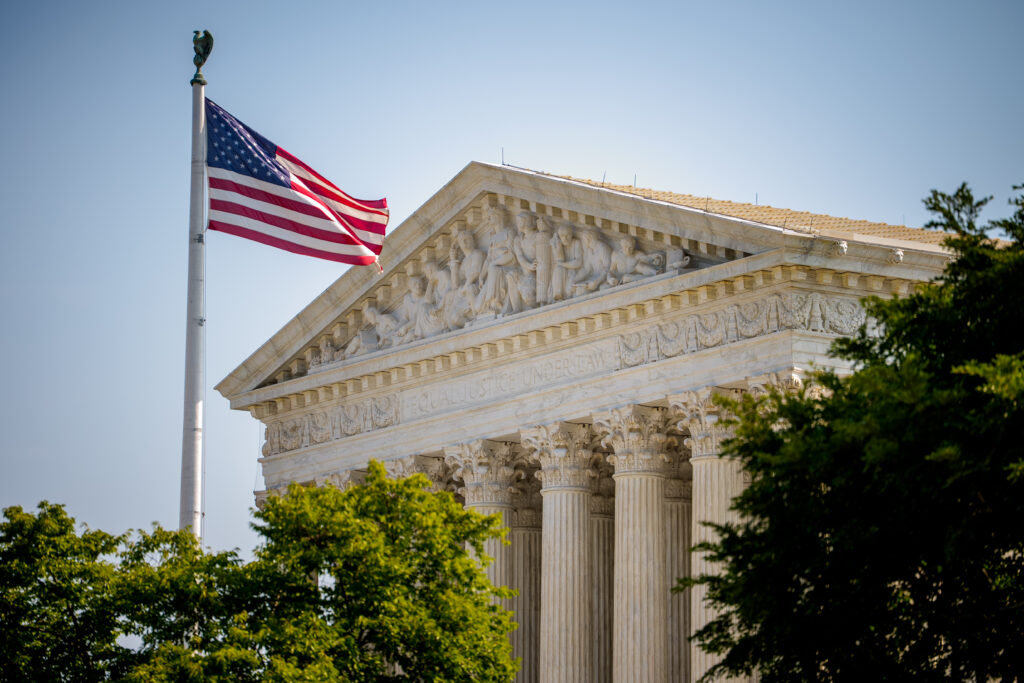
In a major win for voters*, the U.S. Supreme Court Thursday temporarily blocked Missouri’s gerrymandered map that would eliminate a Democratic district in Kansas City while legal challenges are resolved.
Justice Brett Kavanaugh’s order, which did not provide an explanation for his decision, means the gerrymander won’t be used in the 2026 midterms. And Missouri voters will have the chance to reject the map for good in a referendum this fall.
Kavanaugh’s pause remains in effect until the full U.S. Supreme Court decides whether it wants to take the case, which would likely happen when the court convenes in October.
Local election officials were caught in a bind after the Missouri Supreme Court blocked the gerrymandered map, only for a federal district court to quickly issue a separate order essentially requiring Missouri to use that map.
Get updates straight to your inbox — for free
Join 350,000 readers who rely on our daily and weekly newsletters for the latest in voting, elections and democracy.
The Supreme Court’s decision means some Missouri voters will cast ballots in different districts than they voted in during the primary.
State Republicans redrew Missouri’s congressional lines after President Donald Trump demanded new maps to boost the odds Republicans keep control over the House of Representatives in the midterm elections.
Pro-voting groups led by People Not Politicians waged a year-long campaign to put the redrawn map on the November ballot for voters to approve or reject via a referendum. The fight made its way to the state Supreme Court, which ordered that the referendum be placed on the ballot and barred the state from using the gerrymandered map, ruling that the new map “is not the law and has never been the law.”
Days later, a federal judge for the Eastern District of Missouri issued a separate ruling in a lawsuit brought by Rep. Bob Onder (R), barring the state from using any map except the gerrymander for the November elections. The judge concluded that revising the districts between the primary and general elections violated the Constitution’s equal protection clause.
After the 8th Circuit Court of Appeals declined to intervene, pro-voting groups asked the U.S. Supreme Court to step in.
“The law is the law, the Missouri constitution is clear as was the Missouri Supreme Court. Over 305,000 Missouri voters – Republicans, Democrats and Independents took action to block this political power grab last fall. People, not politicians, will have the final say when they vote NO on Proposition A this November,” Richard von Glahn, executive director of People Not Politicians Missouri, said in a statement.
Throughout the year-long battle over the new map, Missouri Secretary of State Denny Hoskins (R) had repeatedly stalled and delayed certifying the referendum. He waited until the last possible day to reject the ballot measure, only to be ordered to approve it by the state Supreme Court.
Despite that pattern of foot-dragging, Missouri Attorney General Catherine Hanaway (R) tried to argue to the U.S. Supreme Court that it was too late to intervene and change maps because the state had a Sept. 8 deadline to finalize its ballots.
“Whereas the District Court’s ruling came before Missouri’s state-law deadline to alter ballots, a stay from this Court would come after that deadline,” the state had argued, noting it has only nine days left before ballots must be sent out.
Amid the conflicting court orders, Hoskins had cited the district court’s ruling to tell local election officials to move forward with the gerrymandered map. He was ordered to appear before the Missouri Supreme Court Thursday for a hearing to determine whether he should be held in contempt of court for ignoring the judges’ order barring use of that map.
*The Elias Law Group (ELG) represents pro-voting parties in this case. ELG Firm Chair Marc Elias is the founder of Democracy Docket.