The Supreme Court could use the ‘Purcell principle’ to save Trump’s attack on mail voting. But will it?
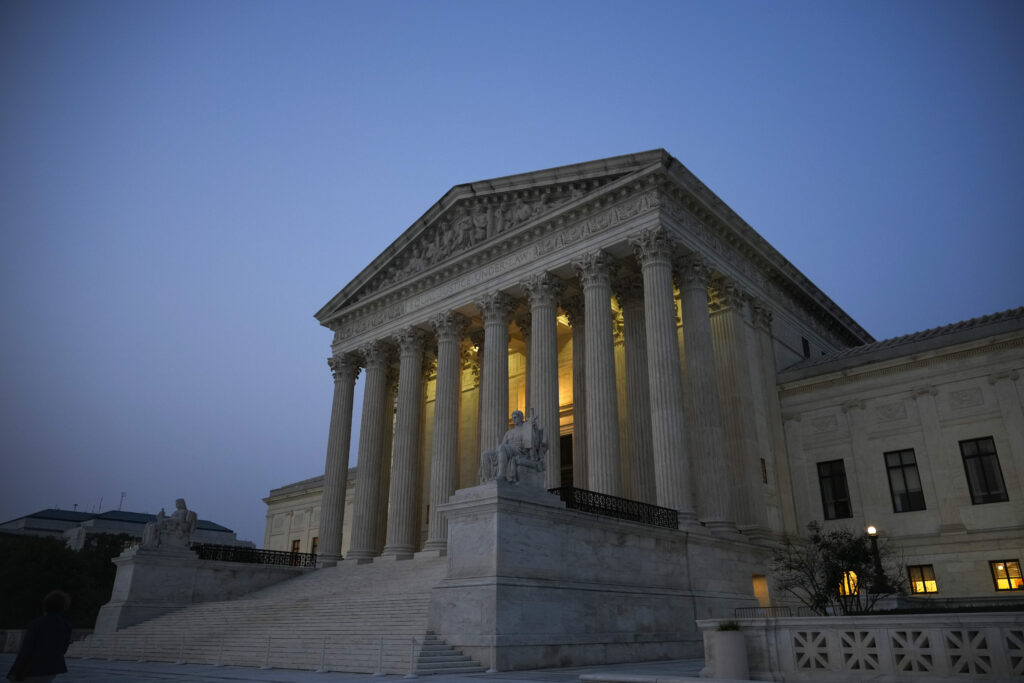
Election Day is just under two months away. But voters still don’t know for certain whether they will be able to cast their ballots by mail. That question is now in the hands of the U.S. Supreme Court.
Many observers believe the law here is clear: The executive branch has no constitutional power over elections. That means the justices should leave in place a federal judge’s order barring the U.S. Postal Service (USPS) from implementing President Donald Trump’s executive order attacking mail voting.
But were they to rule otherwise, it wouldn’t be the first instance of this Supreme Court surprising legal experts with a novel justification that just so happens to support the Republican Party’s favored outcome.
In voting cases, that justification has often been rooted in a short, unsigned emergency docket decision from 20 years ago, Purcell v. Gonzalez.
If the Supreme Court lifts the preliminary injunction U.S. District Judge Indira Talwani issued in State of California v. USPS, it may rely on Purcell to rationalize the chaos that decision would unleash. And, in doing so, the justices would prove their critics right by stretching the precedent’s already-overextended precepts far beyond the limits of logic.
That decision would be all the more gobsmacking given that the federal government argued — and the Supreme Court agreed — just weeks ago in the same case that it was too soon for plaintiffs to challenge the Trump administration’s attempts to undermine mail voting.
Purcell for me, but not for thee
“Court orders affecting elections… can themselves result in voter confusion and consequent incentive to remain away from the polls. As an election draws closer, that risk will increase.”
From those two short lines in a five-page decision, a sweeping — and heavily criticized — legal doctrine has grown. Dubbed the “Purcell principle” by UCLA law professor Rick Hasen, the concept has evolved in recent years from a principle of judicial humility to a controversial jurisprudential tool that, critics say, lets the Supreme Court’s conservative majority put its thumb on the electoral scale for Republicans.
For his part, Hasen doesn’t think the justices will rely on Purcell in the executive order litigation, noting that the DOJ did not raise that argument in its application to the Court.
“The main question is whether the law allows USPS to make these changes and if the equities weigh against a 2026 rollout” of the mail voting rule, Hasen told Democracy Docket in an email. “There, the Court will look at the harm the USPS and government would face if there was a delayed rollout against the election administrators’ impossibility of complying at this late date with the new USPS requirements and the serious risk of mass voter disenfranchisement.”
Moreover, the Supreme Court’s partisan record on voting matters isn’t entirely one-sided. Just this June, Justices Amy Coney Barrett and John Roberts joined the Court’s three Democratic appointees to reject a GOP-led attack on counting late-arriving mail ballots.
And no matter what the Court decides to do with the administration’s mail ballot meddling, there is no guarantee it will explain itself. If it issues a summary order, it will leave observers to wonder whether it considered Purcell — or any other precedent — in reaching its decision.
Get updates straight to your inbox — for free
Join 350,000 readers who rely on our daily and weekly newsletters for the latest in voting, elections and democracy.
But a recent spate of seemingly contradictory rulings has fueled criticism that the justices have selectively deployed the doctrine, turning it into a double standard.
“The justices have made it remarkably difficult to believe that Purcell is doing any real work as a neutral rule of judicial restraint—as opposed to functioning, in practice, as a one-way ratchet,” Georgetown Law’s Steve Vladeck wrote earlier this year.
While the Court invoked Purcell to reverse a lower court’s order that blocked a gerrymandered map from coming into effect six months before Texas’ primary elections in one case, it later stepped in to allow Louisiana to change its congressional maps just days before the state’s own primaries.
While the Supreme Court has cited Purcell with some regularity, it has never fully articulated what it means. That is, in part, because it so often comes up on so-called “shadow docket” cases that the Court decides in hastily written, short opinions — if they explain their reasoning at all.
This has led critics to say Purcell is no principle at all, but rather a weak excuse to engage in partisan politics that fails to further its own stated goal of avoiding “voter confusion” that discourages voting. As Wilfred Codrington, a professor at Cardozo Law, noted in a 2021 NYU Law Review article, when the Court has invoked Purcell, it has tended to actually depress turnout.
Still, a more generous read of the Purcell principle remains, Vladeck noted in a recent blog post.
“[T]he only thread that unites every single application (or not) of Purcell to date is that the relevant change in election rules came from a local or state government—not the United States,” Vladeck wrote.
Rather than viewing Purcell as a protocol against judges tinkering with voting rules too close to Election Day, that position frames Purcell as a principle of federalism — the concept of splitting power among the federal and state governments.
That means it’s up to state courts, not federal courts, to stop state administrators or lawmakers from imposing illegal electoral rules. The U.S. Constitution itself provides states with the primary role in determining the “Times, Places and Manner” of holding elections, subject to congressional supervision.
“The Supreme Court has never previously been asked to apply Purcell where the election-related rule blocked by a lower federal court came from the federal government,” Vladeck wrote. “Going back to Purcell itself, every single application of Purcell by the Supreme Court over the last 20 years has involved a lower-court injunction against a state (or local) directive.”
“By that logic, it ought to be obvious that Purcell would (and should) not likewise constrain federal courts reviewing election procedures grounded in federal statutes and rules—because there is no federalism concern pressuring the federal courts to stay their hand,” Vladeck added.
And that magnanimous understanding of Purcell would fall apart if the Supreme Court decided to lift the preliminary injunction on USPS’s final rule in State of California v. USPS, in which a coalition of 24 states and Washington, D.C., are asking federal courts to block a federal rule.
That distinction matters, Vladeck argues, because plaintiffs can’t realistically turn to state courts to block federal laws.
“Applying Purcell to the federal government would close the doors of every courthouse, leaving voters without any remedy for even the most nefarious, malicious, or otherwise blatantly unlawful last-minute federal interventions in elections,” he wrote.
Justice Brett Kavanaugh bolstered the pro-federalism reading of Purcell Tuesday, when he declined to grant a stay of a Missouri Supreme Court injunction blocking a pro-GOP gerrymander from going into effect. Missouri Republicans had requested that stay in an emergency application.
As Vladeck notes, Kavanaugh has repeatedly described Purcell in explicitly federalist terms. “Federal district courts ordinarily should not enjoin state election laws in the period close to an election,” the justice wrote in one 2022 decision.
Since litigation to block USPS’s rule has advanced, it has become increasingly clear that the context of the original Purcell decision two decades ago is now inverted here: Allowing the rule to stand means unleashing chaos on the eve of the vote, while blocking it helps ensure a more stable, straightforward election.
And the fallout from the Court invoking Purcell to uphold Trump’s mail voting restrictions would be enormous — and would extend far beyond this executive order.
It wouldn’t just validate Purcell’s critics and its detractors at large. It would also all but bless the most egregious actions to undermine free elections that Trump has floated this year — from sending federal agents to the polls to conducting an illegal federal takeover of elections.