Supreme Court revives DHS use of flawed immigration database for voter purges
 Prefer us on Google
to see more of our voting rights news coverage when you search.
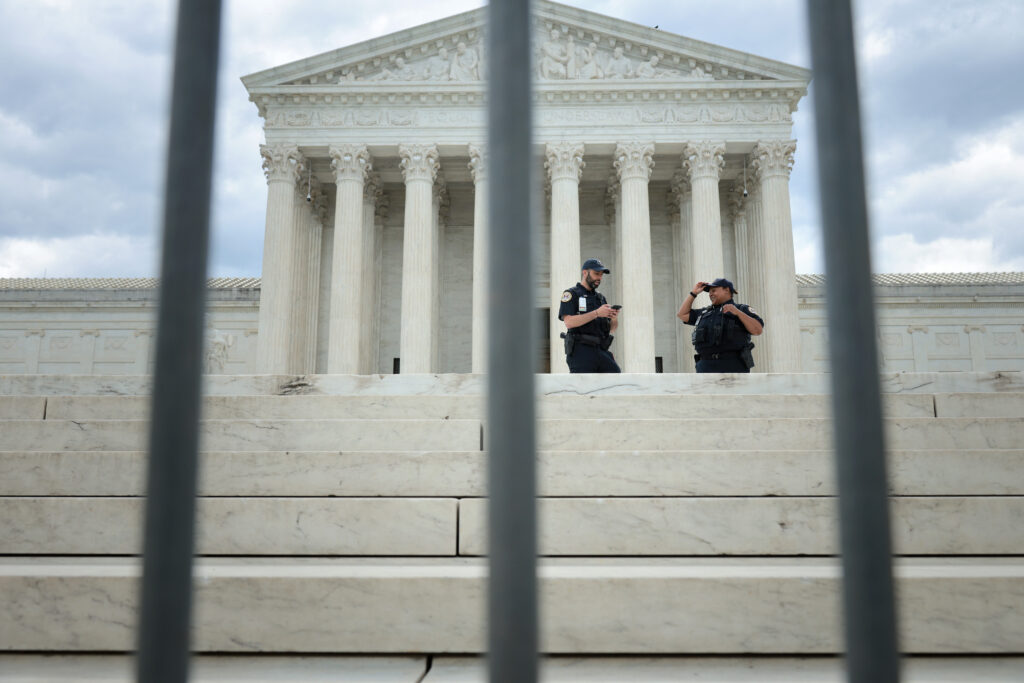
In a dangerous decision for voters, the Supreme Court authorized the Trump administration to overhaul a federal immigration database into a vast, centralized and deeply flawed database of Americans’ personal information to initiate registration purges.
The decision lets the administration move forward with a key provision of President Donald Trump’s 2025 anti-voting executive order, much of which courts have permanently blocked.
At least five of the Court’s Republican-appointed justices lifted a lower-court order that found the Department of Homeland Security’s (DHS) modification and use of the Systematic Alien Verification for Entitlement (SAVE) system “trampled on the privacy rights of American citizens in a manner that threatens the sacred right to vote.”
Get updates straight to your inbox — for free
Join 350,000 readers who rely on our daily and weekly newsletters for the latest in voting, elections and democracy.
The majority’s opinion gave short shrift to the danger of eligible voters, especially naturalized citizens, being wrongly removed from the rolls — a concern highlighted by Justice Ketanji Brown Jackson in her dissent.
“[T]he harm caused by burdening or disenfranchising even a few lawful voters outweighs the nonexistent harm that the Government experiences when it is prevented from taking an action that it likely lacks the authority to take,” Jackson wrote, joined by Justices Sonia Sotomayor and Elena Kagan.
The decision Friday marks a significant loss to voters — particularly naturalized citizens, who have been disproportionately falsely flagged as ineligible voters when states have fed their registration lists into SAVE.
It also deals a blow to voting and privacy groups challenging DHS’s overhaul of SAVE as a violation of federal privacy laws and an unconstitutional attempt to usurp states’ authority over elections.
SAVE has existed for decades as a tool that lets states check the immigration status of people applying for government benefits.
However, in the 2025 executive order, Trump directed DHS to transform the database into a sweeping tool to vet state voter rolls.
The Supreme Court granted the Department of Justice’s (DOJ) request to stay the lower-court ruling even though a coalition of voting and privacy advocates led by the League of Women Voters warned that SAVE was never designed to check voter eligibility and, when used this way, will erroneously flag eligible voters as noncitizens.
“Today’s decision is profoundly disappointing, as it puts millions of Americans at risk of being unlawfully targeted by the administration’s unreliable voter purge database weeks before the midterm elections,” the coalition said in a statement. “However, this case is not over. The D.C. district court ruled that the expanded SAVE program violated multiple laws.”
“We will be doing everything in our power to protect Americans’ voting and privacy rights by ensuring that the district court decision stands,” it added.
“Today’s Supreme Court ruling is an outright attack on the sacred right to vote, undermines critical privacy protections, and will lead to demands to purge eligible voters from the rolls,” Democratic National Committee chair Ken Martin said in a statement, adding: “Trump and his lackeys are doing everything they can to suppress the vote — from redrawing district lines and attacking voting rights to purging eligible voters and spreading debunked conspiracy theories.”
The D.C. Circuit Court of Appeals denied the administration’s emergency request to pause the lower court’s injunction earlier this month.
Currently, federal law bars states from conducting systematic voter purges, as the country is within what’s known as the “quiet period” — a 90-day window before an election when the National Voter Registration Act forbids systematic removals from the registration lists.
However, the DOJ has argued that the quiet period does not prevent states from removing individual voters from their rolls before an election if the federal government flags those people as suspected noncitizens.
The modifications to SAVE that Trump demanded included incorporating huge amounts of Americans’ personal data — including from the Social Security Administration (SSA), the Department of State and other agencies across the federal government — into the system.
In her dissent, Jackson said the inclusion of Social Security numbers in the modified SAVE system explicitly violated confidentiality requirements in the law that created the SSA.
“Nothing,” Jackson wrote, “authorizes the modified SAVE system or overrides the provisions of the Social Security Act and the Privacy Act that Respondents say the Government has violated. And the Government puts forward no nonforfeited arguments that the modifications to SAVE in fact complied with the Social Security Act’s confidentiality provision.”
Democracy Forward*, which represents the coalition in the case, vowed in a statement to “continue using every legal tool available to protect voters, safeguard their privacy, and defend our democracy.”
“We are deeply disappointed by today’s decision, but this case is not over yet,” Democracy Forward President and CEO Skye Perryman said. “The Trump-Vance administration’s overhaul of the SAVE system threatens Americans’ privacy and their fundamental freedom to vote.”
Recent state uses of the modified SAVE system indicate it has a significantly high error rate in verifying voter eligibility. When Texas became the first state to use it last year, it said the system identified “2,724 potential noncitizens” on its voter registration list.
However, in subsequent investigations, county officials confirmed that at least 578 of those people were citizens, an error rate of at least 21%. That means that one in five people identified by the system were ultimately citizens who could have been de-registered — and therefore disenfranchised — through no fault of their own.
Despite SAVE’s alarming error rate, Texas Attorney General Ken Paxton urged the Supreme Court in a filing to allow the Trump administration’s work on the system to continue, claiming that it had been“transformational” for the state’s ability to administer elections.
While the DOJ has asserted that SAVE is legal because it’s a voluntary tool, DHS leadership has attempted to force states to run their voter rolls through it by conditioning federal disaster and anti-terrorism funding on the database’s use.
In fact, earlier this year, Homeland Security Secretary Markwayne Mullin threatened election officials with criminal charges if they don’t use SAVE.
“The states who choose not to participate with the SAVE program and they choose not to participate in secure elections, we will make sure that we make those states a priority to look at who voted in their states and will hold them, the election officials, accountable,” Mullin said.
DHS officials walked back Mullin’s threat in private meetings, saying the department does not have the statutory authority to charge state election officials.
In a case unrelated to the SAVE database but connected to the Trump administration’s use of personal data to increase the executive branch’s control over elections, the State Department told a federal court this week that it will start sharing passport records with unspecified federal agencies “for the purpose of verifying the identity or citizenship for users accessing government websites and applications, voter eligibility, and other governmental services.”
This story has been updated with additional details throughout.