Desperate Trump threatens Thune amid unwavering Senate resistance to SAVE America Act
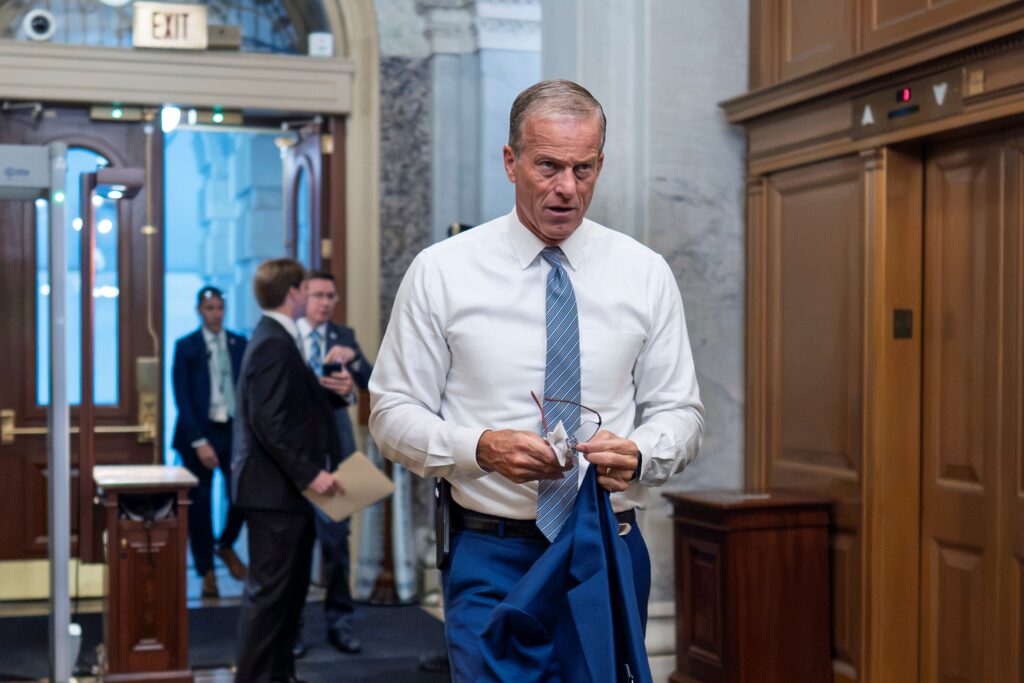
Senate Majority Leader John Thune (R-S.D.) appears to be calling President Donald Trump’s bluff as the White House doubles down on political threats to get parts of his sweeping anti-voting agenda into law.
For most of 2026, Trump has doggedly demanded that Congress pass the SAVE America Act, which would impose voter ID and documentary proof of citizenship requirements, ban no-excuse mail voting, block transgender athletes from competing in women’s sports and restrict gender-affirming care for minors. And for most of 2026, the Senate has refused, even after weeks of floor debate, with a handful of Republicans joining all Democratic and Independent Senators in opposition.
Trump has made all sorts of threats over the preceding few months. In March, Trump swore he wouldn’t sign any other bills unless Congress sent the SAVE America Act to his desk first. Later, he told Republicans to refuse any deals to reopen the then-shutdown Department of Homeland Security. He claimed he would enact the law unilaterally, via an executive order. Trump demanded Republicans kill the filibuster or fire the Senate parliamentarian, who blocked the anti-voting legislation from being included in the budget bill. He promised to never endorse a SAVE America Act opponent, and threatened to sabotage a bipartisan housing bill unless the Senate saved SAVE from the legislative dustbin.
And now he’s taking square aim at Thune, who has consistently maintained that the proposal doesn’t have enough Republican support to pass — not even using budget reconciliation to bypass the filibuster’s 60-vote threshold and pass legislation with a simple majority.
Trump suggested to reporters Wednesday that Thune might not be the right man to lead Senate Republicans. “We will find out, and I will let you know,” Trump said.
The House passed a $95 billion reconciliation framework last week that included $10 billion over 10 years for a grant program for states that implement elements of the SAVE America Act’s election provisions. That resolution — if passed by the Senate — only initiates the lengthy reconciliation process by directing lawmaking committees to draft spending proposals to be included in a final package.
But Thune has said that using reconciliation again — Republicans have already passed two reconciliation bills this year — for SAVE America is a nonstarter. That hasn’t stopped the Trump administration from pressing.
Get updates straight to your inbox — for free
Join 350,000 readers who rely on our daily and weekly newsletters for the latest in voting, elections and democracy.
At a luncheon with Senate Republicans Wednesday, a White House team led by Office of Management and Budget Director Russell Vought sought to sell the caucus on passing the reconciliation package. But as multiple news outlets reported, GOP senators told Trump’s emissaries that Trump’s preoccupation with the SAVE America Act was hurting the party’s chances in November. If the Senate includes election-related provisions in the third reconciliation bill, it would allow Democrats to force more votes on politically fraught amendments during a process known as “vote-a-rama.”
“I think we all hate vote-a-rama,” Senate Budget Chair Ron Johnson (R-Wisc.) told Politico. “Some people are more sensitive to the kind of votes they have to take.”
Senate Republicans have just one week before they are scheduled to leave Washington, D.C. for recess until mid-September. If the chamber doesn’t pass the reconciliation framework now, it will be exceedingly difficult to get the bill across the finish line in the three legislative weeks left on the calendar before Congress takes off most of October for campaigning before the midterms.
Senate Republicans aren’t even sold on the rest of the spending package adopted by the House last week, which would provide $85 billion for funding for the Iran war and bailouts for farmers hurt by Trump’s tariffs. The plan doesn’t call for offsetting spending cuts or revenue boosts, even as the U.S. national debt nears $40 trillion.
The White House’s push to add another $95 billion to the deficit without any pay-fors comes as federal borrowing costs have spiked, in part because the bond markets have begun to question the Federal Reserve’s commitment to tamping down inflation since Trump appointed Kevin Warsh to lead it.
Sen. Lisa Murkowski (R-Alaska) told reporters she didn’t like the idea of another reconciliation bill this year — let alone the two proposed by some of her colleagues.
Compounding the GOP difficulties is Sen. Mitch McConnell’s (R-Ky.) prolonged absence from the Capitol as he recovers from a fall last month. It’s unclear when the 84-year-old lawmaker might return, leaving the GOP with only 52 votes. That means that just three Republican defections — assuming unanimous Democratic and Independent opposition — would sink any reconciliation bill.
And it appears there already are three GOP no votes on SAVE.
In addition to Murkowski’s opposition, Sen. Thom Tillis (R-N.C.) has sworn to block any attempt to pass the SAVE America Act ahead of the 2026 midterms. And Sen. Susan Collins (R-Maine), who faces a tough reelection battle this fall, voted against adding a version of the SAVE America Act to the last reconciliation Republicans enacted in June.
Senate Republicans’ reticence comes as Trump’s ratings fall to new lows. A Quinnipiac University poll released Wednesday found only 32% of voters approved of Trump, a new low. And in a CNN poll that same day, 50% of voters said they strongly disapprove of Trump, while only 15% strongly approve — both record levels — and his approval rating among Republicans also hit a new low, with just 78% support and only 19% of Republicans saying they are enthusiastic about the rest of his term.
Beyond the MAGA base, no voters are yearning to see SAVE. In poll after poll, Americans say the economy and inflation are the top concerns; Trump’s obsession with SAVE undoubtedly contributed to CNN’s pollsters finding that 73% of U.S. adults believe he hasn’t focused on the country’s most important issues.
Even among the 24% of voters that list “elections and democracy” among their top three issues, it’s the anti-SAVE Democrats they trust more to handle the issue, according to Strength in Numbers/Verasight polling. When asked in July which party you trust to handle the issue, 46% said they preferred Democrats, compared to 36% who said Republicans.
While a recent Gallup poll found that large majorities of Americans are worried the upcoming elections might be marred by irregularities, concerns about what Trump might do outweighed those about non-citizen voting. The largest fear, with 67% of Americans saying they were concerned “a great deal” or “a fair amount,” was that political leaders might pressure election officials to change election outcomes — which Trump notoriously did in 2020 when he asked Georgia Secretary of State Brad Raffensperger (R) to “find 11,870” votes.
In his comments to reporters this week, Thune highlighted how Republicans’ intraparty squabble over SAVE was undermining the party’s political messaging as the midterms rapidly approach.
“What we’ve got to do is just make the overarching narrative one that has us drawing contrast with our Democrat opponents rather than us shooting each other,” Thune told Politico.
Even if Thune could finagle 50 aye-votes, it’s unclear whether the plan would even work.
By turning the SAVE America Act’s dictates into conditions on federal grants, supporters hope it will survive a Senate “Byrd bath,” the procedure for stripping non-budgetary measures out of reconciliation bills. But budget experts have said that’s unlikely to work.
Even if it did, Thune has questioned whether whatever emerged would appease Trump. “I think the question at the end is, is that going to be satisfactory to him?” Thune told Politico.
And Axios reported that some Republicans told Vought Wednesday that the reconciliation bill’s election-related provisions wouldn’t take effect in time to impact the November midterms, as Democracy Docket has previously noted.
As they’ve advocated for the SAVE America Act, Trump and his allies have repeatedly promoted lies about alleged widespread illegal voting, even though multiple studies and voter registration roll audits show that exceedingly few noncitizens even attempt to register, let alone actually vote. It is illegal for noncitizens to cast ballots, and those who do face prison time and deportation. As such, DPOC and voter ID rules would burden nearly every voter in a bid to prevent the minuscule amount — 0.000007% by some estimates — of votes cast by noncitizens.