Why the GOP’s newest plan to pass SAVE America Act is DOA
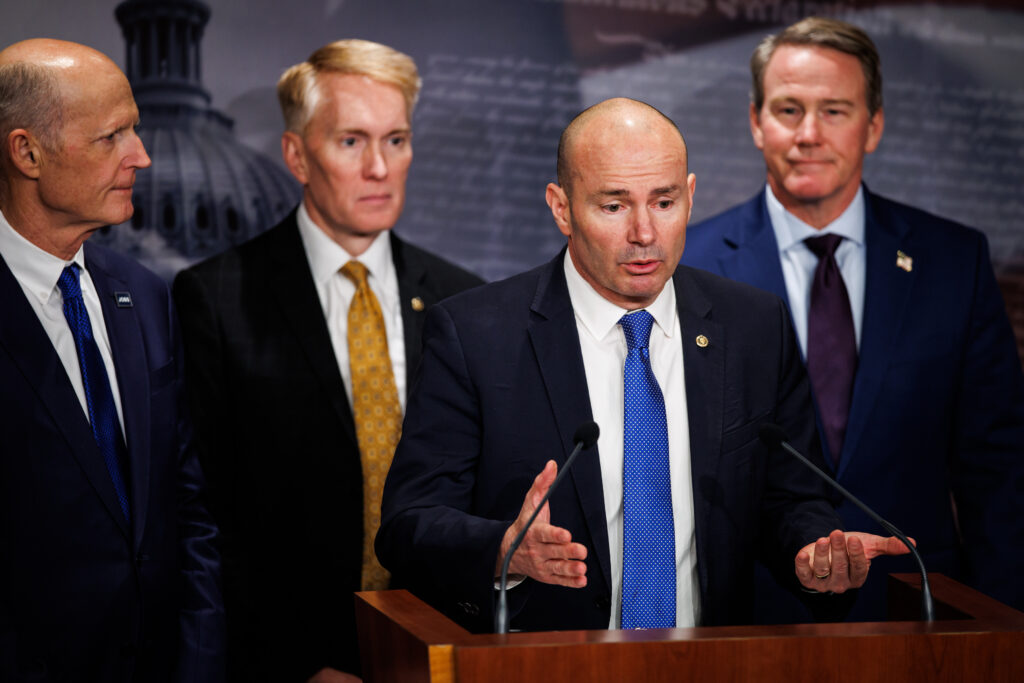
Republican senators reportedly sold the White House on a plan Monday night to pass the SAVE America Act through a reconciliation package after enacting a funding bill for most of the Department of Homeland Security (DHS), which has been shut down for over a month now.
President Donald Trump has repeatedly urged Senate Republicans to pass the SAVE America Act, calling it his “Number 1 priority,” and opposing efforts to reopen DHS first, even though the bill lacks the support needed to clear Democratic opposition. So, now lawmakers are floating a new plan: attach the SAVE America Act to a reconciliation bill, which would only need 50 votes to clear the Senate instead of the 60 required to end a filibuster.
The only problem? It wouldn’t work.
“I can’t see the SAVE [America] Act passing muster,” said Matt Glassman, a senior fellow at Georgetown University’s Government Affairs Institute.
And the bill’s biggest backers all agree.
Get updates straight to your inbox — for free
Join 350,000 readers who rely on our daily and weekly newsletters for the latest in voting, elections and democracy.
“It’s hard to imagine how the SAVE America Act could be passed through reconciliation,” tweeted Sen. Mike Lee (R-Utah), the act’s sponsor. “And by ‘hard’ I mean ‘essentially impossible.’”
“No chance the SAVE America Act can survive reconciliation. This is a classic rug pull operation designed to get support for a shoddy deal in exchange for a bogus future promise that will not pan out,” posted Sean Davis, founder of the right-wing outlet The Federalist. “Republican senators should reject this silliness.”
And the bill’s sponsor in the House, Rep. Chip Roy (R-Texas) quoted Davis’ post, adding “Agree. And if they think we do it on suspension to set up a reconciliation play… that will not go well.”
Congress has faced growing pressure to end the partial government shutdown as airport security lines have lengthened due to unpaid Transportation Security Administration agents calling out sick or quitting. Trump appeared to shoot down a proposal to separate funding for Immigrations and Customs Enforcement and pass the remainder of the DHS budget Sunday, before reportedly agreeing to the reconciliation plan.
Lee has urged GOP leadership in the Senate to pass the SAVE America Act, which passed the House in February, by forcing Democrats to hold a “talking filibuster,” which would allow a vote on the bill once every opponent had a chance to speak, twice, against every motion on the floor. But such an effort would eat up months of the Senate’s calendar, and so far Senate Majority Leader John Thune (R-S.D.) has resisted. Likewise, Senate Republicans are unwilling to scrap the filibuster entirely.
Reconciliation is one of the few exceptions to the Senate’s filibuster rule, which requires 60 votes to end debate on a bill or motion on the chamber floor, and perhaps the most complicated. For certain fiscal measures, the Senate and House budget committees can issue reconciliation instructions to other committees to develop legislation with specific impacts on mandatory spending, revenues, or the debt limit.
The problem with using reconciliation, Glassman said, is “the Byrd rule.”
Named after its primary sponsor, Senator Robert C. Byrd, the Byrd rule amended the Congressional Budget Act to add limits on the kinds of legislation that can be passed via reconciliation. Senators can challenge provisions in a reconciliation package for various reasons, including if they don’t produce budgetary effects or if those budgetary effects are merely incidental to the policy change. If the Senate Parliamentarian — a nonpartisan congressional employee — agrees, those provisions are removed unless there are 60 votes in the Senate to waive the Byrd rule finding.
That would doom the SAVE America Act’s provisions, which would require voters to provide documentary proof of citizenship (DPOC) when they register and voter identification when they cast a ballot. Trump has also called for amendments to the bill that would ban universal mail-in ballots, trans athletes competing in women’s sports and gender-affirming care for minors. None of those are budgetary.
The GOP could try getting around a Senate “Byrd Bath” by changing the SAVE America Act’s dictates into prerequisites for federal funding by, for example, conditioning election assistance grants on states imposing DPOC requirements. But such legislative sophistry would probably fail, said Glassman.
“Finding a workaround to tie it to budgetary related matters would be unlikely to pass muster,” said Glassman. “And I suspect would also have trouble finding the political support, given that people would see it as blowing a massive hole into the Byrd rule that effectively killed it.”
And while the Senate ultimately could disregard the Senate parliamentarian’s finding, Glassman doubts the GOP would be willing to do that, which would be tantamount to ending the filibuster all together. “Nor do I see a majority for overruling or endrunning the parliamentarian’s advice by having the chair ignore it,” he said.
The Senate has been debating the SAVE America Act for a week now without any sign of stopping. The measure’s proponents argue it’s needed to ensure noncitizens cannot vote, even though there is no evidence of unnaturalized immigrants intentionally casting ballots in significant numbers. Meanwhile, opponents note that the millions of voters who lack easy access to a passport or birth certificate for providing DPOC could be disenfranchised if it’s enacted.
Jacob Knutson and Yunior Rivas contributed to this report.