Johnson says House will pass stalled SAVE America Act ‘one more time’ after latest Trump demands
 Prefer us on Google
to see more of our voting rights news coverage when you search.
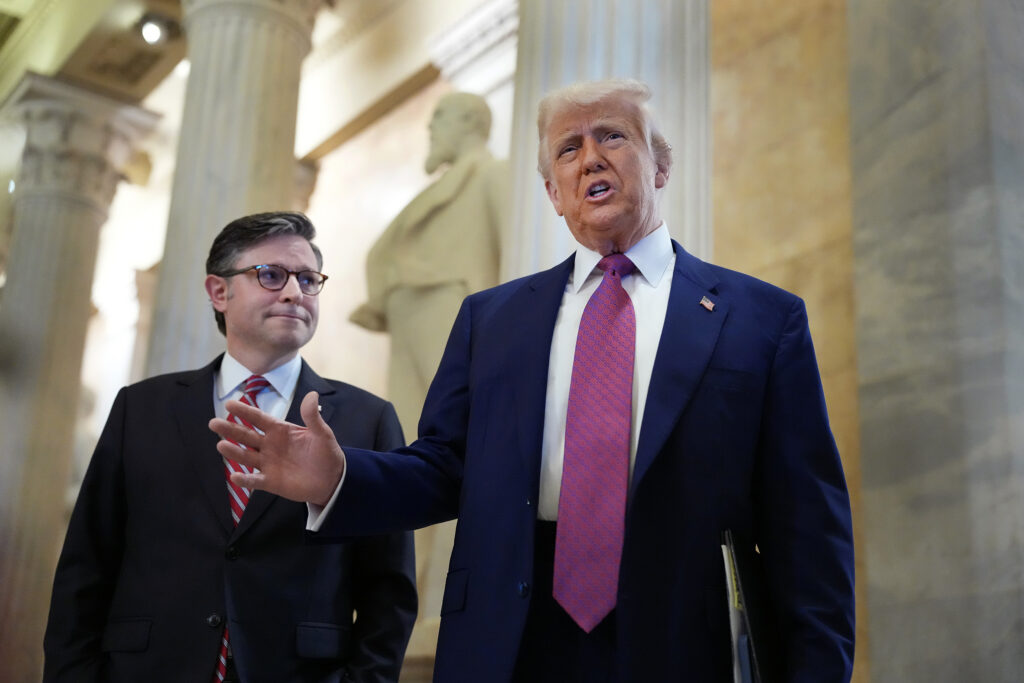
Caving to MAGA hardliners, Speaker Mike Johnson (R-La.) said the U.S. House will pass the SAVE America Act, President Donald Trump’s massive voter suppression bill, “one more time” through a budget reconciliation process.
“The big urgency is to get SAVE America passed,” Johnson told Fox News Sunday. “The president has that as a top priority, and so do I.”
His announcement came a day after Trump used his Independence Day speech to again call for the bill’s passage, presenting it as a means to end nonexistent election fraud. But the bill has repeatedly stalled in the U.S. Senate — and still appears to lack the votes to pass.
Johnson’s approach would attempt to overcome that problem by including the SAVE America Act in a budget reconciliation bill. That “will be the way to get it through the Senate and finally to the president’s desk,” he said.
Get updates straight to your inbox — for free
Join 350,000 readers who rely on our daily and weekly newsletters for the latest in voting, elections and democracy.
But despite the speaker’s confidence, the reconciliation push would almost certainly fail in the Senate because the chamber has strict rules about what can be included in budget bills.
It wouldn’t be the first unsuccessful attempt to ram the bill through.
In recent weeks, far-right lawmakers have paralyzed the House floor through a legislative blockade in support of the bill.
Meanwhile, Trump has relentlessly pressured congressional Republicans to get the voter suppression package to his desk in time for the upcoming midterm elections, as he’s said he believes it will improve the GOP’s slim chances of retaining control of the House.
The president reiterated these demands during the celebration of the U.S.’ 250th anniversary in Washington, D.C., Saturday, saying, “We want to keep America great, and we will do so by approving the SAVE America Act.”
“All voters must show voter ID. All voters must provide a little thing called proof of citizenship. And there will be no mail-in ballots except for illness, disability, military deployment or travel,” Trump added. “And you won’t have cheating on the elections anymore. It’s very simple.”
If it became law, the SAVE America Act would be the most restrictive anti-voting legislation ever passed by Congress. It would likely result in millions of Americans — Republicans and Democrats alike — losing the ability to vote because they are unable to provide proof of citizenship documents or photo identification.
Last week, a small contingent of conservative hardliners led by Rep. Anna Paulina Luna (R-Fla.) forced Johnson to call an early holiday recess by hijacking the House’s agenda in an effort to pressure the speaker to take up the SAVE America Act.
While acknowledging his early decision to take a recess, Johnson downplayed heightened tensions within his party over the bill, saying House Republicans will be unified on the reconciliation push when the House returns from recess next week.
“I just decided it was best to send everybody home to go celebrate July Fourth in their districts,” Johnson said. “We’ll come back, gather everybody together.”
If the SAVE America Act passes as part of a reconciliation bill, it would be the House’s fourth time passing some form of the voter-suppression package in recent years.
Like their previous attempts to pass the bill, House Republicans’ reconciliation push would almost certainly die in the Senate.
That’s because while reconciliation packages are shielded from the typical Senate filibuster and can pass with a simple majority, the Senate parliamentarian, the chamber’s legislative umpire, would strip the act from a reconciliation package for failing to pertain to the budget.
In fact, during the GOP’s last reconciliation push earlier this year, the parliamentarian objected to including the act in a previous budget bill. Trump, in turn, demanded that Senate Republicans fire the parliamentarian.
Frustrated by inaction on the SAVE America Act, Trump has also threatened to derail the GOP’s legislative agenda.
Last month, he refused to sign a bipartisan housing affordability bill — one of the Republican-controlled Congress’s few accomplishments — unless it was paired with the voter suppression bill. He’s also held up a critical intelligence nomination and the reauthorization of a key surveillance tool over the bill.