Mississippi election chief blames local officials for voter purge chaos amid razor-thin Senate race. They’re pushing back
 Prefer us on Google
to see more of our voting rights news coverage when you search.
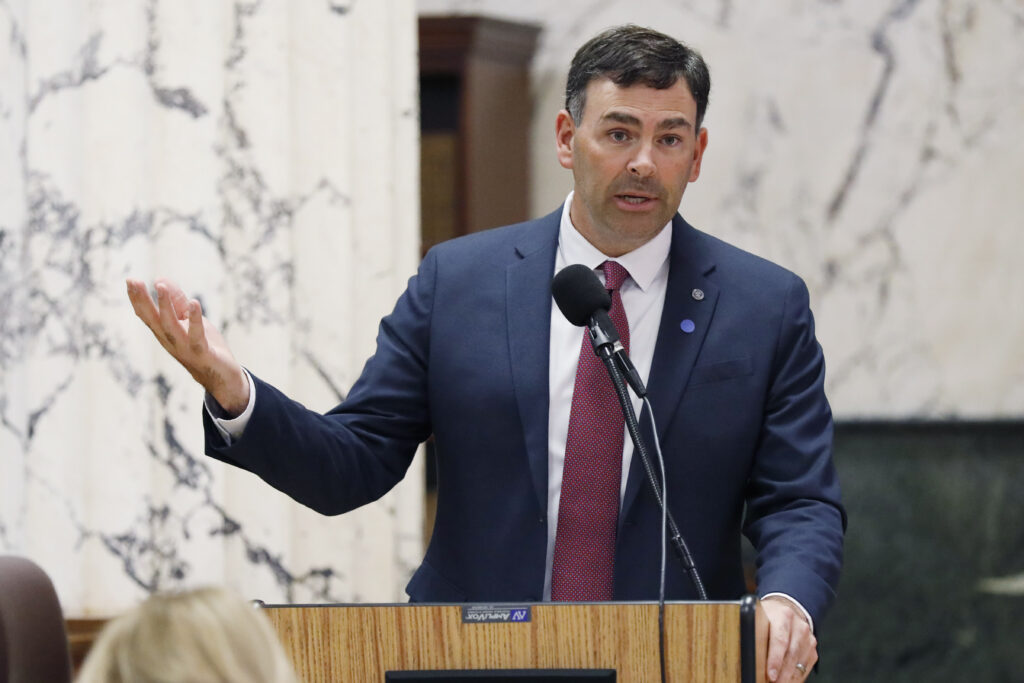
Mississippi Secretary of State Michael Watson (R) defended his office’s controversial voter purge program Monday, insisting it is working as designed despite widespread problems that forced thousands of voters to cast affidavit ballots.
Watson shifted responsibility for the state’s voter roll woes to county election commissioners, arguing that local officials are legally required to verify voter information before changing registrations.
But at least one county election commissioner is pushing back, saying Watson’s own office supplied inaccurate voter data that contributed to the problems and that he failed to adequately inform local officials about the new system.
The dispute comes as Mississippi continues processing thousands of affidavit ballots following last week’s midterm elections, including in the extraordinarily close U.S. Senate race between Republican incumbent Cindy Hyde-Smith and Democrat Scott Colom.
“I cannot make an election commissioner do his or her job,” Watson said during a Monday interview on SuperTalk Mississippi, defending his office’s decision to incorporate data from the credit reporting company Experian into the state’s voter roll maintenance process.
Get updates straight to your inbox — for free
Join 350,000 readers who rely on our daily and weekly newsletters for the latest in voting, elections and democracy.
Watson said his office merely provides counties with information flagging voters who may have moved, leaving election commissioners responsible for investigating the information and determining whether to change their registration status.
“So, this isn’t a change done by the Secretary of State’s office,” Watson said. “And I’ve heard people say, ‘Well, you’re passing the buck.’ What I am doing is explaining how the law works.”
But Tonya Rivers, an election commissioner in Rankin County, disputed the suggestion that local officials were responsible for the problems stemming from the Experian data.
“We have heard it is apparently our fault, that we are not properly using the Experian data and that is causing these problems,” Rivers said in an interview with Democracy Docket over the weekend. “And I will say that I strongly disagree with that.”
The state’s expanded voter-roll maintenance program has come under scrutiny after voters reported arriving at polling places only to discover they had been marked inactive, requiring them to cast “affidavit” ballots — Mississippi’s term for provisional ballots.
Watson’s office contracted with Experian to supplement address-change information traditionally obtained from the U.S. Postal Service, arguing that the additional commercial data would help counties identify voters who had moved.
But Rivers said some of the information supplied to Rankin County was wildly inaccurate.
“Because they are completely nowhere near correct information. Like, they’re insane,” Rivers said when asked why she believed Experian data was contributing to ballot rejections.
She described speaking with voters whose suggested new addresses were in states they said they had never visited.
“And they’re upset. And now they don’t trust us,” Rivers said. “That’s not a great situation to be in. It’s a terrible situation.”
Rivers said local election commissioners weren’t consulted before the secretary of state’s office incorporated Experian data into the information sent to counties. She said commissioners didn’t initially know the new data had been added and only learned about the Experian partnership after raising concerns about the accuracy of address-change information.
At a training session in January, she said, commissioners finally received an explanation.
“That was news to us,” Rivers said.
She acknowledged that county election commissioners are responsible for maintaining voter rolls, including making address changes and removing ineligible registrations. But she emphasized that their authority is restricted and that voters cannot simply be removed based on unverified commercial information.
Instead, commissioners use address-change information to mark voters inactive and send confirmation notices, she explained. Removing voters for having moved generally requires their signed confirmation or for a legally prescribed waiting period to have passed.
Rivers said Rankin County received roughly 16,000 suggested address changes in its latest batch of information, creating substantial work for local officials.
Watson, meanwhile, defended his office’s aggressive approach to voter roll maintenance, acknowledging that the process may have caused some disruption.
“Is there going to be a little bit of pain? Perhaps,” Watson said.
He suggested that voters who had to spend an additional five or 10 minutes casting affidavit ballots should put that inconvenience into perspective by considering the sacrifices of American service members.
“Would those soldiers that died across the seas fighting for our freedom switch places with them for that extra five minutes waiting in line?” Watson asked. “You better believe it.”
But the problems described by local election officials extend beyond longer waits at polling places. Some affidavit ballots have been rejected, meaning the affected votes will not be counted.
Rivers said her county was experiencing a higher-than-normal rejection rate and attributed part of the increase to the Experian information.
She also described other problems complicating the process, including voters casting ballots in the wrong precinct and poll workers failing to sign affidavit-ballot envelopes, an omission that can lead to rejection even when the voter did nothing wrong.
Watson nevertheless insisted that the process was succeeding.
“The system at the end of the day… is working as it was designed,” he said.
He argued that affidavit ballots serve as a safety net for voters whose registration information was incorrectly changed, allowing eligible voters to have their registration status corrected and their ballots counted.
Watson cited an affidavit-ballot acceptance rate of approximately 77% to 78% statewide as evidence that the system was functioning properly.
But Rivers said inaccurate address information had created problems for local officials and undermined voters’ confidence in the election system.
While Watson maintained that election commissioners must verify the information they receive, Rivers suggested the secretary of state’s office bore the responsibility for continuing to use data that local officials had found unreliable.
“If they’ve been notified by Experian that there are issues with their data, they should have dropped Experian, in my opinion,” Rivers said.
Watson has given no indication that he intends to abandon the program.
Asked whether he believed Mississippi had conducted a safe, secure and fair election, Watson said he had no reason to believe otherwise.
“I stand behind and will not apologize for having clean voter rolls,” he said.