Voters didn’t just flip Congress. They rejected key anti-voting architects
 Prefer us on Google
to see more of our voting rights news coverage when you search.
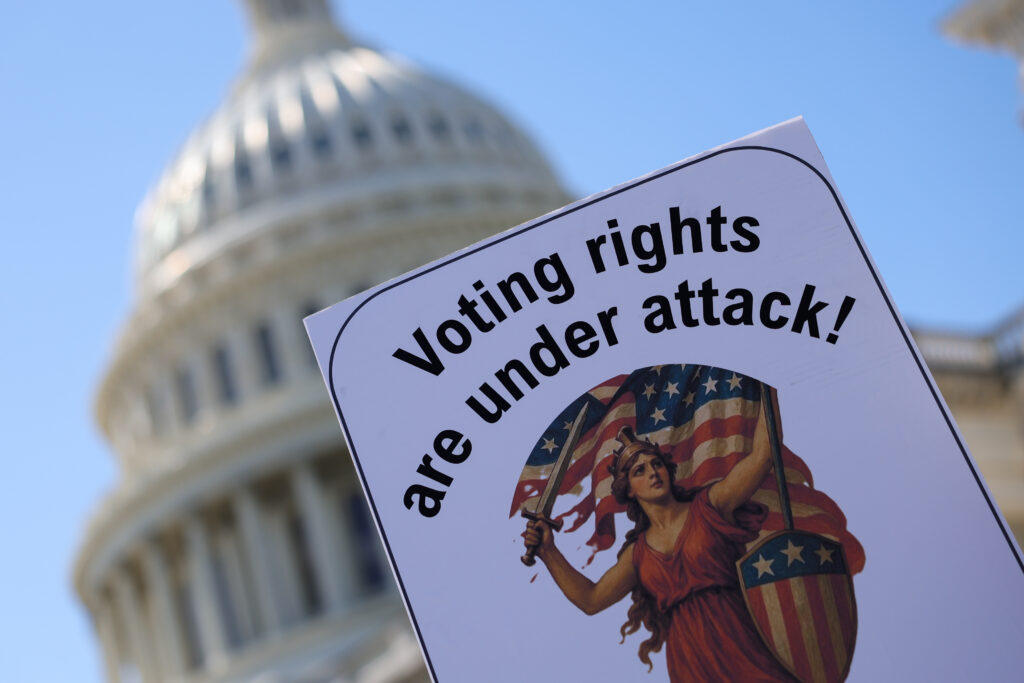
The 2026 midterms did more than hand Democrats sweeping gains across Congress and state governments. Voters nationwide also removed from power — and denied promotions to — some of the country’s most prolific architects and defenders of voting restrictions.
The losses cut across nearly every level of government. They included members of Congress who authored sweeping voter suppression bills, attorneys general who used their offices to defend restrictive state voting laws, party leaders who built national anti-voting operations and state lawmakers who helped draft new voting barriers.
Taken together, their defeats amount to a significant setback for the infrastructure behind the modern anti-voting movement — not just its rhetoric, but the officials who had the power to turn that agenda into law or defend it in court.
That does not mean voters rejected those candidates solely because of their records on voting rights. The Democratic wave was driven by a mix of issues, including dissatisfaction with President Donald Trump’s broader agenda.
But regardless of why individual voters cast their ballots, the practical consequence for voting rights is substantial: several of the officials most responsible for advancing restrictive election laws will enter 2027 with far less power — or none at all.
Get updates straight to your inbox — for free
Join 350,000 readers who rely on our daily and weekly newsletters for the latest in voting, elections and democracy.
Bryan Steil
Few defeated lawmakers were more directly responsible for the GOP’s federal anti-voting agenda than Rep. Bryan Steil (R-Wis.).
Democrat Mitchell Berman defeated Steil in Wisconsin’s 1st Congressional District, flipping a seat Democrats had not held in three decades. Steil conceded on election night as Democrats picked up two congressional districts in Wisconsin.
As chair of the powerful House Administration Committee, which oversees federal elections, Steil was the lead author of Republicans’ dangerous Make Elections Great Again Act. The legislation would have required strict photo identification to vote in federal elections and documentary proof of citizenship to register, mandated more aggressive voter roll purges, required mail ballots to arrive by Election Day and banned universal mail voting. Voting rights groups warned the bill would disenfranchise millions of eligible voters.
Steil’s defeat does more than remove one supporter of the legislation. It takes its principal author and the House’s top election-policy chairman out of Congress just as Democrats assume control of the chamber, sharply changing who will set the federal election agenda next year.
Chip Roy
Rep. Chip Roy (R-Texas) was not technically defeated this November, but his departure from Congress will still remove one of the House’s most influential architects of new federal voting restrictions.
Roy gave up his House seat to run for Texas attorney general and lost the Republican primary runoff earlier this year. His congressional term expires in January.
During his final years in Congress, Roy was the driving force behind the Safeguard American Voter Eligibility (SAVE Act), which sought to require documentary proof of U.S. citizenship to register to vote in federal elections. He then helped expand that proposal into the SAVE America Act, adding a nationwide photo identification requirement for federal voting and provisions directing states to identify and remove suspected noncitizens from their voter rolls. The House passed the expanded bill in February.
Roy continued pushing the measure throughout 2026, at times tying other major legislative priorities to its passage and urging Senate Republicans to force the bill through over Democratic opposition. The bill has stalled and failed multiple times to pass the Senate.
His exit is especially consequential alongside the defeat of Steil.
Steil helped build Republicans’ broader federal election agenda from atop the House Administration Committee, while Roy authored the party’s signature citizenship and voter ID legislation. Neither will be in Congress next year.
Their simultaneous departures mean two of the House Republicans most directly responsible for designing the party’s federal voting restrictions will be absent just as Democrats take control of the chamber — a significant break in the congressional infrastructure that produced some of the most sweeping voting legislation of the past several years.
Kris Kobach
Kansas Attorney General Kris Kobach’s defeat ended the latest chapter of one of the longest careers in the modern movement to impose proof-of-citizenship requirements on voters.
Chris Mann defeated Kobach by just over one percentage point, becoming the first Democrat elected Kansas attorney general since 2011.
Kobach’s voting record stretches back well over a decade. As Kansas secretary of state, he was the draftsman and chief defender of a law requiring people to produce documentary proof of U.S. citizenship before registering to vote. More than 30,000 otherwise eligible Kansans were prevented from completing their registrations while the law was in effect before federal courts struck it down. Kobach personally defended the requirement in court and was sanctioned during the litigation.
He also helped develop the failed Interstate Voter Registration Crosscheck program and later served as vice chair of Trump’s short-lived election integrity commission.
Kobach’s loss removes from statewide office a politician who spent much of his career trying to turn documentary proof of citizenship from a fringe proposal into law — just as similar requirements have become a centerpiece of Republican legislation nationally.
Ken Paxton
Texas Attorney General Ken Paxton spent years using the power of his office to defend some of the country’s most restrictive voting laws. His attempt to move from that office to the U.S. Senate ended in defeat.
State Rep. James Talarico beat Paxton in the race for Texas’ open Senate seat, giving Democrats their first U.S. Senate victory in the state since 1988 and their first statewide win of any kind since 1994.
Paxton was a central defender of Texas Senate Bill 1 (SB 1), the extreme 2021 election law that imposed new identification requirements on mail ballot applications and envelopes, restricted assistance to voters and added criminal penalties to parts of the voting process.
His office repeatedly fought in federal court to keep those provisions intact. As recently as August, Paxton celebrated a Fifth Circuit ruling preserving SB 1’s requirement that mail voters provide an identification number matching state records, one of several legal battles his office pursued over the law.
Paxton’s defeat means he will leave the attorney general’s office rather than take that record to Washington. And because Democrats also won the Texas attorney general race, the state office that spent years defending SB 1 and other restrictive election policies will itself be under new leadership.
Michael Whatley
Michael Whatley never held public office, but he helped construct something just as consequential: the Republican Party’s national election-litigation operation.
Former North Carolina Gov. Roy Cooper (D) defeated Whatley for the state’s open U.S. Senate seat, flipping a Republican-held seat. Whatley had previously chaired both the North Carolina Republican Party and Republican National Committee (RNC).
As RNC chair, Whatley led a massive election-focused legal and monitoring operation involving thousands of Republican attorneys and volunteers. Under his leadership, the party brought litigation challenging voter registration procedures, overseas voting access and mail ballot rules.
In North Carolina alone, the RNC sued to purge over 225,000 voter registrations that it alleged lacked required identification information. The party also challenged state guidance allowing certain absentee ballots to be counted and later fought over ballots cast by some overseas voters.
Whatley’s loss prevented the former head of that national legal operation from moving into the Senate. It also marks a setback for the party infrastructure that increasingly used litigation — rather than legislation alone — to challenge voter eligibility and ballot counting rules.
Warren Petersen
Arizona Senate President Warren Petersen (R) did not merely advocate for stricter election rules. He went to court to try to impose them.
Attorney General Kris Mayes (D) defeated Petersen by roughly 11 percentage points, giving Mayes a second term after she won her first race by only a few hundred votes in 2022.
As Senate president, Petersen joined Arizona’s Republican House speaker in suing Secretary of State Adrian Fontes (D) over the state’s Elections Procedures Manual. The lawsuit challenged rules governing voter-registration cancellations, the state’s Active Early Voting List and county certification, among other provisions. The litigation continued through the Arizona appellate courts before the state Supreme Court declined this year to take up Republicans’ remaining challenges.
Petersen therefore entered the attorney general race with an extensive record of using his legislative office to litigate election rules — and was seeking control of the very office responsible for defending Arizona law in court.
His defeat leaves Mayes in that position and denies Petersen a significantly more powerful platform from which to pursue those election law fights.
Ross Berry
The pro-voting backlash extended below Congress and statewide offices.
New Hampshire Rep. Ross Berry (R), chair of the state House Election Law Committee, lost his reelection bid after six years in the Legislature. In the two-seat Hillsborough County District 44 race, Berry finished behind Democrat Chris Conroy, Republican Lisa Mazur and Democrat Bob Jones. Berry acknowledged after the election that he was among the Republican lawmakers swept out during the state’s Democratic surge.
Berry had been one of the Legislature’s most prominent proponents of tighter voting requirements. He was a lead sponsor of a law enacted this year that eliminated student identification cards as an acceptable form of identification for voting, forcing students without another qualifying government-issued photo ID to obtain one before casting a regular ballot. Voting rights groups sued over the change, arguing that it disproportionately burdened young voters, but courts declined to intervene before the midterms.
His defeat may be smaller in scale than losing a Senate seat or attorney general’s office, but it illustrates how far down the ballot the shift reached: even the chairman of a state legislative committee responsible for writing election law lost the power to shape those rules.