This week at Democracy Docket: Trump’s voter roll scheme hits a major roadblock, and ICE’s role in voting crackdown revealed
 Prefer us on Google
to see more of our voting rights news coverage when you search.
A federal judge’s ruling may have just thrown President Donald Trump’s scheme to assert control over state voter rolls into turmoil.
Meanwhile, we’re keeping a close eye on courtrooms in states across the country, where, with Election Day approaching, the on-the-ground rules for voting access are being decided. Which GOP-backed suppression tactics will be in effect, and which will be blocked?
Get updates straight to your inbox — for free
Join 350,000 readers who rely on our daily and weekly newsletters for the latest in voting, elections and democracy.
We’ll get to that. But first, let’s quickly unpack Friday’s decision, which came in a challenge to the sweeping Department of Justice (DOJ) plan to obtain voter roll data from all 50 states, then run it through a flawed government database, SAVE, to find noncitizens for states to purge.
Judge Sparkle Sooknanan not only ruled that DOJ has no right to state voter data, but also barred it from doing anything with the data it’s already received from 18 cooperative red states.
“The Court vacates a policy that has removed United States citizens from the voter rolls in their home states and risks disenfranchising many more,” Sooknanan wrote.
The full implications of the ruling aren’t yet clear. Sooknanan did say that states themselves can continue to run their rolls through SAVE — something the Supreme Court recently greenlit. But her ruling, if it stands, could hugely complicate the administration’s attempt to create a national “citizenship list” — currently the subject of a separate lawsuit — and to help states identify voters to be purged.
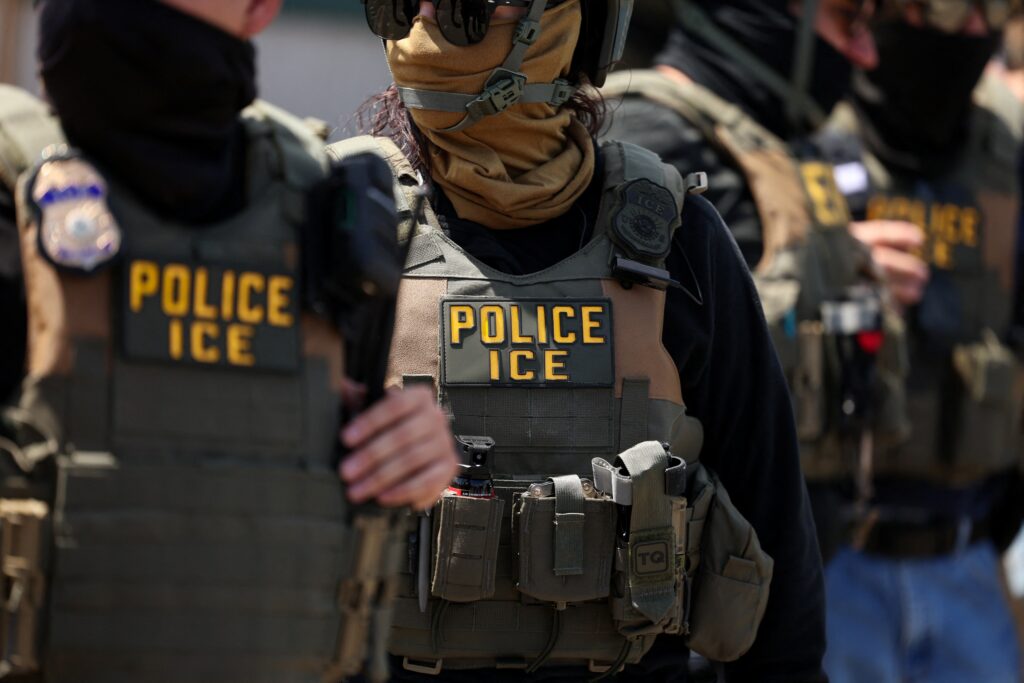
We also obtained a trove of documents this week, via our friends at Democracy Forward*, that shed light on how Immigration and Customs Enforcement (ICE) is playing a major role in the administration’s hunt for noncitizen voters.
They revealed, among other things, that ICE:
- amassed tens of millions of voter records, many via Heather Honey, the election denial activist who’s now a senior Department of Homeland Security official;
- probed not only hundreds of groups that work to register new voters, but also, um, a clothing company favored by teen skaters;
- tried to have voter data uploaded to a system run by Peter Thiel’s Palantir (a source familiar with the matter told us the data was never uploaded);
- discussed deporting those roughly 400 noncitizens in New Jersey who were mistakenly added to the rolls and voted;
- and really doesn’t want to give a straight answer on whether it has plans to send agents to the polls this fall.
On Friday, Democracy Forward filed a lawsuit against ICE, seeking additional records. which the group says haven’t been turned over despite a Freedom of Information Act request.
Something else the administration doesn’t want to reveal: Its plans to send DOJ monitors to watch voting this fall. It’s said it’s going to send an unprecedented 1,000 monitors, but the NAACP filed a lawsuit this week to get access to additional information on the scheme.
Still, some documents we got our hands on this week — again working with Democracy Forward — may shed light on the effort. They showed that during the primaries, DOJ used criminal prosecutors and an FBI agent as monitors. That’s a stark departure from the usual approach of sending voting rights lawyers, and it suggests that the goal of the program is to restrict, rather than to protect, access for voters.
Oh, and the documents also revealed that David Michael Levin, the DOJ lawyer who did jail time in 2016 for hacking into election websites, was a monitor not only in Minnesota, as we’ve reported, but also in Maricopa County, Arizona.
Now, to the states, where Republicans are fighting everywhere they can to impose the most restrictive rules possible on voters.
In New Hampshire, Republican officials are arguing in court to make sure students can’t use their school IDs in any capacity to help them vote. This comes after a lower court left a GOP-backed ID ban in place, but said election officials could still consider student IDs as part of the evidence used to establish residency.
The student ID ban imposes a major barrier to the polls for Granite State students, who make up a significant part of the Democratic base in the state. New Hampshire hosts a pivotal Senate race this fall.
Meanwhile, in North Carolina, national Republicans are getting involved to help defend new restrictions on mail ballots, passed last month by the state’s GOP-led election board. The new rules make it easier for election administrators to throw out mail ballots over minor technical issues, and bar voters from getting help in returning their ballots.
The national GOP also is wading into a voting fight in Gwinnett County, Georgia, asking a judge to stop the state’s second-largest county from letting voters hand-deliver mail ballots to early voting sites that don’t have dropboxes. The judge already dismissed the GOP’s lawsuit over the issue, but the party wants the practice blocked while they appeal.
And in Wisconsin, a court declined to allow voters to cast a provisional ballot if their mail ballot doesn’t arrive by election night — a ruling that could lead some mail voters to be disenfranchised. In local elections in April, many clerks in the state reported problems with late-arriving ballots.
There’ll be many more of these state-level skirmishes over voting rules between now and Election Day — always with Republicans looking to make it harder to cast a ballot.
And at Democracy Docket, we’ll be tracking them closer than anyone else.
* Democracy Docket founder Marc Elias serves as chair of Democracy Forward’s board.