Federal judge declines to block New Hampshire student ID ban for midterm election
 Prefer us on Google
to see more of our voting rights news coverage when you search.
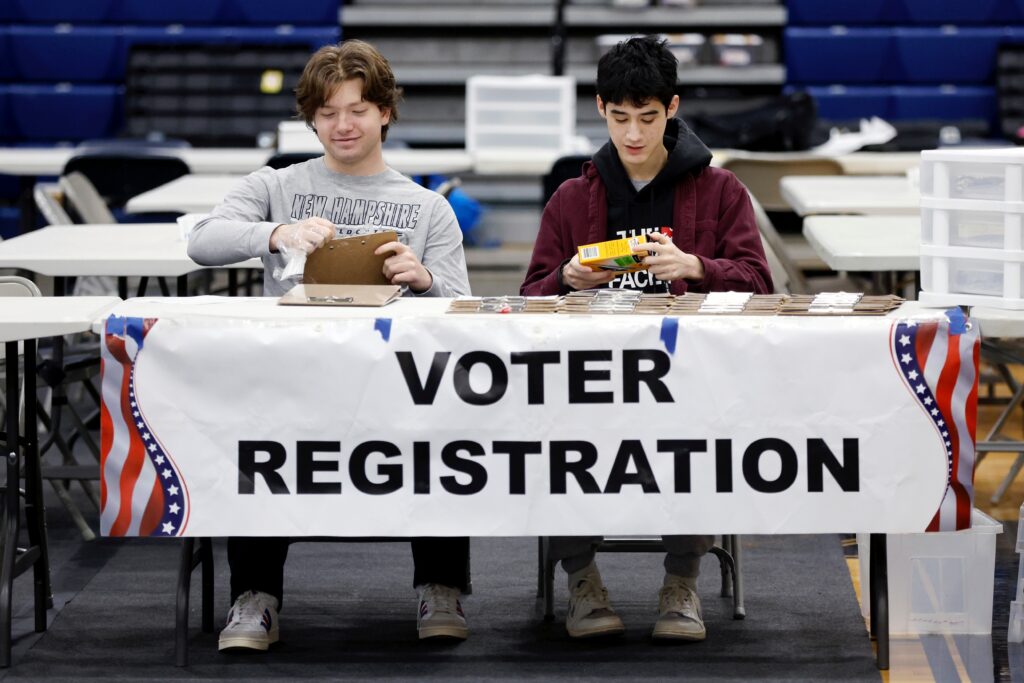
A federal judge in New Hampshire will allow the state’s new ban on using student IDs for voting to remain in place for this fall’s general election. But he also barred the state from enforcing a directive that prohibits New Hampshire election officials from accepting a student ID as a valid form of identification to vote.
Meaning: If a voter has no other way to prove their identity to vote, an election official can still consider a student ID as part of the evidence they are qualified to vote.
The decision may slightly loosen the ID rules, but will introduce confusion and uncertainty for students, who already face a range of obstacles to voting.
Despite that, the Coalition for Open Democracy (COD), the pro-voting plaintiff in the case, hailed the ruling as a partial win.
“We are pleased that the court enjoined as unconstitutional any effort by New Hampshire to prohibit or discourage voting officials from considering student IDs as evidence of identification when registering and voting in New Hampshire elections,” the plaintiff’s counsel said in a statement to Democracy Docket. “The Court’s decision did not yet enjoin the recently enacted New Hampshire law, HB 323, that removed student IDs from that list. We will continue to urge the courts to recognize that HB 323 violates the constitutional right of students to vote and must be enjoined in its entirety.”
In April, Gov. Kelly Ayotte (R) signed HB 323 into law, which eliminated student IDs as an acceptable form of identification for obtaining a ballot. Secretary of State David Scanlan (R) promptly issued guidance to election officials that they can no longer accept student ID to prove a voter’s identity when registering to vote, requesting an absentee ballot, or checking in to vote.
The pro-voting group Coalition for Open Democracy sued New Hampshire in August to block the GOP-backed state law from taking effect, but U.S. District Judge Joseph Laplante — a George W. Bush appointee — cited the Purcell principle in denying the motion for a preliminary injunction. Purcell is a legal doctrine stating that courts should not change voting rules too close to an election because it could confuse voters and officials.
COD sued New Hampshire in August to block the GOP-backed state law from taking effect, but U.S. District Judge Joseph Laplante — a George W. Bush appointee — cited the Purcell principle in denying the motion for a preliminary injunction. Purcell is a legal doctrine stating that courts should not change voting rules too close to an election because it could confuse voters and officials.
In September, Laplante ruled that the ban could stay in place for New Hampshire’s Sept. 8 primary election. But he also suggested that the legality of the state’s student ID ban “may be on different footing” for the general election.
Get updates straight to your inbox — for free
Join 350,000 readers who rely on our daily and weekly newsletters for the latest in voting, elections and democracy.
The plaintiffs had argued that HB 323 illegally discriminates against young voters and that Scanlan exceeded his authority by issuing his directive to election officials.
“As a result, young voters in New Hampshire must now navigate a burdensome bureaucracy to exercise their fundamental right to vote,” their complaint stated. “This scheme unconstitutionally burdens the right to vote, discriminates against young voters on account of their age, and unlawfully rewrites New Hampshire’s election statutes.”
But on Oct. 2, Laplante did not find that HB 323 violated the U.S. Constitution.
“HB 323 did one specific thing: it removed student ID cards from the forms of identification that are expressly valid to obtain a ballot,” he wrote. “The legislature made that choice, and the court upholds it at this preliminary stage because the plaintiff has not demonstrated a likelihood of proving that it is unconstitutional.”
Because the law didn’t include any provision to instruct local election officials on what forms of ID to accept, Laplante found that Scanlan’s April directive violated the state’s “safety valve” law, which allows voters to present other evidence to prove their identity when voting.
“HB 323 made no such provision, and the Secretary of State has offered no independent justification for making it,” Laplante wrote.
Limiting access for student voters has long been a goal of the Trump administration and the GOP — and New Hampshire has a long record of making it harder for students to vote. This includes passing laws that impose stringent residency requirements for registering to vote.
Even though Laplante’s ruling is a limited victory for voters, it nonetheless adds confusion for student voters in the Granite State, who might not know what’s required for them to cast their ballot.
“Student IDs are one piece of identification used to verify voters who are already registered,” Lisa Kovack of the New Hampshire Campaign for Voting Rights told Democracy Docket back in April, when Ayotte signed HB 323 into law. “The Trump administration has openly stated its desire to ensure only ‘the right people’ vote. Laws like this one are how that goal is pursued at the state level.”