Montana voters head to the polls with increased access — for some
 Prefer us on Google
to see more of our voting rights news coverage when you search.
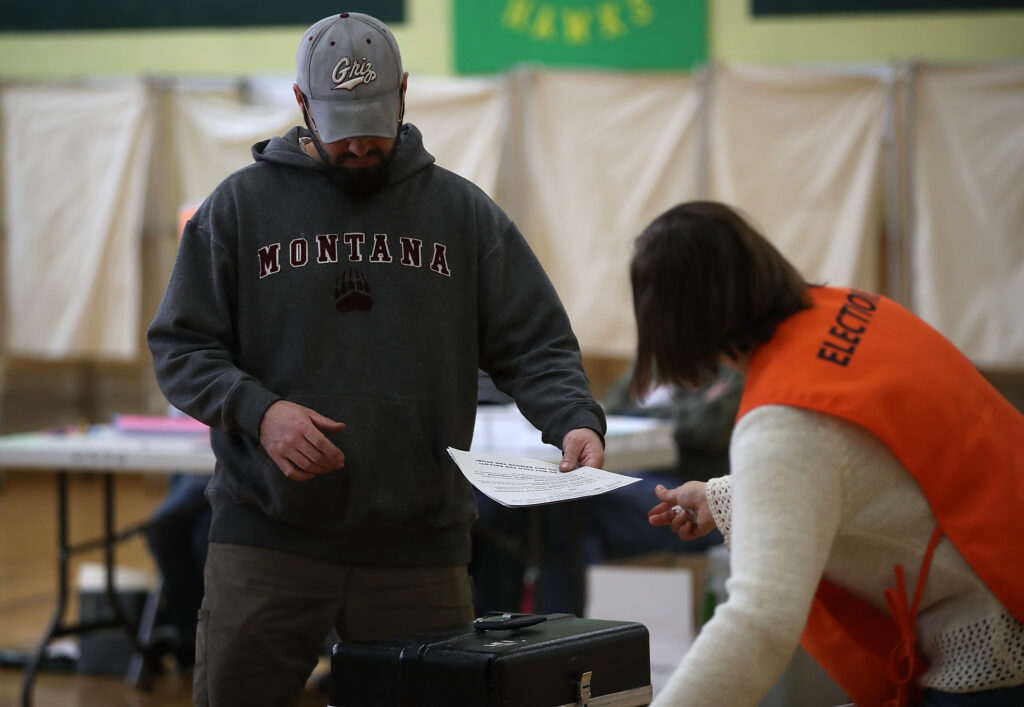
Midterm voting in Montana is here. Early in-person polls opened Monday and mail ballots will start flowing to voters Friday, Oct. 9. The state is a battleground, both for the U.S. Senate and in courtroom fights over voter access.
Just this week, the state saw big wins for voters with disabilities and for direct democracy, but more marginalized groups, including student voters, still face significant access barriers.
Top of mind for many Montana voters is mail voting. That’s because Big Sky Country is indeed big, with people so scattered across the state that it transcends the label of “rural.” It’s designated “frontier” terrain. This means lots of voters — more than two-thirds — rely on mail voting, making access to the balloting method vital.
With just 26 days until Election Day, here’s what voters should know when it comes to voting access, and the ongoing battles to protect it, for the midterms.
Get updates straight to your inbox — for free
Join 350,000 readers who rely on our daily and weekly newsletters for the latest in voting, elections and democracy.
Montana hands over voter data, sort of
One issue that may sum up the state’s shaky voting access scene is the data grab that never was.
Before President Donald Trump’s Department of Justice had the chance to sue Montana for its voter rolls, Secretary of State Christi Jacobsen (R) offered up some data voluntarily.
The state’s chief elections official wrote to the DOJ in December 2025, commending the administration’s efforts to root out noncitizen voting — a nonissue as proven by countless studies and reports on voter fraud. He then proceeded to hand over statewide voter registration data.
The problem is that Montana merely provided publicly available voter data. This was seemingly enough for the red state to dodge a shoddy lawsuit, like the ones thrown out in 26 states.
At face value, Montana offered a helping hand in Trump’s voter data crusade. In reality, the move did nothing but recuse the state from further scrutiny while the DOJ focused on loss after loss in other states. Still, Jacobsen’s eager attitude reflects a broader characterization of voting rights in the state — one that leans into GOP-backed restrictions only warded off by hard-fought court battles, some of which are still ongoing as voters head to the polls in the coming weeks.
Where does voting access stand? It’s complicated
Direct democracy is on the ballot in Montana. And just this week, the state Supreme Court unanimously ruled against restrictions on citizen ballot initiatives. Montanans will now decide if they want to further enshrine direct democracy into the state’s constitution when they vote on CI-133 this fall.
In other recent good news for voters, the state Supreme Court last week struck down a law that required those casting a mail ballot to manually write their birthdate on the ballot envelope.
Nearly 3,000 mail ballots in the 2025 November election were rejected because of the now-overturned law. The ruling is especially significant for voters with disabilities, like those with fine motor skill or visual impairments that would make it impossible to handwrite a date, and who are more likely to vote by mail.
It’s “more difficult to access civil rights when you’re a person in care,” Disability Montana’s Tal Goldin told Democracy Docket in April amid the legal advocacy organization’s court fight.
But for out-of-state students, another group that favors mail voting, there’s a restrictive voting bill that, for now, remains in effect for the midterms. The law requires students to declare their future place of residency before registering to vote. Under the law, students must promise to live in the same county they attend school in — a strange declaration no other Montana voters must adhere to, as those challenging the law put it.
While there’s a hearing set in the case for later this month, it’s unlikely a court order will come in time for the election, leaving the law in place.
Meanwhile, in a voting access win, a district court in May blocked a Republican-led attempt to limit same-day registration by eight hours. The court ruled the restriction posed a “direct burden” for voters. This means the 20-year tradition within the state prevails, preserving the ability for voters to register throughout Election Day.
But in the same ruling, the court stopped short of blocking the state’s photo ID bill that eliminated the state’s declaration form used by voters as a backup option for those unable to obtain their voter ID.
A Montana driver’s license or the last four digits of a Social Security number are required for voter registration. More options are permissible for voting, but photo ID is still required. Voters can check the state’s list of acceptable voter identification to ensure they can vote in person.