ICE at the polls? Even after FOIA lawsuit, agency refuses to give a straight answer
 Prefer us on Google
to see more of our voting rights news coverage when you search.
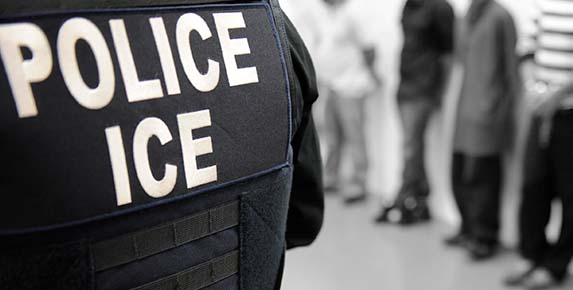
Is U.S. Immigration and Customs Enforcement (ICE) going to send agents to the polls during this fall’s midterms? The federal agency really doesn’t want to say.
With President Donald Trump and other top administration officials insinuating that they could deploy immigration agents or federal troops to voting sites, Democracy Forward filed a Freedom of Information Act (FOIA) request in April seeking to find out whether ICE would do that. After ICE mostly ignored them, the pro-democracy organization sued. The agency eventually turned over 166 pages of documents, which Democracy Forward published Wednesday.
The produced records seem to get tantalizingly close to finally answering whether ICE intends to send agents to voting locations. But the presumptive response is redacted, citing a questionable exemption to the FOIA statute.
Wednesday’s release includes a talking points memo prepared for an unnamed official ahead of some kind of meeting with members of Congress on the topic of “ICE’s Role in Elections and at Polling Facilities.”
The memo offers “Value Statements,” like “[t]here is no reason for lCE officers and agents to be deployed to polling places, unless a threat arises,” and “Key Talking Points” such as “ICE does not possess independent authority to administer or oversee elections.”
It then instructs the official on how to respond to questions like “Will ICE arrest people at polling places? If you are ordered to send ICE personnel to polling places, will you comply with the order?” and “How many arrests has ICE made regarding voter fraud?”
But instead of revealing an answer — or even a nonanswer — prepared by the memo’s uncredited author, the proposed response is blanked out with a citation to an unexpected FOIA exemption.
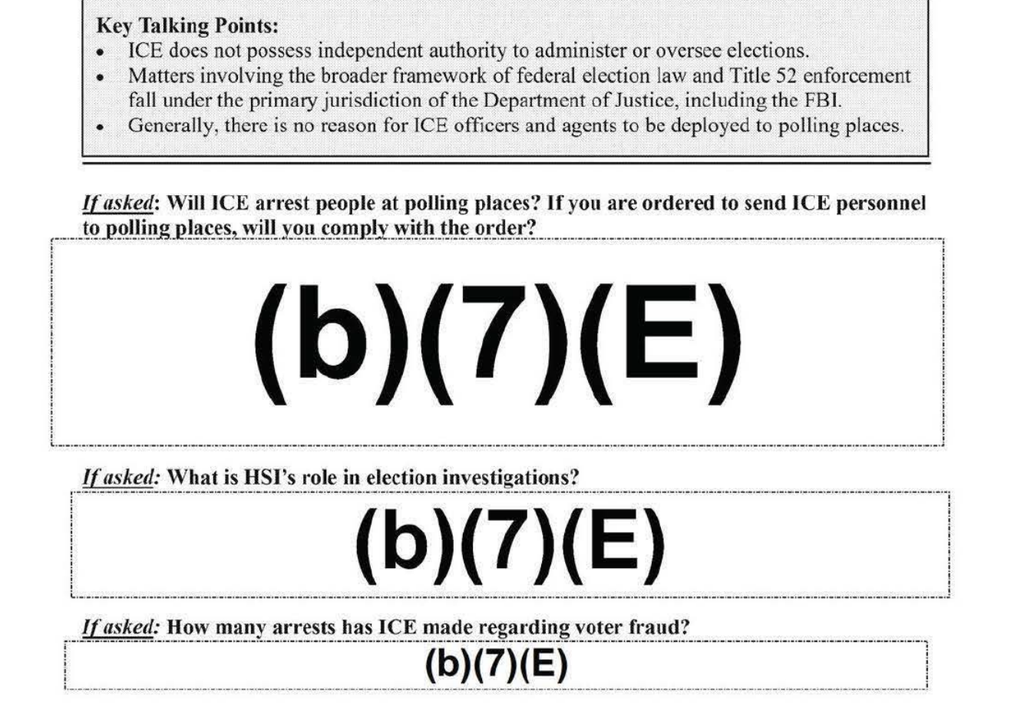
That provision, Section 552(b)(7)(E), exempts federal agencies from handing over records that “would disclose techniques and procedures for law enforcement investigations or prosecutions, or would disclose guidelines for law enforcement investigations or prosecutions if such disclosure could reasonably be expected to risk circumvention of the law.”
It’s unclear how that could apply to a pre-prepared answer to an expected question from a lawmaker.
Get updates straight to your inbox — for free
Join 350,000 readers who rely on our daily and weekly newsletters for the latest in voting, elections and democracy.
Moreover, redacting a proposed reply seems odd, given that ICE officials have responded to questions on this subject, and publicly available information generally isn’t exempt from FOIA.
ICE’s FOIA response includes an undated letter from then-acting director Todd Lyons to Colorado Secretary of State Jena Griswold, who had asked for written confirmation that ICE “officers and special agents won’t be present at voting and election administration locations during the 2026 election.”
Lyons provided a careful answer that implies heavily that ICE won’t be deployed to the polls without definitively ruling it out — the kind of evasive response typically found in talking points memos.
“[T]here is no reason for ICE officers and special agents to be deployed to polling places,” Lyons writes. “ICE officers and special agents are sworn federal immigration officers who arrest aliens for violating immigration and criminal laws. However, ICE Homeland Security Investigations (HSI) plays an important role in investigating voter fraud, and will continue to perform this vital mission.”
At other points, the FOIA response relies on Section 552(b)(7)(E) to redact the name of an agency task force and a proposed response to a hypothetical question from a lawmaker about the number of arrests related to voter fraud by HSI.
A spokesperson for Democracy Forward said the organization is still assessing ICE’s response and expects further litigation in the FOIA lawsuit.
As a result of the suit, ICE is supposed to release additional documents — possibly up to 4,500 pages more — in later transfers.
*Democracy Docket Founder Marc Elias is the chair of Democracy Forward’s board.