‘Hypocritical’: RNC pushes mail voting for its supporters while attacking it in court
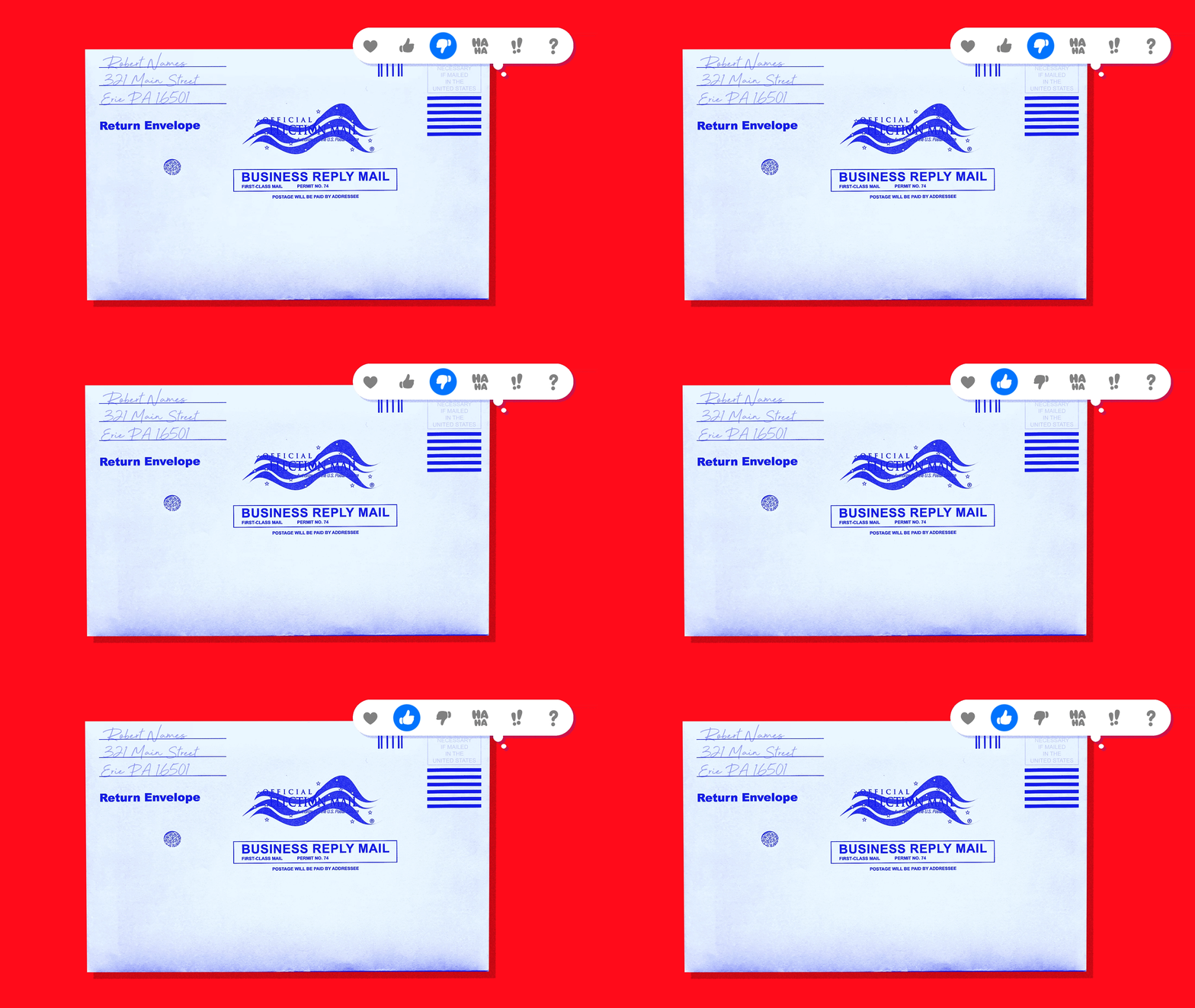
The Republican National Committee (RNC) is encouraging voters to request mail ballots while challenging mail voting infrastructure nationwide.
Over the past six years, the RNC has filed a slew of lawsuits across the United States to restrict mail-voting deadlines, overseas voting and permanent absentee laws. But it also paid for emails and a get-out-the-vote website telling voters to “request your mail-in ballot now,” a Democracy Docket analysis found.
Experts told Democracy Docket that the dichotomy shows the committee’s duplicitous faith in mail voting’s security.
Jonathan Diaz, the nonpartisan Campaign Legal Center’s voting advocacy and partnerships director, said the RNC’s anti-absentee rhetoric has created a “stark partisan split” in mail voting that harms the election system’s integrity.
“If the campaigns want people who support them to vote by mail, then there isn’t actually a problem with vote by mail,” Diaz said. “They just don’t want their opponents to be able to use it.”
“That shows that the arguments that some political actors make about mail voting being unreliable or being unsafe are hypocritical and entirely made up,” Diaz added.
Get updates straight to your inbox — for free
Join 350,000 readers who rely on our daily and weekly newsletters for the latest in voting, elections and democracy.
The RNC did not respond to Democracy Docket’s questions on why it has promoted mail voting while simultaneously disparaging it.
The RNC sent an email to Pennsylvania voters Sept. 14 advertising mail voting, and the committee’s “Swamp the Vote” website offers absentee registration information for certain states — including those with permanent absentee rules that Republicans have decried.
The RNC’s two-sided approach is “not surprising at all,” said Charles Stewart III, a political science professor at the Massachusetts Institute of Technology (MIT).
“Voting by mail is really valuable for any candidate, regardless of their party,” Stewart said. Restricting that, he added, would remove “a really valuable weapon in the arsenal of electoral combat.”
In New York, for instance, the RNC lost a challenge to state law allowing voters to submit absentee ballots during the early voting period. However, the party’s “Swamp the Vote” website advertises New York’s ballot deadlines.
Pennsylvania’s highest court, meanwhile, rejected an RNC lawsuit against a state law allowing voters to submit provisional in-person ballots if their mail ballots were invalid.
In a landmark ruling this year, the Supreme Court also rejected the RNC’s challenge to a Mississippi law that allows election officials to count ballots arriving after Election Day so long as they are postmarked before the voting deadline.
In 2025, the RNC argued in a legal brief that state mail voting laws force Republicans to “divert resources from in-person election activities.”
But it appears the RNC is doing that anyway as campaign strategists recognize mail voting’s electoral importance. In 2024, RNC chair Ronna McDaniel drew ire for similar rhetoric that undercut mail voting while instructing candidates to rely on it.
“From a campaign perspective, no matter your party or who your candidate is, I think candidates and campaigns want voters to vote early, vote by mail, because every voter who turns in a ballot one week, two weeks before Election Day is one less voter you have to try to turn out on Election Day,” Diaz said.
Ben Hovland, who served on the U.S. Election Assistance Commission from 2019 to 2026, said “the politicization of election administration” undermines voters’ confidence in a secure system.
“Both the litigation and the confusion that is being sown by it will have a negative impact on some voters and whether or not they feel like mail ballots are trustworthy,” Hovland said. “Certainly we’ve seen an impact of the president’s rhetoric on many Republicans not trusting mail ballots. That’s unfortunate because it’s a great way for Americans of any party to participate.”
Hovland, who was nominated by Trump before the president fired him this year, added that mail voting “is not inherently political” and does not favor either party.
Mail voting originated as early as the Civil War, when Union soldiers sent ballots from the battlefield. But it grew over the past few decades before surging during and after the COVID-19 pandemic.
Nearly one-third of U.S. voters used mail ballots in 2024.
“It’s a safe, secure method to participate, and it is one that is often more flexible with American schedules,” said Hovland, who now researches election security at the Center for American Progress, a progressive think tank.
Most Republican challenges to mail voting have either been defeated or delayed in courts, leaving the system generally intact for the 2026 midterm elections. But as attacks persist, future elections remain uncertain.
Stewart, the MIT professor, said partisan attacks only stoke division and cause Republicans to distrust mail voting.
Diaz said mail voting is a core part of U.S. democracy.
“Restrictions on mail voting are motivated entirely by partisanship and by politicians trying to hold on to power and escape accountability from the American people,” Diaz said. “They’re not about making our elections safer.”