Supreme Court allows mail ballots to count after Election Day in win for voters
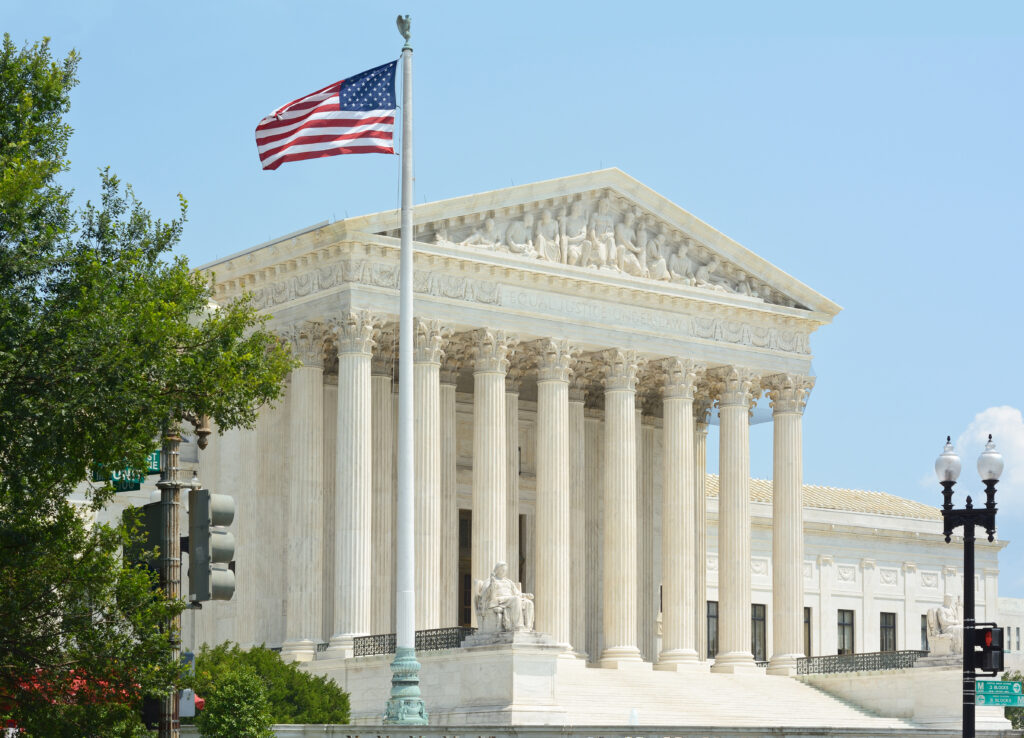
The U.S. Supreme Court blessed grace periods for ballots mailed by Election Day Monday, rejecting a GOP bid to restrict mail voting and preserving pro-voter laws in 14 states.
In a 5-4 decision, the Supreme Court upheld a 2020 Mississippi law that let mail ballots postmarked by Election Day still count if they arrived within five days later.
Writing for the majority in Watson v. Republican National Committee (RNC), Justice Amy Coney Barrett rejected the GOP’s argument that federal laws setting a date for elections preempted states from accepting ballots after that day.*
“[E]lection-day statutes do not set a deadline for ballot receipt, so they do not prevent Mississippi from counting ballots postmarked after election day yet received afterward,” Barrett wrote.
“The Framers recognized the difficulty of crafting election laws ‘applicable to every probable change in the situation of the country.’ So instead of constitutionalizing election law, they decided that ‘a discretionary power over elections’ needed to be lodged ‘somewhere,’” Barrett wrote. “Suffice it to say, that power was not lodged in this Court. The election-day statutes say nothing about ballot receipt, and we cannot add to the words Congress chose.”
Barrett was joined by Chief Justice John Roberts and Justices Sonia Sotomayor, Elena Kagan and Ketanji Brown Jackson.
Get updates straight to your inbox — for free
Join 350,000 readers who rely on our daily and weekly newsletters for the latest in voting, elections and democracy.
In addition to protecting similar laws in 13 other states and Washington D.C., the ruling will make it harder for the GOP to mount a legal assault on early voting, which legal experts said would be likely if the court ruled for the RNC. It also spares laws in 17 states that specifically provide ballot receipt grace periods for military and overseas voters.
The decision is a welcome reprieve from the high bench’s recent assault on democracy. Earlier this spring, the Court took a billy club to the Voting Rights Act, sparking a gerrymandering firestorm across the GOP-controlled South. The justices poured fuel on that fire in a series of dubious orders clearing the way for Republicans to erase majority-Black districts in Louisiana and Alabama.
The ruling will undoubtedly draw the ire of President Donald Trump, who blamed mail-in voting for his 2020 presidential campaign loss and attempted to ban states from counting ballots that arrive after Election Day by an executive order, which the courts quickly blocked. He also has pushed to ban no-excuse mail voting outright with the SAVE America Act, which passed the House but has stalled in the Senate.
Nearly one in three Americans — about 31%, or roughly 48 million voters — cast their ballots by mail in the 2024 general election. Even with grace periods in place, more than 100,000 ballots were rejected for arriving too late that year.
The Supreme Court took up Watson after the 5th U.S. Circuit Court of Appeals reversed a district court decision dismissing the challenge, which was brought by the RNC and the Libertarian Party of Mississippi. The 5th Circuit ruled that the wording of the federal statutes — as understood at the time — meant that ballots must be received by officials by Election Day, thereby invalidating grace periods for late arriving ballots.
Writing in dissent, Justice Samuel Alito argued that the decision “creates a serious risk of further undermining public confidence in our elections and our system of self-government.”
“Not only is today’s decision inconsistent with statutory text, legal context, historical practice, and precedent; it also threatens to produce lamentable consequences,” Alito added. “The majority’s holding spawns a slurry of troubling election-law questions and risks further undermining Americans’ confidence in election integrity.”
Barrett addressed those arguments in the majority’s opinion. “Election fraud and its appearance are serious issues. Like other such issues, however, they must be addressed through the democratic process,” she wrote. “The election-day statutes are proof of concept: When voting on different days in different States sparked allegations of fraud, Congress set a nationally uniform deadline for voting. If varied deadlines for ballot receipt similarly call for a national solution, the American people must choose it through their elected representatives.”
In its opinion, the majority also appeared to contemplate how rejecting late-arriving ballots would affect the practice of early voting. “At bottom, plaintiffs’ theory is that because we are governed by 19th-century election-day laws, we are also governed by 19th-century voting practices,” Barrett wrote. “Carried to its logical conclusion, this theory would call into question the way modern elections work.”
“Early voting would also be at risk, because in the 19th century, the polls were open only on election day itself,” Barrett added.
Barrett also specifically rejected an argument advanced by the Department of Justice’s amicus brief that tried to “reconcile” their interpretation of the election-day statutes with the Uniformed and Overseas Citizens Absentee Voting Act, which allows Americans abroad a grace period for their mail-in ballots.
“Their theories are unpersuasive,” Barrett wrote. “Plaintiffs and the United States cannot even agree among themselves on how this reconciliation should work.”
Following oral arguments in March, legal experts thought the court could go either way.
*Intervenors were represented by the Elias Law Group (ELG). ELG Chair Marc Elias is the founder of Democracy Docket.
Jacob Knutson contributed to this report.
This is a breaking news story that has been updated.