Karma: By gutting Voting Rights Act, Supreme Court launched a new Civil Rights movement and may have broken Mississippi’s red wall
 Prefer us on Google
to see more of our voting rights news coverage when you search.
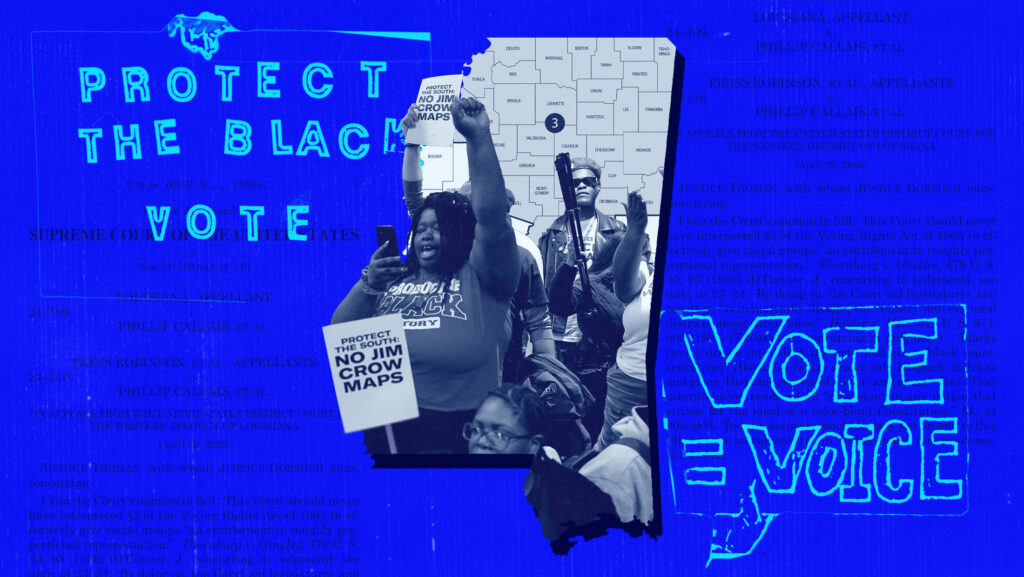
It has been 156 years since the nation elected its first Black United States senator. He represented Mississippi. The state may soon see its second Black senator in history, after voters flocked to the polls in defiance of the state’s restrictive voting system and in the throes of the greater South’s redistricting campaign.
Not three weeks after the Supreme Court erased significant portions of the Voting Rights Act, Mississippi’s Republican state leaders rushed toward gerrymandering. The governor declared he would call the state legislature back for a special session while the secretary of state announced the state would turn back the clock on congressional maps.
All across the South, at President Donald Trump’s directive, states began redrawing maps. And all across the South, Black leaders started mobilizing.
Get updates straight to your inbox — for free
Join 350,000 readers who rely on our daily and weekly newsletters for the latest in voting, elections and democracy.
In churches, classrooms and courtrooms, there was a resurgence of a fight indicative of more than just a moment in time. Lydia Grizzell, the ACLU of Mississippi’s policy director, described the group’s work and ensuing impact in the months after Louisiana v. Callais as nothing short of historical.
“I want America to think about this moment like the moment in which the Civil Rights movement was at its peak,” Grizzell told Democracy Docket.
The legal group, along with countless other advocacy groups, took part in eight weekly public legislative hearings across the state. Each week, opposition to mid-decade redistricting grew.
At the first meeting in Tupelo, just one person voiced outcry at the push to revert to old maps. By the time the campaign reached Jackson, protesters spilled from the room into the state capitol hallways. A sea of people donned shirts in protest with messages including “I fight for voting rights” and “MS votes.”
They drowned out the sprinkle of red blazers, worn by the Mississippi Federation of Republican Women, in the front row.
Meanwhile, legislators remained steadfast in their commitment to diluting Black political power, Grizzell said.
“They were like ‘we must do this now, we must do this immediately,’” Grizzell described of state leaders’ efforts. “It was almost like a wildfire.”
As legal battles continued, others worked to canvass door to door, organize rallies and appeal to communities that have not historically shown up to the polls to make their voices heard.
Voters answered. In the state with the highest Black population across the country, voter turnout surged 35% since the last midterm season. Mississippi, while perhaps one of the clearest examples of voter resilience, was not alone.
In southern states where the GOP was sure it would secure seats, gerrymanders were thwarted by voters who overwhelmingly voted in Democrats instead. Voters rejected gerrymanders across Florida, North Carolina, Texas, Alabama and Missouri. Black voter turnout also skyrocketed in South Carolina and Georgia.
In Mississippi, a red wall has barricaded the state from Democratic control for 44 years, since John C. Stennis won re-election in 1982. But Democrat Scott Colom — who’s marginally leading opponent Cindy Hyde-Smith (R) as the state awaits a final count — could be his successor. And it’s because Black voters turned up to the polls.
Voting rights groups say regardless of the outcome, monumental turnout speaks to the success of the movement as a karmic rebuke of the high court.
Angela Grayson heads up civic engagement and voting rights at the Mississippi Women’s Roundtable. She said she’s never witnessed an election where people so clearly showed up at the ballot box to protect voting rights, with Callais notably so recent.
The NAACP, founded in the wake of racial violence, was one of many to lead the charge in the direct aftermath of the court’s decision in Callais.
In Mississippi, the organization set up shop with 11 regional offices. Staffers knocked on hundreds of thousands of doors and helped register over 17,000 voters in the lead-up to the election, NAACP’s President and CEO Derrick Johnson described in a statement.
Grayson underscored that the Supreme Court’s decision did not singularly mobilize Black voters to the polls. It was an impetus, and a hefty one at that, but only pushed to the finish line with the decades of wisdom and work brought forth by Black advocates across the South.
“Black women have undergirded this process, have always shown up for community, have always voted in their best interests,” Grayson said. “And when you lift Black women, you lift the entire state.”
Grayson said she knows this because she has done this very work for two decades. This election, it manifested in tireless organizing to provide resources and support to communities not always reached every election cycle — “opportunity districts,” she said.
Grizzell, who was born and raised in Mississippi, shared a similar sentiment. She said in Jackson right now, the mood is indescribable.
Like for communities across the nation, reckoning with historical milestones in voting rights and representation, it’s a new era for Mississippi.
“We got here very quickly, but it was not by happenstance,” Grizzell said. “It was the culmination of organizations and people getting together, and now we’re at a time where, I don’t know, Mississippi has never been here before. This is unprecedented.”
But advocates said the work is far from over. The massive turnout Black organizers catalyzed was not just in spite of legal battles, but also despite the state’s existing voting system. It’s one of just three states that do not allow early in-person voting. It also does not have “no-excuse” mail voting, as the majority of the nation does.
A Democrat representing the state’s interests in Washington could make strides in pushing through voting reform. But not before counties finish counting all remaining votes, largely consisting of provisional or affidavit ballots, that some had to cast this season because they were deemed “inactive” voters by the state.
In university classrooms and grocery stores, in churches and on porch fronts, Mississippians are talking. Because there is no uniform process for all of the state’s 82 counties to notify voters of their ballot status, community members are asking friends and neighbors who among them had to cast affidavit ballots this election. They’re sharing what to do next to ensure each and every one of their votes counts, according to Grizzell of the ACLU.
Grayson spent her day Thursday fielding calls from voters and stopping by Jackson State University to help students get the resources they need to cure their ballots. Grizzell told Democracy Docket she could not wait to get off the phone — so she could get back to work.
While all eyes are on the state, advocates nationwide are flooding it with resources and boots on the ground.
“You remember when Bob Moses came down [in 1960], and there were so many people from the north coming to Mississippi to the south, organizing in back rooms and hubs,” Grizzell said.
She paused for a moment.
“That is happening right now.”