In sweeping attack on elections, Trump fires leadership of key federal voting assistance commission
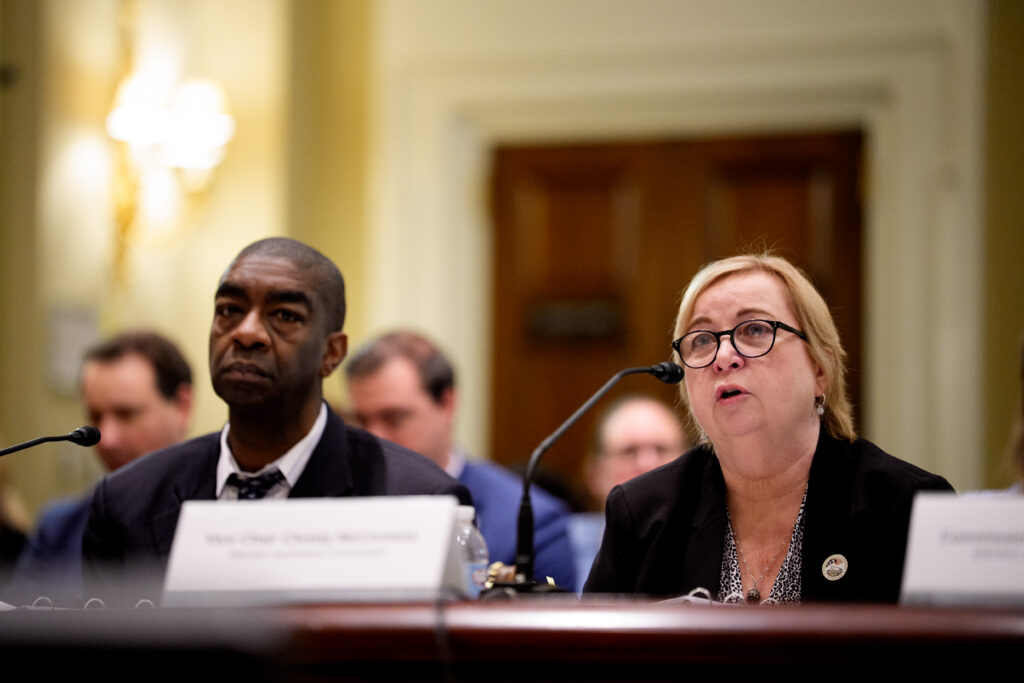
President Donald Trump Thursday dismissed all remaining commissioners on the Election Assistance Commission (EAC), a bipartisan federal agency created to help states administer elections, according to multiple media reports.
Trump’s firing of Democratic Commissioners Thomas Hicks and Ben Hovland and Republican Commissioner Christy McCormick leaves the four-commissioner federal agency without leadership just months before the upcoming 2026 election.
Donald Palmer, a Republican and the agency’s fourth commissioner, abruptly resigned earlier this year.
Get updates straight to your inbox — for free
Join 350,000 readers who rely on our daily and weekly newsletters for the latest in voting, elections and democracy.
In a statement, the Democratic Association of Secretaries of State (DASS) denounced the dismissals as “incredibly irresponsible.”
“The EAC plays a critical role in supporting state and local election officials, and it will again fall on Secretaries of State and other election administrators to fill the gap,” DASS Chair and Nevada Secretary of State Cisco Aguilar said.
“From cutting funding for cybersecurity to launching baseless investigations, this pattern of behavior from the Trump administration makes it harder for our election officials to do their work and does nothing to make elections more secure,” Aguilar added.
The dismissals come after Trump has attempted to use the EAC in his efforts to assert control over U.S. elections.
Max Flugrath, a voting rights advocate with Fair Fight Action, said the firings fit into a broader effort by Trump to pressure the EAC to change election rules after Republicans failed to pass the SAVE America Act through Congress.
“Since he took office, Trump has pressured the Election Assistance Commission to change election rules to effectively implement the SAVE Act — because they can’t pass it through Congress,” Flugrath wrote on social media. “It’s another power grab by a desperate president who doesn’t want a fair midterm election.”
In an anti-voting executive order last year, Trump directed the commission to add a proof of citizenship requirement to a federal voter registration form, make changes to the standards it uses to certify the voting systems used in all U.S. elections, and withhold federal funds from states that did not comply with other requirements.
Trump’s decision to purge the EAC marks his first major dismissals following a landmark Supreme Court ruling last month that shattered decades of precedent and gave the president almost unlimited authority to fire officials at independent federal agencies.
The firings raise immediate questions about what, if anything, the EAC can do without commissioners.
It remains unresolved whether the Supreme Court’s recent ruling actually allows the president to fire the heads of bipartisan election agencies like the EAC or Federal Election Commission, Rick Hasen, an election law professor at the University of California, Los Angeles, told VoteBeat. They could potentially be protected by a separate exception because Congress structured them around bipartisan balance, he added.
“Most boldly (and I would argue illegally) Trump could try to direct the commissioner-less EAC to do his bidding, for example by stating that the EAC must amend the federal voter registration form that states must accept for federal elections to include documentary proof of citizenship,” Hasen wrote on his blog. “Trump’s first voting-related [executive order] tried to do this, and he was stymied. But that was acting through the commissioners and before” the Supreme Court ruling.
The Brennan Center for Justice said in a statement that the EAC was designed by Congress as a bipartisan, four-member body, with no more than two commissioners from the same political party. The agency cannot take significant action unless three confirmed commissioners agree.
“Congress deliberately structured the Election Assistance Commission as a bipartisan agency to help states administer free, fair, and secure elections,” Michael Waldman, president and CEO of the Brennan Center for Justice at NYU Law, said. “These removals leave the agency without leadership and unable to carry out its major responsibilities.”
Until bipartisan replacements are confirmed, the group said, the EAC “cannot lawfully make any decisions that affect how Americans vote.”
This is a breaking news story. Please check back for additional details.