New York and New Jersey start voting as ballot access fights intensify
 Prefer us on Google
to see more of our voting rights news coverage when you search.
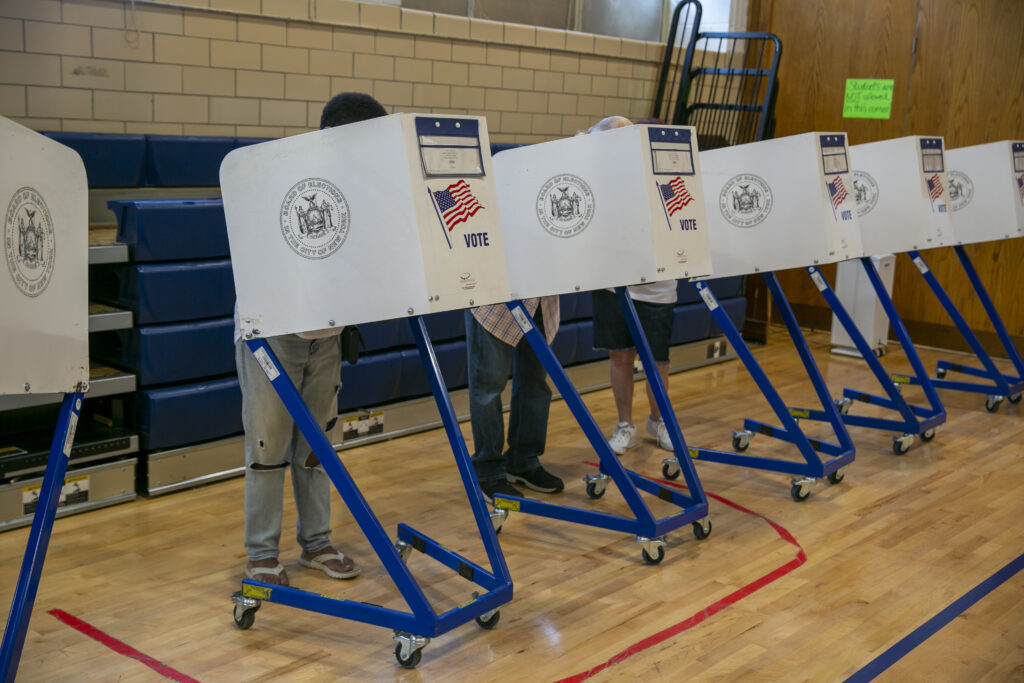
New York and New Jersey may be separated by a river and plenty of rivalry, but they both begin early voting Saturday with a strikingly similar set of election pressures.
Millions of voters across both states are preparing to cast ballots as disputes over voter eligibility, mail voting and federal access to voter data have intensified in the final weeks before Election Day.
Get updates straight to your inbox — for free
Join 350,000 readers who rely on our daily and weekly newsletters for the latest in voting, elections and democracy.
In New Jersey, a software error that registered roughly 6,600 people who indicated they were not U.S. citizens has triggered an escalating federal and congressional response. House Republicans this week subpoenaed acting Secretary of State Shirley Emehelu (D) for additional records about the incident, months after the Department of Justice (DOJ) unsuccessfully sued the state for access to voter registration data.
The state says fewer than 400 people newly registered because of the error actually voted and that those votes did not affect any election.
At the same time, voting rights groups are continuing to challenge a New Jersey Republican-led probe targeting dozens of voters in Ocean County.
Both New York and New Jersey are preparing to count mail ballots that are lawfully cast on time but may arrive after Election Day — a process that could again become a target of misinformation if close congressional races remain unresolved.
New Jersey is still cleaning up a registration error as federal scrutiny intensifies
New Jersey’s most closely watched voting issue began with a software failure at the Motor Vehicle Commission.
Between June 2023 and June 2024, roughly 6,600 people who answered “no” when asked whether they were U.S. citizens were nevertheless marked as citizens by the state’s software and transmitted for voter registration. Gov. Mikie Sherrill (D) said fewer than 400 people who were newly registered because of the error later voted.
The state has spent months removing registrations that resulted solely from the error while separately reviewing people who may have another valid registration or evidence of eligibility.
But the episode has also become the basis for escalating federal and congressional demands for sensitive voter information.
On Wednesday, House Republicans subpoenaed Emehelu for additional documents about the glitch, arguing the state’s response has been inadequate. The subpoena came after New Jersey refused to provide personally identifying information about the affected voters and after DOJ lost its own lawsuit seeking broader voter-registration data from the state in July.
The immediate ballot access question is whether efforts to correct the rolls remain narrowly limited to ineligible registrations — or whether eligible voters become caught in a last-minute “cleanup” or subsequent challenges.
A local probe could determine whether some Democratic New Jersey voters will have their ballots counted
In Ocean County, a separate dispute is testing how far local officials can go in questioning voters’ residency just before an election.
The county Board of Elections has been investigating dozens of Democratic and unaffiliated voters in Bay Head whose property-tax bills are sent outside the borough. Voting rights groups sued, alleging the process discriminated against those voters while excluding similarly situated Republicans. A judge declined last week to halt the investigation, allowing the review to continue.
The dispute involves only a few dozen voters, but the mechanism has broader implications: whether partisan residency challenges can force registered voters to prove their eligibility shortly before an election and potentially face additional scrutiny at the polls, or even after Election Day
Mail ballots can arrive after Election Day in both states and still count
New York and New Jersey both allow timely cast mail ballots to arrive after polls close — a rule that could become important if close House races remain unresolved for days.
In New York, ballots must be postmarked by Nov. 3 and received by Nov. 10. Election officials warn that ballots placed in collection boxes after the final Election Day pickup may not receive a timely postmark.
New Jersey similarly accepts ballots postmarked by Election Day if they arrive by Nov. 9, the last day of the state’s post-election receipt window. Voters can also return ballots directly to authorized drop boxes or election officials rather than relying on late mail delivery.
Those ballots are not late votes. They were cast under state rules allowing election officials additional time to receive and process them.
That distinction matters because lawful post-Election Day counting has repeatedly been portrayed as suspicious when close races remain undecided.
Some rejected mail ballots can still be fixed
A ballot that arrives on time can still face another hurdle: signature verification.
Both states provide procedures for voters to correct certain defects, such as a missing or mismatched signature, rather than automatically losing their vote.
That makes cure rates another number worth watching after Election Day. A large pool of unresolved ballots in a close congressional district can delay a result, but those ballots remain part of the lawful counting process while voters are given the opportunity required by state law to fix eligible defects.
Both states are still fighting federal demands for their voter rolls
New York and New Jersey have also become prime targets of the Trump administration’s broader effort to obtain unredacted voter registration records from states.
Both states rejected DOJ demands for sensitive voter data, and federal judges dismissed lawsuits seeking to compel the records. Those disputes remain alive on appeal.
The administration says the data are needed to enforce federal election laws and identify ineligible voters. State officials and voting rights advocates have raised concerns about privacy and about federal data being used to pressure states into aggressive removals that could sweep up eligible citizens.
In New Jersey, the MVC glitch has now become intertwined with that dispute: congressional Republicans cited the registration error this week while demanding additional records.
Federal election monitoring could become another source of tension
DOJ is expected to deploy election monitors around the country this year, in every state, including in jurisdictions where federal officials say scrutiny is warranted.
Federal election monitoring itself is longstanding and has historically been used to enforce voting rights laws. But state officials and civil rights groups are watching whether the scale or stated mission of this year’s effort — particularly amid heightened focus on alleged noncitizen voting — deters eligible voters.
The scrutiny comes as both states host consequential House contests. That raises the stakes of even small disputes over rejected mail ballots, eligibility challenges or post-Election Day counting: in a close district, several hundred or several thousand unresolved ballots can matter long before anyone knows the final margin.
What New York and New Jersey voters need to know
Early in-person voting runs Oct. 24 through Nov. 1 in both states.
In New York, Oct. 24 is also the voter registration deadline for the general election and the deadline for mailed or online early-mail and absentee ballot applications to be received.
New York voters returning ballots by mail should make sure they are postmarked no later than Nov. 3 and received by Nov. 10. The state recommends allowing about seven days for delivery.
New Jersey voters can vote early through Nov. 1 or return mail ballots through authorized channels before Election Day deadlines.
In both states, voters who requested a mail ballot but decide to vote in person should check the rules before heading to the polls, because they may need to cast an affidavit or provisional ballot rather than a regular machine ballot.