Alito peddles Trump’s mail voting fraud claims despite complete lack of evidence
 Prefer us on Google
to see more of our voting rights news coverage when you search.
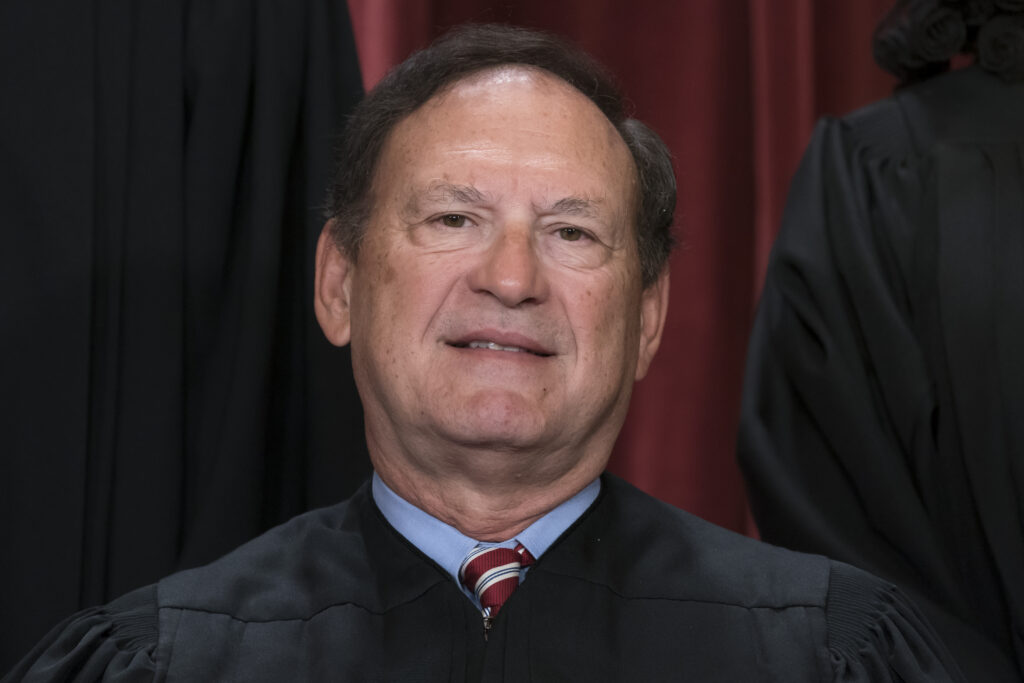
Justice Samuel Alito, in his unsuccessful defense of President Donald Trump’s plan to restrict mail voting in the midterm elections, parroted the administration’s unsubstantiated claims of fraud despite multiple lower court judges calling out the administration’s failure to produce any evidence.
Trump, who routinely votes by mail himself, for years has baselessly claimed that mail voting is rife with fraud. The administration cast its attempt to restrict mail ballots as an effort to curtail fraudulent voting even though multiple studies show it is exceedingly rare and does not happen in sufficient quantities to tip an election. However, Democrats use mail voting more often than Republicans.
The majority of the U.S. Supreme Court on Monday soundly rejected Trump’s attempted mail-voting power grab, warning the administration it is unlikely to win as legal battles work their way through lower courts.
However, Alito in his 8-page dissent, which Justice Clarence Thomas joined, wrote the “Government has a strong interest in enforcing the rule, and implementing it will also ‘enhance the visibility of Federal Ballot Mail’ in order to better detect election fraud.”
Alito’s assertion comes after federal judges on both sides of the political spectrum chastised Trump’s Justice Department for failing to provide any evidence of fraud.
Get updates straight to your inbox — for free
Join 350,000 readers who rely on our daily and weekly newsletters for the latest in voting, elections and democracy.
District Court Judge Carl Nichols, a Trump appointee, in his preliminary injunction against the Postal Service rule earlier this week wrote that the “Federal Government does not point to any record evidence that there will be significant fraud in the upcoming elections in the event the Court enters preliminary injunctive relief.”
Nichols went on to add that the government and the public “certainly have an interest in ‘strengthening public confidence in mail voting’” but that “there is no indication in the record before the Court that preliminarily enjoining the Ballot Mail Rule would actually harm those interests.”
Though Chief Justice John Roberts and all three of Trump’s appointees to the court voted against allowing the mail voting rule to take effect for the midterms, all of the court’s Republicans previously gave credence to Trump’s claim that the Postal Service rule is a good faith effort to secure elections rather than an attempt to restrict a method one-third of voters routinely use to cast their ballots.
“The President recently issued an Executive Order regarding election integrity,” the Republican justices wrote in the opening line of an unsigned order striking down a previous attempt to block the mail voting rule as premature.
Alito and Thomas’ latest dissent ultimately earned them Trump’s praise in a lengthy social media post after the Supreme Court’s decision. The president called them “legends,” while he hammered the justices who ruled against him – including his own hand-picked nominees, who he said were a “shell of their original selves.”
“Republicans just got another bad decision from the United States Supreme Court, one that the Court System took forever to give, and then blamed it, in part, on no time left to implement a solution to our totally CORRUPT and out of control Mail-In voting ‘disaster,’” Trump wrote in a Truth Social post.