Blue states, voting orgs rebut Trump admin’s justifications for restricting mail voting ahead of pivotal hearing
Pro-voting organizations and a group of blue states defended their entreaties for a judicial order preventing the Trump administration from carrying out the president’s sweeping attack on mail voting Tuesday in the final briefs ahead of a pivotal hearing Thursday.
A coalition of voting-rights organizations led by the League of Women Voters of Massachusetts (LWVMA) and 24 Democratic-led states and Washington, D.C., both picked apart the arguments offered by the Department of Justice (DOJ) and a dozen Republican-led states defending President Donald Trump’s anti-mail voting executive order and a U.S. Postal Service rule implementing it.
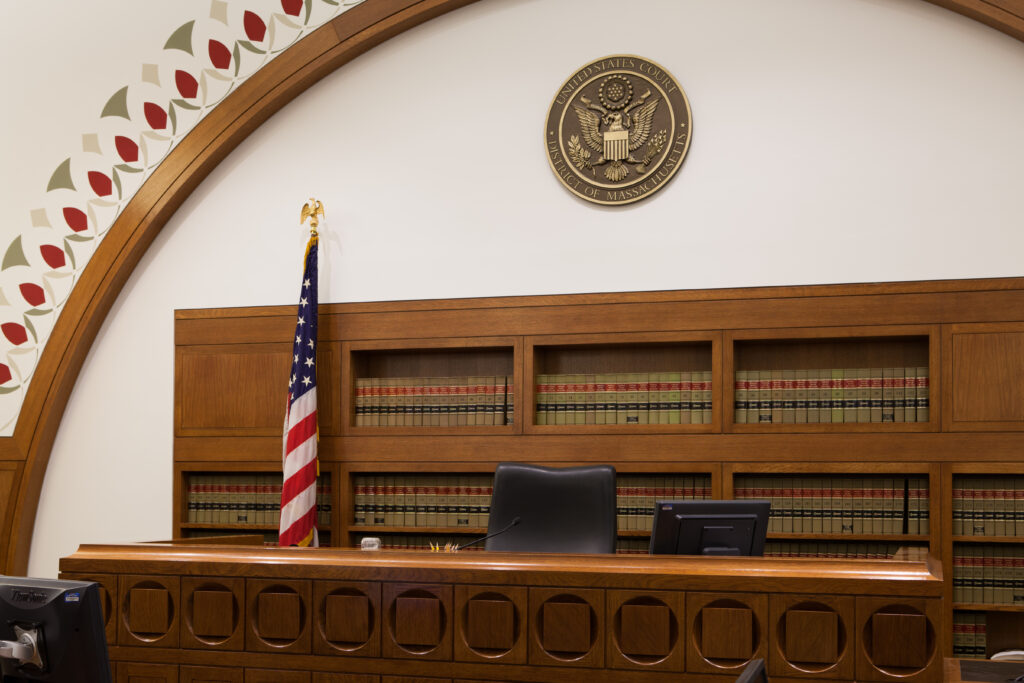
The parties will all cram into a federal courtroom in Boston Thursday to make their case in person before U.S. District Court Judge Indira Talwani.
First filed in April, the two legal challenges have steadily grown in urgency as Election Day — now 63 days away — rapidly approaches. The intensity of the overlapping litigation peaked last week when the U.S. Supreme Court lifted an injunction Talwani had imposed on Trump’s order, setting off a flurry of new legal filings.
Meanwhile, the fate of mail voting in the 2026 midterms hangs in the balance.
In their latest filings, the Democratic states provided new and updated testimony from election officials warning how the final rule puts the sanctity of the upcoming midterm vote at risk. In a declaration filed Monday, Wisconsin Elections Commission Chair Don Millis, who was appointed by a Republican, said it “would be virtually impossible for Wisconsin to comply with the Rule, for several reasons.”
While Wisconsin law requires municipal clerks to mail out absentee ballots no later than Sept. 17, some clerks intend to begin that process on Sept. 1, Millis wrote. As of Monday, Wisconsin voters had submitted 270,964 mail ballot requests (excluding military and overseas requests), but USPS has provided no information on how the state’s mass of local bureaucrats is supposed to use its new system.
“Even if [USPS’s] Ballot Portal were available today, and working as intended, it would be virtually impossible to ensure that each absentee voter in Wisconsin is enrolled,” Millis stated. “Municipal clerks would likely be responsible for enrolling their absentee voters. These 2,500-plus [Statewide Voter Registration System] users would need to be trained in how to use the new technology, become authorized users, and then enter the data—all within the next two weeks.”
“Because so many municipal clerks… hold these positions on a part-time basis, have other full-time jobs, and, especially in rural areas, have little to no administrative support, full and accurate compliance is extremely unlikely,” he added.
Get updates straight to your inbox — for free
Join 350,000 readers who rely on our daily and weekly newsletters for the latest in voting, elections and democracy.
The stakes couldn’t be higher, the Democratic states argued in their brief Monday.
“Over the next several weeks, state and local election officials will begin mailing ballots to tens of millions of voters who, under the laws of the Plaintiff States, have a right to receive and cast those ballots. This is a massive undertaking,” they wrote. “And, in several Plaintiff States, including Colorado, Hawai‘i, Oregon, and Washington, elections are run almost exclusively by mail.”
Embattled executive order
Trump’s electoral edict directed the Postal Service to issue new regulations making it harder to vote by mail. Talwani already tried to block the order — twice. But after the Supreme Court reversed one of her injunctions last Monday on the procedural grounds that it was too early to challenge a not-yet-finalized USPS rule, Talwani lifted the other.
Those procedural problems, however, disappeared when USPS formally published its final rule last week. The new regulation would require local and state election administrators to use pre-approved, barcode-equipped envelopes for mail ballots. The offices would also need to submit lists of eligible postal voters before mailing ballots. And if state or local officials fail to get USPS’s approval for their envelope design or don’t upload their voter data, then mail carriers wouldn’t deliver their mail ballots.
Talwani quickly suspended those mandates on state and local election officials with a 14-day temporary restraining order. Given her past decisions, most observers expect her to maintain the rule roadblock through November’s midterm elections.
The LWVMA’s final brief highlighted the steps taken to bolster its litigation from the administration’s procedural attacks during the past week of rapid legal maneuvering.
“Plaintiffs also have identified members who need to vote by mail and now risk being unable to vote at all,” the pro-voting organization wrote, pointing to declarations by out-of-state voters and voters with disabilities who rely on mail ballots to vote.
“This harm is not ‘speculative’ or ‘generic,’” LWVMA continued, citing the defendants’ latest arguments and noting that “USPS ‘will’ refuse to transmit mail ballots that do not comply.”
In its brief over the weekend, the DOJ wrote that USPS’s broad authority to regulate the collection, handling and delivery of mail also empowered it to condition the delivery of mail ballots on new envelope designs and absentee voter list rules.
But that’s simply wrong, the pro-voting plaintiffs argued Monday.
“General authority to carry out USPS’s postal functions does not create a new function Congress never assigned: ‘[The] right to exclude letters, or to refuse to permit their delivery to persons addressed, must depend upon some law of Congress,’” they wrote, citing a Supreme Court opinion from 1902. “USPS identifies no such law.”
The DOJ and red states have repeatedly likened mail ballots to cremated remains and fake bombs, noting that USPS can issue specific rules for handling that kind of “sensitive mail.” But those regulations are tethered to specific statutes, LWVMA noted.
Moreover, while Congress has specified categories of “nonmailable matter” by law, “mail ballots that do not comply with the Rule’s regulations are not on that list.” And while USPS can issue regulations on “postal integrity,” the final rule explicitly says it addresses “election integrity,” echoing the title of Trump’s order: “Ensuring Citizenship Verification and Integrity in Federal Elections.”
LWVMA likewise attacked the DOJ’s contentions that USPS wasn’t intruding on states’ authority to run elections.
“The argument that the Rule does not regulate elections because states retain authority over voter rolls and who may vote blinks reality,” the plaintiffs wrote. “The issue is not whether states may still determine eligibility as a legal matter; it is that USPS conditions ballot carriage on states’ redesign of ballot envelopes, creation of bar codes, and pre-submission of error-free voter information, and will block transmission of ballots to voters whom the states have deemed eligible if they do not comply with the Rule.”
Who’s really harmed?
Given her past rulings in these cases, Talwani will most likely issue another injunction soon after Thursday’s hearing. If the White House and its handful of red state allies end up appealing all the way to the Supreme Court, the issue may ultimately come down to what lawyers call the “balance of the equities” and the public interest.
Both sides argue that they will be “irreparably harmed” if the other side wins. The Democratic states’ brief warns the damage to democratic rule could be catastrophic.
“The voluminous evidence in the record establishes that implementation of this Rule, on this timeframe, will prevent millions of Americans from voting by mail under state law, and likely, from voting at all,” they wrote. “This inevitability does incalculable and irreparable harm to Plaintiff States, as well as severe damage to the public’s fundamental interest in the right to freely participate in our democracy.”
Across legal filings and public statements, the administration has repeatedly sworn that the rule is needed to help stop fraudulent voting. But, as LWVMA responded Monday, “[t]he record continues to lack any evidence regarding fraudulent absentee or mail-in voting… and USPS’s ‘generalized worries… do not amount to irreparable harm.’”
And the Democratic states rebutted the DOJ’s recent attempts to downplay the enormity of the new rule. “USPS now attempts to assure the Court that its novel claim of power is ‘modest’ and that the new requirements are ‘limited,’” they wrote. “But the mail is a critical instrumentality through which elections are conducted—nearly exclusively in some Plaintiff States, heavily in all.”
“Extensive and unrebutted declarations from Plaintiff States establish that these requirements range from infeasible to impossible,” they added. “Mass disenfranchisement will result.”