Judge lifts second block on Trump’s mail voting order, clears way for legal fight on constitutionality
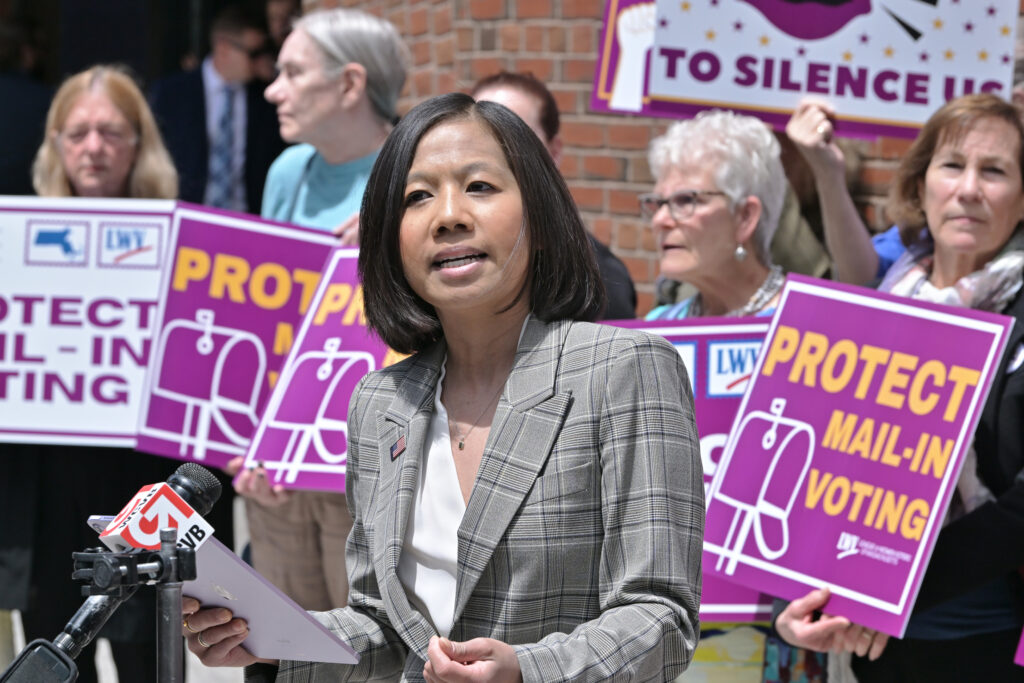
A federal judge in Massachusetts lifted restrictions preventing the U.S. Postal Service (USPS) from implementing President Donald Trump’s anti-mail voting executive order. The decision allows the administration to continue work on the order for now as a legal battle over its constitutionality looms.
U.S. District Court Judge Indira Talwani’s decision to lift her own blockade Wednesday came two days after the U.S. Supreme Court invalidated her other injunction against the order in a separate lawsuit.
In explaining her decision, Talwani noted that the Supreme Court’s procedural reasoning in the other case — that she was too quick to issue an injunction before Trump’s order was actually implemented — also applied in this case.
“The Supreme Court found that this court erred in [the other case] by ‘speculat[ing]’ that the USPS would (1) propose a rule; (2) weigh the comments; and (3) issue a final rule consistent with the EO’s directives, and admonished that ‘[f]ederal courts review final rules, not proposed rules––and certainly not antecedent internal directives to propose a rule,’” Talwani wrote. “The court finds it likely that the Supreme Court would apply the same reasoning here.”
While she removed her injunction, Talwani took veiled swipes at the conservative majority’s logic in the other case, State of California v. Trump.
“[W]ithout any consideration of whether the Executive’s ‘goals’ are lawful, or even likely lawful or possibly lawful, the Supreme Court concluded that appellate review on the merits of the court’s final judgment in California v. Trump ‘would come too late for the 2026 midterms’ and that the court’s errors [as to justiciability] deal ‘a serious setback’ to those ‘goals’ while an injunction is in place,” she wrote.
Despite the vacated injunctions, the legal battle over Trump’s attempt to interfere in mail voting ahead of November’s midterm elections is far from over.
USPS’s rule implementing Trump’s order was formally published Wednesday morning, meaning it is now ripe for a legal challenge on its merits.
Get updates straight to your inbox — for free
Join 350,000 readers who rely on our daily and weekly newsletters for the latest in voting, elections and democracy.
In lifting the second injunction, Talwani allowed the plaintiffs — pro-voting groups led by the League of Women Voters of Massachusetts (LWVMA) — to amend their complaint and seek a new court order to block the federal government from carrying out Trump’s decree.
A day earlier, in a separate, ongoing lawsuit in Washington, D.C., Democratic plaintiffs renewed their own bid to block Trump’s order, filing a supplemental complaint arguing that the finalized USPS rule removed the procedural concerns that led a judge there to reject their first injunction request as premature.*
With under three months left before the midterms, the ongoing legal saga means election officials and voters may not get the final word on mail voting until late, adding uncertainty and the potential for mass confusion to an already fraught election.
Trump’s attack on mail voting began in March, when he signed an executive order (EO) directing the U.S. Postal Service (USPS) to only deliver mail ballots to voters on pre-approved lists maintained by the federal government using new, specifically designed envelopes with mandatory barcodes.
The order triggered a flurry of lawsuits questioning the EO’s legality, including two brought before Talwani: one by a coalition of pro-voting groups led by LWVMA and another by 23 Democratic-led states and Washington, D.C., led by California.
Talwani granted a permanent injunction in the California lawsuit, which the administration appealed all the way to the Supreme Court. The Court invalidated that injunction Monday, ruling that because USPS had not yet published a final rule, Talwani had blocked the EO’s implementation based on conjecture.
But when USPS published its final rule, it rendered the procedural problems with Talwani’s injunctions moot.
As a result, the Democratic states filed a new lawsuit Wednesday, adding Hawaii as another plaintiff. That case, which was assigned to Talwani, calls for a temporary restraining order on an expedited litigation schedule. Like the lawsuit before it, this new challenge contends that Trump’s order is blatantly unconstitutional.
As Justice Ketanji Brown Jackson noted in her dissent Monday, the administration hasn’t even tried to defend the EO on its merits in any of the lawsuits challenging it, relying instead on the arguments about legal standing and timing.
“The Government has not even bothered to assert, much less demonstrate, that the President has the constitutional authority to issue an order that directs the manner in which the mail-in ballot aspect of federal elections is to be administered,” she wrote.
The Constitution clearly provides states and Congress, not the executive branch, with the power to regulate elections.
In a separate, related order Tuesday, Talwani called out USPS for filing its final rule Friday in the face of her preliminary injunction that barred it from “initiating or completing rulemaking to promulgate the specific regulations outlined” in the EO.
“[D]espite the Defendants’ protestations that ‘[t]he United States takes its obligation to comply with court orders very seriously,’ the court finds that Defendants violated the preliminary injunction in this case,” Talwani wrote.
But she declined to issue the restraining order the LWVMA plaintiffs had requested, noting that the USPS’s defiance of her court order will now allow the pro-voting organizations to file a stronger, amended claim “noting that the issuance of a Final Rule is no longer hypothetical.”
Adeline Tolle contributed to this report.
*The Elias Law Group (ELG) represents the Democratic plaintiffs in their lawsuit. ELG Firm Chair Marc Elias is the founder of Democracy Docket.