USPS repeatedly defied courts to advance Trump’s mail voting attack, whistleblower alleges
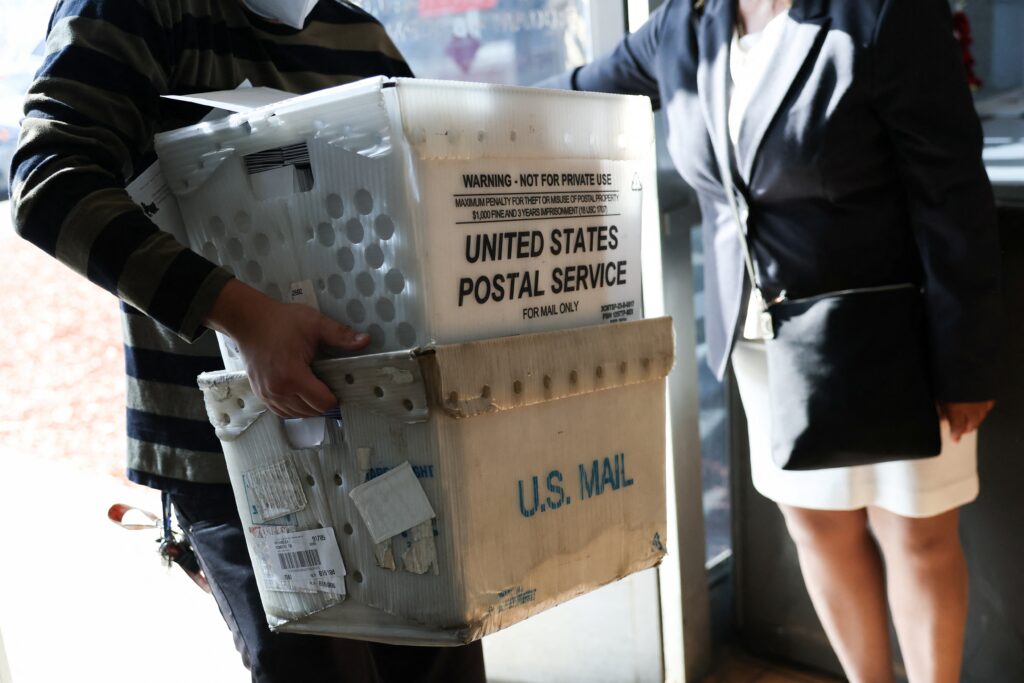
A bombshell whistleblower report alleged that the U.S. Postal Service (USPS) brazenly violated multiple court orders to secretly advance President Donald Trump’s attempt to restrict mail voting ahead of the upcoming midterms.
The report, released by Sen. Richard Blumenthal’s (D-Conn.) office Tuesday, claims that USPS continued to implement parts of Trump’s March 2026 anti-voting executive order weeks after it said it was complying with multiple court orders largely barring it from doing so. And the document offers details of how the postal agency allegedly did that.
The defiance alleged by the whistleblower dovetails with the administration’s broader alarming pattern of skirting or ignoring court orders in immigration-related cases and other lawsuits.
With lawsuits ongoing against Trump’s mail voting restrictions, the revelations in the report could allow the plaintiffs to argue for additional court orders against USPS or for existing orders to remain in place.
Get updates straight to your inbox — for free
Join 350,000 readers who rely on our daily and weekly newsletters for the latest in voting, elections and democracy.
According to the whistleblower, USPS didn’t just misrepresent its plans. The agency also disregarded court orders while the Department of Justice (DOJ) was simultaneously seeking extraordinary legal relief from the Supreme Court to lift those same orders.
The Court eventually granted that relief last week.
Moreover, the report claimed that the Trump administration’s haphazard implementation of its mail voting restrictions could unleash chaos during the November election and result in tens of thousands of ballots being undelivered for no reason.
The whistleblower, whose statement was prepared by the nonprofit advocacy group Whistleblower Aid, said the agency’s work implementing Trump’s mail voting restrictions began in earnest in June.
But later that month, District Judge Indira Talwani, who was appointed by former President Barack Obama, barred USPS from fulfilling Trump’s demands, finding that they were “legally void” because the Constitution allows states and Congress to administer elections, not the president.
At the time, USPS was working on a then-proposed rule directly stemming from Trump’s executive order. The rule, which the Postal Service formally adopted last week, requires states to alter the envelopes they use to send voters mail ballots and give the federal government a list of all voters who intend to vote by mail.
If states don’t comply with its demands, USPS would refuse to deliver ballots to people in those states, potentially disenfranchising millions of voters.
Talwani’s ruling applied to the 23 states and the District of Columbia that are suing USPS over the rule.
The whistleblower said USPS, to comply with Talwani’s ruling, initially stopped creating a new online system. The agency intends to use the system — called the “USPS Federal Ballot Mail Portal” — to receive the states’ lists of voters who intend to vote by mail.
However, the whistleblower said USPS suddenly resumed work on the portal and other aspects of its rule “on or around” July 29 — over a month after Talwani issued her first block against Trump’s executive order.
Work began again even as USPS leaders, publicly and in letters to members of Congress, maintained that the agency was not moving forward with the rule because of Talwani’s injunction and a separate court order involving the NAACP.
“The Postal Service is abiding by these injunctions, which are also currently under appeal,” Postmaster General David Steiner and Amber McReynolds, chairwoman of the USPS board of governors, wrote in a letter to Senate Democrats on July 15.
The date when USPS allegedly resumed work is key: Just days earlier, a panel for the 1st Circuit Court of Appeals had affirmed Talwani’s initial order. And on July 27, Solicitor General John Sauer — on behalf of USPS — asked the Supreme Court to stay Talwani’s initial order, claiming that it was issued prematurely.
The Supreme Court’s conservative-appointed majority granted the Trump administration’s stay request last week, essentially resetting litigation over the president’s attempt to restrict mail voting before the midterms. That means that, for roughly a month, USPS had been working to advance the mail voting restrictions, allegedly in violation of the court order.
The whistleblower’s allegations have been in part corroborated by Talwani. On Aug. 11, she also issued a second block against Trump’s order in a separate case brought by the Massachusetts branch of the League of Women Voters. This time, her ruling applied nationwide, meaning any effort to implement Trump’s order would have defied standing court orders.
Still, USPS continued to work in violation of court orders, Talwani determined in an Aug. 25 ruling.
“[D]espite the Defendants’ protestations that ‘[t]he United States takes its obligation to comply with court orders very seriously,’ the court finds that Defendants violated the preliminary injunction in this case,” Talwani wrote, though she held off on issuing a punishment for the violation.
The whistleblowers’ allegations could have implications in other lawsuits challenging Trump’s order.
In a lawsuit filed by Democrats* in Washington, D.C., a federal judge ordered the DOJ to notify the court of any “material factual developments while this litigation remains pending.” Despite that standing order, the DOJ did not inform the court that USPS resumed implementing Trump’s order in late July.
In a new lawsuit filed by 24 states and D.C. last week, Talwani issued a temporary 14-day restraining order barring USPS from requiring all states to change their mail ballot procedures or submit their lists of absentee voters to the federal government.
The DOJ asked the 1st Circuit Monday to stay Talwani’s temporary order — an extraordinary form of legal relief that’s seldom granted by appeals courts.
Typically, temporary injunctions like Talwani’s latest order aren’t appealable. But the DOJ, in its rush to get Trump’s mail voting restrictions in place by the midterms, asserted that the appeals court must treat the temporary order as an appealable preliminary injunction.