A federal judge has said from the start Trump’s anti-mail voting order is unconstitutional. Here’s how
 Prefer us on Google
to see more of our voting rights news coverage when you search.

Months ago, a federal judge in Massachusetts declared President Donald Trump’s attack on mail voting through executive order unconstitutional.
U.S. District Judge Indira Talwani, in a 37-page ruling on June 25, said key parts of the order were “legally void” for exceeding the president’s power and for encroaching on states’ authority to administer elections.
In subsequent rulings and orders, Talwani has continued to build a thorough and painstaking case for why it’s crucial the administration should be blocked from moving forward with Trump’s directive — to avoid large numbers of voters facing major hurdles to the ballot box.
Those concerns were underscored Tuesday by the release of a whistleblower report claiming that the rushed process by the U.S. Postal Service (USPS) in implementing the order could cause a “catastrophic failure” of the mail voting system.
Get updates straight to your inbox — for free
Join 350,000 readers who rely on our daily and weekly newsletters for the latest in voting, elections and democracy.
The Trump administration appealed Talwani’s June order to the Supreme Court, which ruled last week that Talwani’s block on the order came too early. What the Court notably didn’t determine is whether the order and a new U.S. Postal Service rule to implement it are lawful.
Now, Talwani’s arguments are coming full circle as she oversees two refiled legal challenges to stop Trump’s restrictions on mail voting from going into effect before November’s high-stakes midterm elections.
Under Trump’s demands, states would be forced to meet new ballot envelope design requirements and submit data on who is voting by mail to a new federal government portal. If the standards aren’t met, USPS would refuse to mail affected ballots to voters.
Here’s a closer look at what Talwani has said about why the order violates the Constitution.
Trump doesn’t have power over elections
In a broad rejection of Trump’s effort to unilaterally change election procedures through executive action, Talwani bluntly wrote in her June 25 order: “The Constitution does not grant the President any specific powers over elections.”
Talwani added further emphasis by underlining the words “does not.”
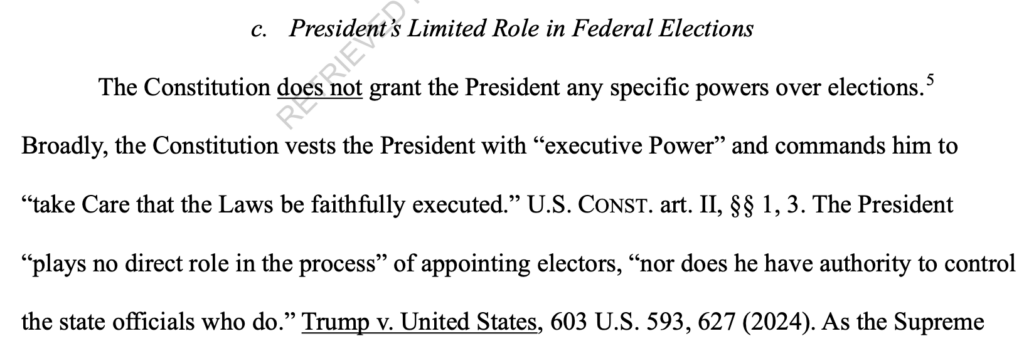
She said that while the Constitution gives a president the power to see that the country’s laws are being “faithfully executed,” that authority has limits and “refutes the idea that he is to be a lawmaker” himself.
“The President ‘plays no direct role in the process’ of appointing electors, ‘nor does he have authority to control the state officials who do,’” Talwani added.
She also later declined a request from the administration to remove Trump as a defendant in the case.
Talwani’s rejection of Trump’s authority wasn’t limited to one technical provision. In her June 25 order, she declared Sections 2 and 3 of the executive order “legally void” because they were beyond the president’s legal power and because they violated the separation of powers.
Section 2 directed the Department of Homeland Security to compile lists of voting-age citizens in each state and send them to state election officials, while Section 3 directed USPS to create new rules for mail ballots — including envelope-design requirements and a system under which USPS would not transmit mail ballots from voters who were not “enrolled” on a state-specific mail ballot list.
That framing has shaped the litigation ever since: For Talwani, the problem is not simply that the administration moved too quickly or imposed burdensome rules. It is that Trump attempted to use executive power to do what the Constitution assigns to states and Congress.
States have the authority to administer elections
Talwani has repeatedly emphasized that the Constitution grants authority over elections to individual states, not the executive branch.
In her June 25 ruling, she cited the Elections Clause of the Constitution, which gives state legislatures the power to set the “Times, Places and Manner” of federal elections.
“The Constitution reserves the power to determine voter eligibility to the States alone. Neither the Executive Branch nor Congress may interfere with this power,” she wrote.
Congress has a role, but hasn’t acted here
“The Elections Clause empowers Congress to ‘make or alter’ State election laws ‘at any time,’” Talwani wrote.
Congress has exercised this power on multiple occasions. Talwani specifically highlighted as examples the Voting Rights Act, the National Voter Registration Act and the Help America Vote Act.
“However, no law enacted by Congress delegates authority to control mail-in voting to USPS,” Talwani wrote.
Talwani also distinguished between USPS’ traditional election-mail guidance and the binding requirements Trump’s order demanded. USPS has long issued recommendations for election mail, she wrote, but those recommendations were “not binding on the States.”
By contrast, Trump’s order sought mandatory rules governing mail ballots — a step Talwani said USPS lacked statutory authority to take.
Talwani doubled down on this point in her temporary restraining order (TRO) on Aug. 27, writing: “As to the substantive merits, the Constitution charges the States with election administration. While the States’ decisions may be pre-empted by Congress, the court is unaware of, and no party has proffered, any delegation Congress has made that would permit the USPS to regulate election mail.”
That distinction became even more important once USPS finalized its rule.
In her temporary restraining order, Talwani wrote that USPS would not mail ballots if state or local election officials failed to obtain federal approval of ballot-envelope designs, upload voter information or include unique barcodes. In her view, that meant USPS was conditioning states’ use of the mail on federal sign-off and voter-data submissions.
USPS can deliver ballots. It can’t gatekeep them
Talwani’s latest rulings also directly reject the administration’s argument that USPS’ final rule is merely a modest mail-processing regulation.
“Defendants’ branding the Final Rule’s changes as ‘modest’ does not alter the actual requirements of the Final Rule,” she wrote.
In her TRO, she found that the plaintiffs are likely to succeed on claims that USPS lacked authority to issue the rule, that the rule unconstitutionally imposes requirements on states and that it unconstitutionally bars noncompliant state and local officials from using USPS to mail ballots.
The rule, Talwani wrote, “conditions States’ use of the postal service on the USPS’s sign-off on ballot envelopes and return envelopes and on State and local election officials uploading and certifying voter information through the USPS portal.”
In practical terms, Talwani said the rule would move USPS beyond delivering ballot mail and into deciding whether states have satisfied federal conditions before voters can receive ballots through the mail.
The threat to voters is real
Talwani has also been blunt about the practical stakes.
In her TRO, she also wrote that the record “continues to lack any evidence regarding fraudulent absentee or mail-in voting,” while USPS’ interest in correcting an “unsubstantiated problem” was outweighed by the risk of disenfranchising voters who need mail ballots to vote.
That harm, Talwani wrote, is especially urgent because elections cannot simply be redone after voters lose access to the ballot.
For her, the constitutional question and the practical danger are intertwined. A federal agency acting without lawful authority could reshape mail voting so late in the election cycle that states cannot comply and voters cannot recover.