‘A deliberate barrier’: Texas battleground county cuts 30% of midterm voting locations
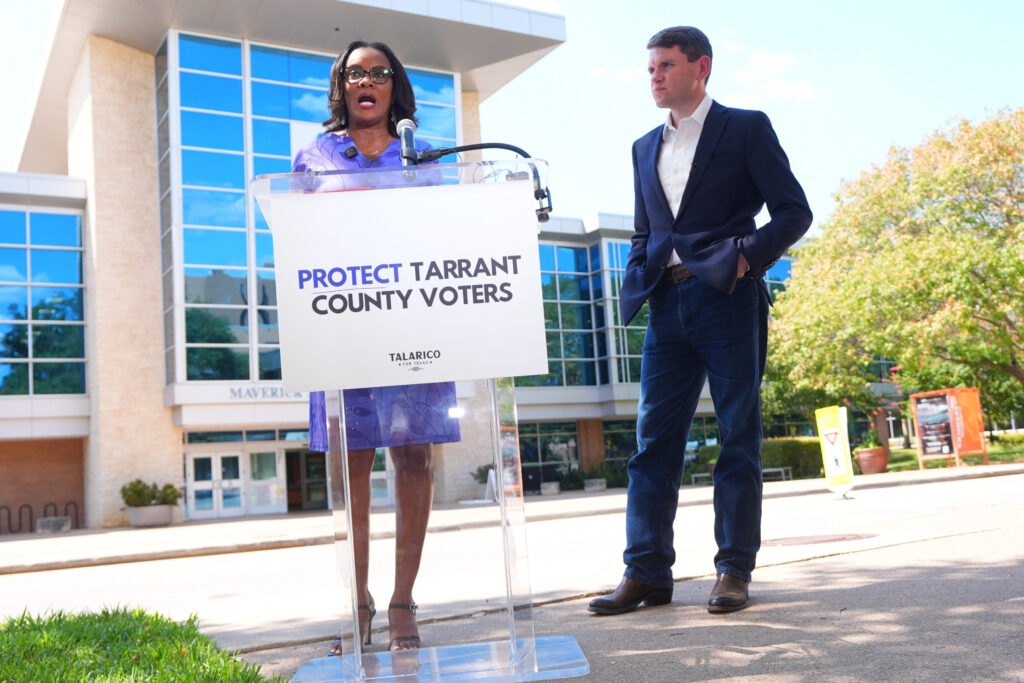
Republican officials in a major battleground Texas county voted Tuesday to slash Election Day polling locations by 30% for the November midterm elections.
Under the new plan, Tarrant County will have 224 Election Day voting locations, down from 316 in the 2022 midterms. It will also have 47 early voting locations, down from 50.
The county commissioners approved the early voting and Election Day location plans in separate 3-2 votes. County Judge Tim O’Hare and Commissioners Matt Krause and Manny Ramirez voted in favor of both plans, while Commissioners Roderick Miles Jr. and Alisa Simmons voted against them.
The Republican majority also rejected amendments that would have restored polling locations at the University of Texas at Arlington and the Northeast and South campuses of Tarrant County College. Another amendment seeking to restore dozens of Election Day locations also failed 2-3.
Outraged Tarrant County voters showed up at Tuesday’s county commissioners meeting in force, more than filling two overflow rooms and holding signs with a clear message about the Republican local officials who supported the plan: “Vote them out.”
“We are making national headlines for all the wrong reasons this week,” Tarrant County resident Brooke Whittaker told county leaders. “Ordinary citizens should not have to come down here and explain to you why making it harder to vote is a bad idea, but here we are.”
Get updates straight to your inbox — for free
Join 350,000 readers who rely on our daily and weekly newsletters for the latest in voting, elections and democracy.
Tarrant County, home to Fort Worth, is the 14th largest county in the U.S. Traditionally a safe GOP stronghold, it’s become a crucial battleground county with a growing minority population that votes increasingly Democratic. Earlier this year, Texas Republicans were stunned when Democrat Taylor Rehmet won a special election to fill a state senate seat in Tarrant County.
Texas will host a pivotal U.S. Senate race, as well as several key U.S. House races, this fall.
State Rep. Chris Turner (D) blasted GOP county leaders for closing polls, particularly at the University of Texas at Arlington and Bethlehem Baptist Church.
“Stripping a major university of its polling site is not a neutral decision,” Turner said in a letter posted on social media. “It is a deliberate barrier placed in front of young voters, first-time voters, and voters who already face disproportionate obstacles to civic participation.”
“Equally unacceptable is the proposed elimination of Bethlehem Baptist Church, a site that opened in 2024 and has since become a model of community engagement,” Turner went on. “From 2024 to 2026, Bethlehem Baptist Church more than tripled its voter turnout, a clear sign that when communities are given accessible, trusted locations, they show up.”
Kayla Gillespie, a student at the University of Texas at Arlington, spoke at Tuesday’s meeting, imploring leaders to keep the campus polling site open.
“Accessibility is one of the biggest factors when it comes to young voters,” she said.
During the debate, Simmons read from an email in which a UTA official said the university was “happy to accommodate early voting and day-of voting at the Maverick Activity Center.” Election Administrator Clint Ludwig said he did not receive final confirmation from the university until the Saturday before the vote.
Simmons argued that sending students to another location ignored the practical burden involved. “You expect the student to walk a mile to the Arlington sub-courthouse,” she said. “You walk a mile and it’s going to take you about 45 minutes each way, and you’ve got class to get back to.”
Another Tarrant County resident, Donna Reagan, said she worried that Tarrant County’s GOP leadership was headed in an increasingly alarming direction.
“I realize that if this trend continues of suppressing the vote of populations you deem unworthy, by the time my grandkids are old enough to vote the obstacles may seem so insurmountable they don’t even register — which might be the point,” Reagan said.
Miles warned his fellow commissioners that a polling location’s significance cannot be measured by distance or turnout numbers alone.
“These are not just buildings. These are not just places where people go to vote,” he said. “There’s history in these buildings. There’s familiarity. There’s community in these buildings.”
“It’s easy to say it’s only a mile if you’ve got a car,” Miles continued. “It’s easy to say that it’s on the bus route if you’ve got money to buy a bus fare. What about the people who don’t have the ability to do those things?”
Voters did not appear to be persuaded by GOP officials’ claims that the cuts were motivated by financial constraints.
“You tell us this is about efficiency and saving our tax dollars,” Tarrant County voter Laney Hawes told officials. “I’d love to know what you all think our tax dollars are for. They are to serve us and I can’t think of a better use of taxpayer money than to encourage and support the democratic process.”
Simmons said an analysis of the adopted list showed that the quarter of Tarrant County ZIP codes with the lowest poverty rates would lose about 15% of their Election Day locations, while the quarter with the highest poverty rates would lose about 41%.
Miles compared the new barriers to the poll taxes imposed on earlier generations of voters, holding up the poll-tax receipt belonging to his wife’s great-grandmother, Maggie McCain.
“She was willing to suffer the indignity of having to pay a poll tax for a right that belonged to her,” he said. “What we are doing with reducing polling locations is instituting barriers to making access to voting for people. It’s modern-day poll taxes.”
Voters were furious when county leaders initially considered a plan last month that would have cut almost half of the Election Day polls and closed eight early voting sites, including some on college campuses.
But Tarrant County Judge Tim O’Hare (R), who leads the county government, will have to face those voters himself in November. He decided to postpone the final vote to Sept. 1 to add more locations.
O’Hare has drawn a serious challenger in his re-election bid: Democratic County Commissioner Alisa Simmons, whose district was dismantled by a mid-decade gerrymander O’Hare spearheaded last year. Simmons has called the voting location closures a “deliberate act to reduce voter access.”
During Tuesday’s debate, Simmons said the cuts were about political control rather than saving money.
“What you have not heard today is anything about cost,” she said. “This is not about cost. This is about power.”
At Tuesday’s meeting, state Rep. Vikki Goodwin, the Democratic candidate running for Texas lieutenant governor, criticized the cuts and urged Tarrant County residents to exercise their right to vote regardless of the closures.
“Closing down a third of your polling locations doesn’t make sense,” Goodwin said. “If it looks like voter suppression, if it sounds like voter suppression, it is voter suppression.”
Still, the public outcry did at least secure some victory. County leaders retreated from their original plan to eliminate nearly half of Election Day polling places, limiting the final reduction to 30%.