Trump admin offers no evidence of election fraud in court battle over mail voting restrictions
 Prefer us on Google
to see more of our voting rights news coverage when you search.
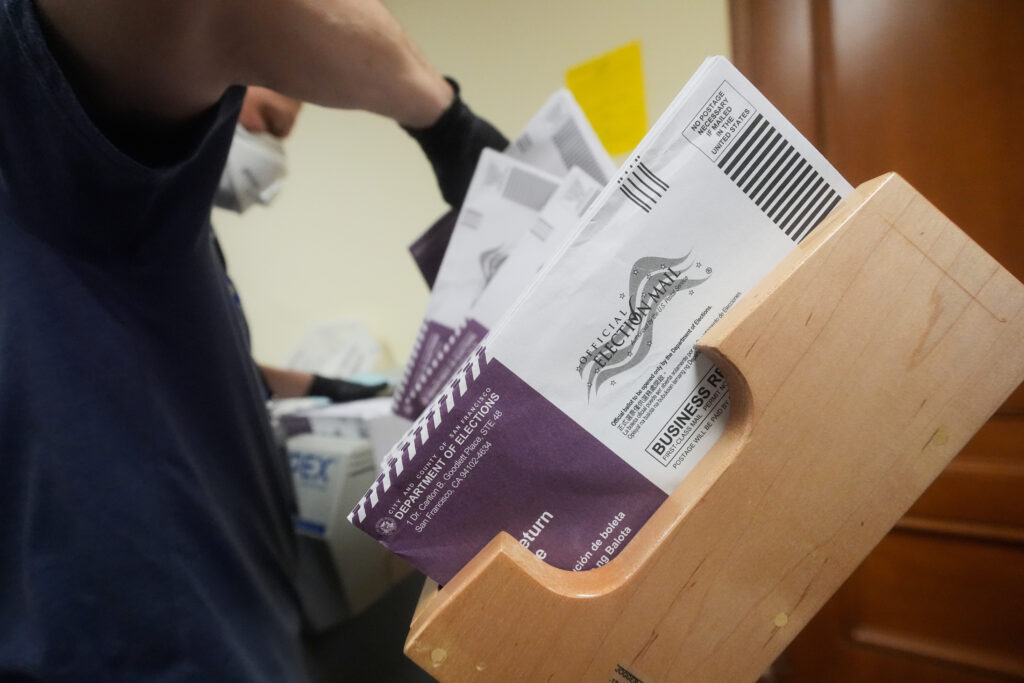
The keystone contention supporting President Donald Trump’s executive order on mail voting and the U.S. Postal Service’s (USPS) rule carrying it out is that noncitizen voting risks undermining the legitimacy of American elections.
But throughout the legal battles over the USPS rule, the administration has not presented an iota of evidence that fraud would flourish absent the new restrictions.
In his order enjoining the new rule Sunday night, U.S. District Court Judge Carl Nichols flagged the omission.*
“The Federal Government does not point to any record evidence that there will be significant fraud in the upcoming elections in the event the Court enters preliminary injunctive relief,” Nichols, a Trump appointee, wrote. “That’s perhaps not surprising, since the Government’s position is that the Final Rule is just a ‘regulation of the U.S. mail, and a modest one at that.’”
Across the countless legal filings in the many lawsuits challenging Trump’s order and USPS’s subsequent rules, the Department of Justice (DOJ) has repeatedly failed to provide evidence backing the central claim behind them: that noncitizen voting and mail ballot fraud are real, substantial problems that must be addressed by federal government intervention.
Ever since he lost the 2020 presidential election, Trump has harped on voter fraud, repeatedly lying about “rigged” ballot counts at the hands of Venezuela, China or “the deep state.” In a primetime national address in July, Trump presented “evidence” that hundreds of thousands of noncitizens were registered and voting; those claims were immediately debunked.
While Trump and his MAGA allies are free to spout falsehoods in speeches and interviews, the government’s lawyers are far more constrained in a court of law, where making false statements can lead to contempt charges and even disbarment. Some of Trump’s personal attorneys learned that the hard way: Rudy Giuliani was disbarred over statements he made in court promoting Trump’s election denialism.
Nichols’ decision in DSCC v. Trump echoed U.S. District Court Judge Indira Talwani’s ruling earlier this month in separate, overlapping litigation in Massachusetts.
“[T]he record includes no evidence relating to fraudulent mail voting to support the rushed implementation of the Final Rule,” Talwani wrote.
Then, in a footnote, Talwani highlighted that the “strongest support in the record for the USPS’s asserted policy justification,” came from a one-off line in the final rule referring to “commenters’ ‘differing views on the incidence of voter fraud and its impact on election integrity.’”
Get updates straight to your inbox — for free
Join 350,000 readers who rely on our daily and weekly newsletters for the latest in voting, elections and democracy.
Last week, the 1st Circuit Court of Appeals upheld Talwani’s findings. That unanimous panel of judges also remarked on the administration’s startlingly scant support for the alleged problem of noncitizen voting to defend this attempted incursion into states’ authority to run elections.
“[T]here is no record evidence of past fraud or a likelihood of impending fraud related to the November 3 election,” the appellate judges wrote. “Thus, we see no obvious error in the district court’s conclusion that allowing this Final Rule to be effective for the soon-arriving November 3 election will likely result in the disenfranchisement of millions of voters across the country while providing minimal – if any – gains in combating voter fraud.”
Beyond the courtroom, legal experts have observed the DOJ’s inability to support its central contention with bewilderment, even as the administration has appealed Talwani’s injunction up to the U.S. Supreme Court.
In a supplemental filing before the Supreme Court Monday morning, the DOJ downplayed the legal significance of its missing voter fraud evidence. “[T]he DSCC court’s rationale disregards that interfering with efforts to deter and catch voter fraud, and to foster greater public confidence that such fraud is not occurring, is a serious irreparable injury regardless of how much voter fraud would actually occur absent the Rule’s prophylaxis,” the DOJ wrote.
“The most inexplicable thing about the USPS rulemaking and the Government’s briefs, however, is that they offer nothing to support that claim—no basis at all to believe that the conditions the USPS would require would have the slightest impact on the Government’s ability to ferret out ‘voter fraud’ (which is exceedingly rare), nor even a theory or speculation about why they might do so,” Georgetown University law professor Marty Lederman wrote recently on Just Security.
Lederman went on to note that even if you take the DOJ’s word that voter fraud is a problem, the USPS rule does nothing to seriously solve it — unless you believe the rot extends to the Post Office itself.
“Because the Rule regulates the delivery of ‘outbound’ ballots from election officials to voters, rather than the voters’ own ‘return’ ballots, I suppose it’s possible the USPS’ ‘fraud’ prevention rationale in its rulemaking was referring, not so much to voters’ alleged fraudulent conduct, but to alleged actions of state and local election officials to aid noncitizens in voting unlawfully,” Lederman wrote. “There’s no history of that phenomenon, however, nor has the USPS or the Solicitor General suggested to the contrary.”
Noncitizen voting is exceedingly rare, as dozens of studies and audits have shown. Despite the Trump administration diverting investigative and prosecutorial resources away from crimes like drug trafficking to focus on this specious threat to electoral integrity, few new incidents have been found.
Likewise, postal voting is overwhelmingly secure and mail ballot fraud is vanishingly infrequent.
*The Elias Law Group (ELG) represents the plaintiffs in this case. ELG Firm Chair Marc Elias is the founder of Democracy Docket.