Judge appears deeply skeptical of case for Trump’s mail voting restrictions
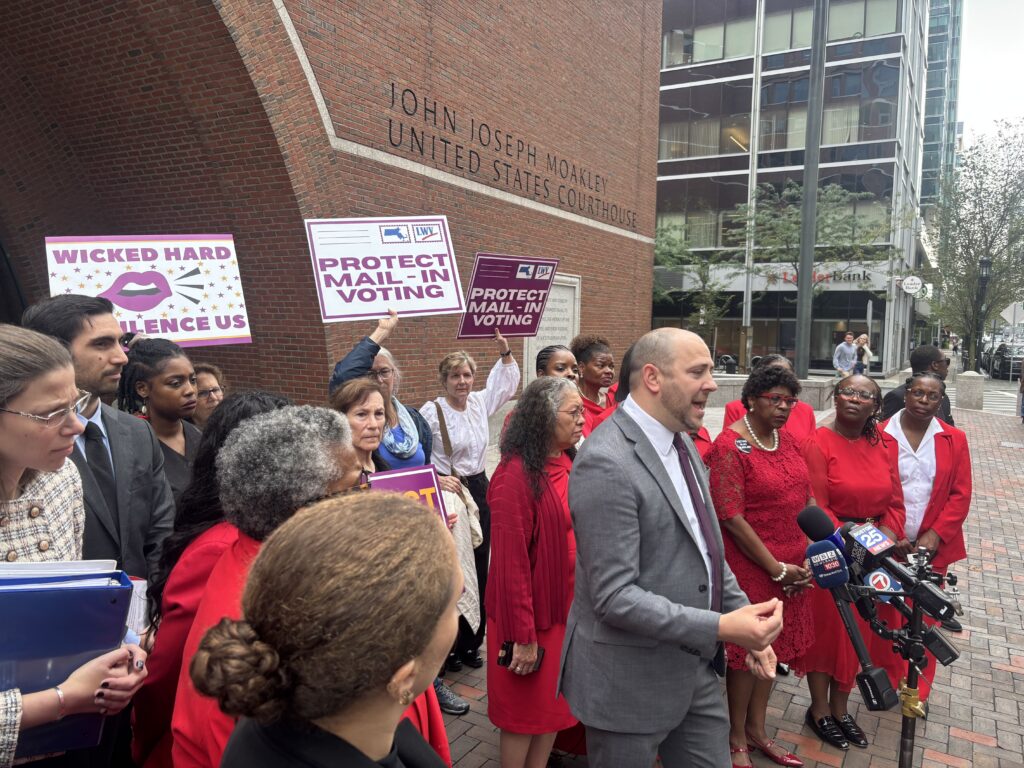
BOSTON — With Election Day just two months away, the lawyer defending the Postal Service’s recently issued rule carrying out President Donald Trump’s anti-mail voting executive order could not tell a federal judge how — or even if — the new rule would work.
At Thursday’s hearing in Boston, U.S. District Judge Indira Talwani repeatedly asked the U.S. Postal Service (USPS), represented by the Department of Justice’s (DOJ) Michael Velchik, whether the agency was ready to implement the rule, which was only published last week.
And Velchik repeatedly refused to do anything more than refer her to the rule itself, which provides scant details about when the agency might be able to begin its rollout ahead of the rapidly approaching midterm elections.
That exchange — and others like it — threw into sharp relief just how quickly and haphazardly USPS is moving to implement the new postal requirements, which critics say could potentially strip millions of Americans of the ability to vote by mail. As the hearing wore on, Talwani seemed increasingly exasperated with the defendants’ arguments.
Get updates straight to your inbox — for free
Join 350,000 readers who rely on our daily and weekly newsletters for the latest in voting, elections and democracy.
The postal rule in question requires election officials to submit barcode-equipped envelopes for mail ballots to the U.S. Postal Service (USPS) for approval and also lists of eligible mail voters. If state or local administrators fail to get USPS’s greenlight for their envelope design or don’t upload their voter data, then mail carriers won’t deliver mail ballots to those states’ residents.
Two sets of plaintiffs are challenging the rule in separate lawsuits that were combined into a single hearing Thursday. One is a coalition of pro-voting organizations and individual mail voters led by the League of Women Voters of Massachusetts (LWVMA). The other is 24 Democratic-led states and Washington, D.C., led by California.
The plaintiffs argue that the rule would make mail voting “virtually impossible” and result in “mass disenfranchisement,” citing the testimony of dozens of state and local officials from both major political parties.
In response to those claims, Velchik largely cited the rule itself, which provides no timeline on when an online portal for state officials to submit their envelopes and voter lists might go live.
Meanwhile, in a report published Tuesday, an anonymous USPS whistleblower warned that the portal’s “slapdash” development would almost certainly result in “catastrophic failure.”
Whose ‘irreparable harm’?
The parties gathered in Courtroom 9 of the John J. Moakley Courthouse Thursday because, 11 days ago, the U.S. Supreme Court had reversed a 1st U.S. Circuit Court of Appeals decision and lifted an injunction that Talwani had previously issued against the USPS rule. The Court agreed with the DOJ’s argument that it was too soon for a court to assess the legality of Trump’s order — after all, it concluded, USPS hadn’t implemented it yet.
That procedural argument over the lawsuit’s “ripeness” disappeared when USPS published its final rule soon thereafter. But USPS seems far from ready to actually put the rule into effect.
Asked when the USPS’s portal might go live, Velchik demurred.
“I can’t make specific representations,” he said.
“We’ve been here for a week and you can’t tell me the government is ready to go?” Talwani responded, incredulously.
That question gets to a critical issue that could decide the matter’s fate if — as expected — it again rises to the Supreme Court.
Talwani repeatedly asked the DOJ to provide details of the “irreparable harm” the government would suffer if she granted a preliminary injunction barring the rule’s implementation in November’s midterm elections. Such an explanation — were the DOJ to provide it — would also rebut the plaintiffs’ mirroring claims of their own irreparable harm if the rule is left in place. But Velchik could only meekly point to the final rule.
Talwani gave the DOJ until 3 p.m. Thursday to supplement the record with specifics about the readiness of the USPS’s portal.
“And if you can’t provide details, I’m going to assume it’s not finalized yet,” she warned, adding that she would also assume the government’s claims about irreparable harm were made “without any facts.”
Just before that deadline, the DOJ submitted additional information provided by a USPS executive, but it lacked the precision Talwani had requested.
“We continue to make refinements to the Portal, including consideration of changes needed in light of the TRO,” the declaration from USPS Chief Customer and Marketing Officer Steven Monteith stated. “We anticipate being in a position to make the Portal available to users for voluntary use by sometime next week.”
The DOJ was joined in the case by a dozen Republican-led states, represented primarily by Missouri Solicitor General Louis J. Capozzi III, in defending the new rule. Capozzi noted Thursday that his own state’s top election official provided a statement saying that Missouri could successfully comply with the new rule.
But Davin Rosborough, an ACLU lawyer representing the LWVMA plaintiffs, noted during the hearing that the other 11 red states’ silence spoke far louder than one short statement from Capozzi.
“The only evidence that the states who intervened on the defendant’s side put in [the record] was a single one-page declaration from the Missouri Secretary of State saying, in vague terms, ‘I think we can comply,’” Rosborough said at a press conference following the hearing. “Alabama, Texas, none of the other states put in anything…”
“I think the failure to put anything in writing — and under penalty of perjury — speaks volumes,” he added.
Talwani noted Thursday that local election officials from Texas’ Travis and Harris counties also provided sworn declarations that the USPS rule would result in disfranchised voters.
Decision coming
Talwani indicated that she may issue her decision as early as Thursday night. In recognition of the tight time constraints, she suggested that she would issue relatively cursory rulings on many of the claims raised by both sides, while more fully explaining her position on the few she believed to be most important.
At its core, the case will turn on whether USPS had the power to enact its rule. “The $64,000 question is: Is this authorized by the statute?” Velchik said.
The U.S. Constitution provides that states make the rules for the “Times, Places and Manner” of holding elections, which Congress can then override. But it provides no independent authority to the president.
The defendants maintained that the general statute Congress enacted to empower USPS to pass regulations on the collection and handling of mail covers this rule on mail ballot envelopes and the refusal to deliver them. USPS requires all mail to include things like return addresses and postage — including mail ballots — and no one ever complained about that, they argued.
Likewise, USPS has long provided guidelines to election officials on steps they can take to ensure mail ballots are delivered quickly, like special envelopes, and those also weren’t a problem.
But those are different, Rosborough argued. The Postal Service’s past regulations on mail ballots were voluntary — states were free to ignore them and still trust their ballots would be delivered. And a general rule on postage is nothing like a specific rule on mail ballots alone.
As a lawyer for the Democratic states noted, “The Supreme Court said over 100 years ago [that] the power to refuse to deliver requires an act of Congress. Here, there is no statute that allows USPS to not deliver mail ballots. Full stop.”
In contrast to past hearings, which hinged on technicalities, Thursday’s hearing focused almost entirely on the merits. There was just one notable exception: Capozzi argued that the LWVMA plaintiffs, who include individual voters in every state, lacked standing to block the rule — at least in the states he represented. If she was going to issue the preliminary injunction, Capozzi asked Talwani to at least not apply it to the intervenor defendant states.
That led Talwani to eventually ask what Capozzi hoped that would accomplish — in one of the sharpest back-and-forths out of many during the session.
Capozzi said letting states like Texas and Missouri voluntarily comply with the new USPS rule would provide evidence of how it operates in the real world.
“So, we’re going to do a test run on this election?” Talwani asked.
“In some states,” Capozzi responded.
“We’re not talking about an intellectual puzzle game,” Talwani replied with exasperation. “We’re talking about people’s right to vote.”
At another point, Talwani noted that USPS’s final rule provided an estimated two-day turnaround for approving mail ballot envelope designs, despite thousands of local election offices submitting them all at once.
“So… based on 10,000 jurisdictions submitting ballots, you still stand by a two-day turnaround?” Talwani asked Velchik.
“Yes, your honor,” he replied.
“…Okay,” she responded in an almost sarcastic tone, eliciting stifled laughter from the gallery.
As the hearing proceeded, election administrators across the country said they were pulling for a quick decision blocking the new rule.
“Election officials across the country from both parties are holding our breath today,” said Utah Lt. Gov. Deirdre Henderson (R), her state’s top election official. “It’s hard to describe the level of chaos, confusion, and uncertainty we experienced during the 36 hours the rule was briefly in effect last week.”