Federal appeals court shoots down Trump administration’s bid to reinstate anti-mail voting order
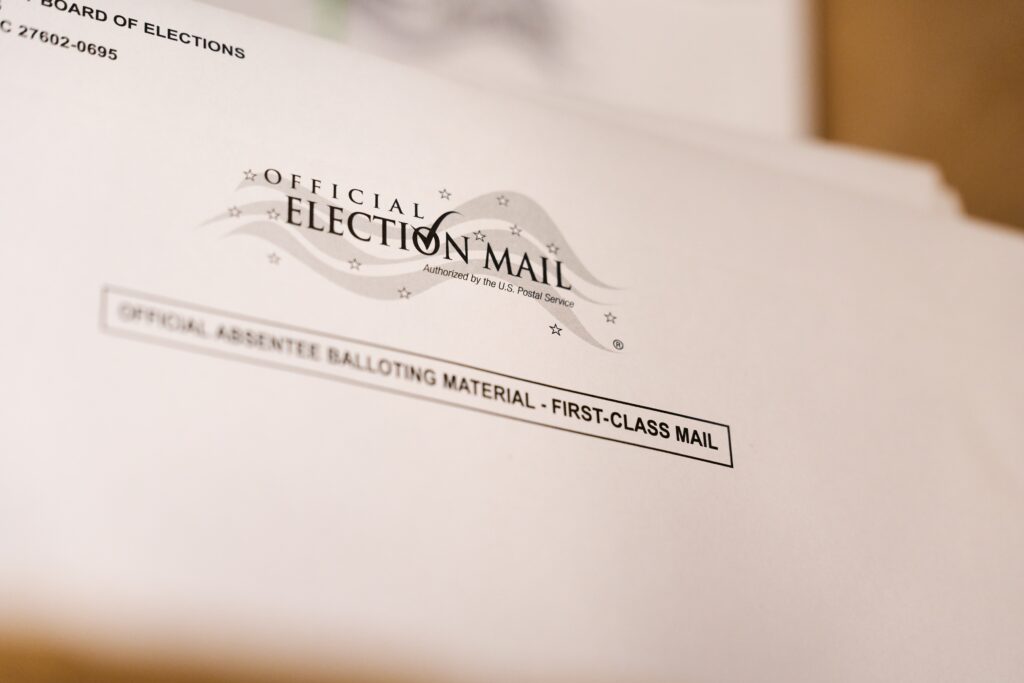
The 1st Circuit Court of Appeals on Thursday denied the Justice Department’s latest effort to reinstate key parts of President Donald Trump’s anti-mail voting order for this year’s pivotal midterm elections.
The appeals court dismissed the Justice Department’s arguments that the U.S. Postal Service’s new restrictions on mail ballots are not an attempt to regulate elections by a federal agency with no authority to do so.
While the appellate court refused to let the rule take effect for now, a similar request to implement the Postal Service regulations is still pending before the U.S. Supreme Court, which could rule at any time.
“Most prominently, appellants have not made a strong showing that the district court erred in determining that the Final Rule is likely unlawful,” the 1st Circuit said.
Get updates straight to your inbox — for free
Join 350,000 readers who rely on our daily and weekly newsletters for the latest in voting, elections and democracy.
U.S. District Judge Indira Talwani halted the Postal Service rule while legal challenges proceed.
The 1st Circuit said it agreed with Talwani that the Postal Service rule likely violates the elections clause of the Constitution, which gives states the power to set the rules for federal elections subject to laws passed by Congress.
“Appellants seek to avoid the constitutional problem by denying that the Final Rule regulates the manner of holding elections. The district court charitably concluded that ‘[t]his denial rings hollow.’ The title of the Final Rule is ‘Ballot Mail for Federal Elections,’ and the Final Rule explicitly and exclusively regulates election mail,” the 1st Circuit said.
More specifically, the 1st Circuit said it wasn’t swayed by the Trump administration’s argument that the rule falls under the Postal Service’s statutory authority to regulate the mail.
“Appellants have not convinced us that it is likely that Congress would delegate constitutionally assigned tasks relevant to maintaining our electoral system to the Postal Service through the ‘wafer-thin reed’ of a general grant of authority to manage the postal system,” the court said.
The appellate court also sided with Talwani on the practical consequences of the rule, echoing her determination that trying to implement it so close to the election will “likely result in the disenfranchisement of millions of voters across the country.”
The 1st Circuit said the Trump administration didn’t sufficiently demonstrate that it would suffer more harm from pausing the rule than blue states, pro-voter groups and overall public interest would experience should the rule go into effect.
“Indeed, appellants have not even seriously challenged this aspect of the district court’s ruling, much less demonstrated why it is clearly erroneous,” the court said. “And moreover, there is no record evidence of past fraud or a likelihood of impending fraud related to the November 3 election.”