Georgia election board asks for Trump admin to help go after state’s voting machines
 Prefer us on Google
to see more of our voting rights news coverage when you search.
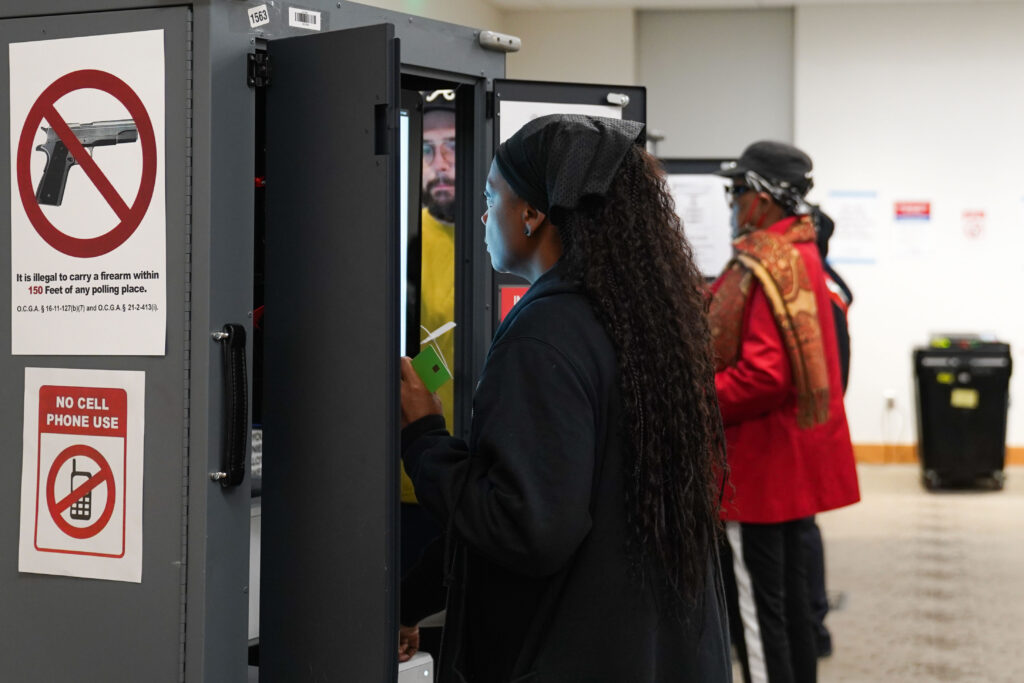
Republican members of the Georgia State Election Board (SEB) adopted a resolution Monday seeking the Trump administration to intervene in a vague crusade against the state’s voting system just weeks before the midterm elections.
The resolution directs James Mills, the board’s executive director, to pursue assistance “from any quarter,” including the departments of Justice (DOJ) and Homeland Security (DHS), while pressuring Secretary of State Brad Raffensperger to pursue an ill-defined software update to Georgia’s voting equipment.
The invitation for federal involvement in intimate election operations comes as President Donald Trump attempts to exert greater control over state election procedures, including what voting machines they use.
The DOJ and DHS have been key components of the president’s effort — specifically his attacks on certain voting systems.
Get updates straight to your inbox — for free
Join 350,000 readers who rely on our daily and weekly newsletters for the latest in voting, elections and democracy.
Introduced by member Carolyn Roddy, the Republican Party’s appointee to the board, the resolution cites “public comments and complaints” to assert that unspecified vulnerabilities “threaten the security of the voting system and the ballot secrecy guaranteed to Georgia’s voters.”
In addition to seeking assistance from the Trump administration, the resolution directs Raffensperger to share data on Georgia’s election machines with the DOJ and DHS to assist with federal investigations into voting machines.
The board passed the resolution in a 3-2 vote, with John Fervier, the board’s chairman and Gov. Brian Kemp’s (R) appointee, opposing it.
“I have a fundamental issue with the federal government becoming involved in Georgia elections. “I just fundamentally disagree with it,” Fervier said. “I’m just a limited government kind of guy, whether it’s state or federal.”
Board member Sara Tindall Ghazal, the SEB’s lone Democrat, also sharply criticized the resolution.
“No matter who is in office, I do not support federal intervention in state-run elections,” Tindall Ghazal said. “I think this is federal overreach.”
“How would you feel if I had come up with this proposal under the previous administration? Would you be comfortable with that?” she asked SEB Vice Chair Janelle King, who represents the Republican-held state House on the board.
King, who strongly supported the resolution, claimed she would be “100%” on board with the Biden administration intervening in Georgia’s elections.
Though she repeatedly said she opposed federal involvement in state election procedures, Salleigh Grubbs, Georgia Lt. Gov. Burt Jones’ appointee, also supported the resolution.
“Now the issue is whether to have federal intervention or not. I don’t want federal intervention. I am a strict constitutionalist, and I just want people to leave me the hell alone and let me cast my vote in privacy,” Grubbs said moments before voting for the resolution.
It’s unclear exactly what assistance Mills, a former Republican state lawmaker, could seek from the Trump administration.
Since the 2020 election, Trump and election deniers in Georgia have repeatedly and baselessly attacked the state’s election machines, which were predominantly manufactured by Dominion. The company has since been acquired by Liberty Vote.
Specifically, the conspiracies have focused on Georgia’s electronic ballot-marking devices, which voters use to make their selections. The Liberty Vote machines then print out voters’ selections on paper ballots with QR codes that are scanned by tabulators during the counting process.
Voting technology experts have recommended that states move away from machines that encode votes in QR or barcodes because they believe that votes should be counted from human-readable text that voters can verify.
However, Trump and his allies have taken those concerns to an extreme, using them as vehicles to claim fraud and try to undermine election outcomes.
Since returning to the White House last year, Trump has made several attempts to restrict the use of ballot-marking devices that encode voting information in bar or QR codes — an attack that appears to be specifically tailored for Georgia.
He signed an executive order in March 2025 directing the U.S. Election Assistance Commission to decertify any such machines, though several court orders barred the commission from going forward with that directive.
More recently, Homeland Security Secretary Markwayne Mullin asked Attorney General Todd Blanche in an alarming letter earlier this month for a legal determination of whether voting machines that count votes from barcodes and QR codes violate the Help America Vote Act (HAVA).
Roddy’s resolution built on that letter, demanding that Raffensperger share data with the Trump administration to assist with Blanche’s legal determination on the machines.
The resolution comes just weeks after a Georgia special committee embarked on a years-long effort to overhaul the state’s election system to phase out ballot-marking devices for most voters. Under federal law, however, ballot marking devices must still be made available, particularly for voters with disabilities who may not be able to fill out a hand-marked ballot without assistance.