Second judge halts Trump’s election power grab, barring states from voluntarily working on mail voting rule
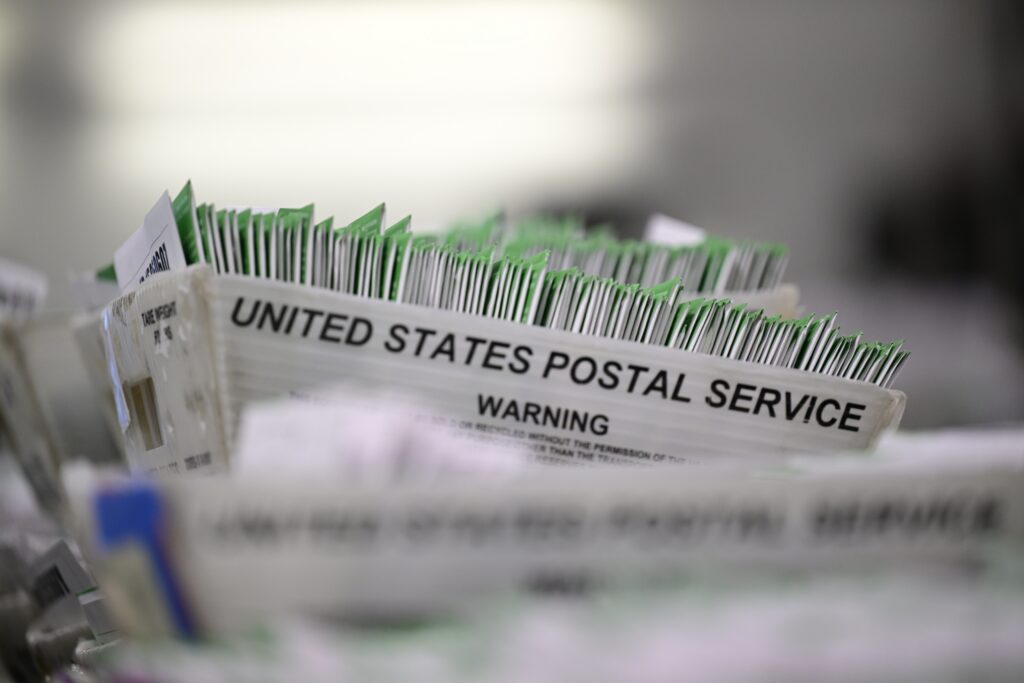
States cannot voluntarily work toward meeting the U.S. Postal Service’s new mail voting requirements after a second judge said the requirements likely overstep the post office’s authority.
In another win for voters, U.S. District Judge Carl Nichols in Washington, D.C. – appointed by President Donald Trump – issued a preliminary injunction late Sunday in favor of Democrats* who challenged the rule as an unconstitutional power grab.
Nichols said states taking steps to comply with the mail voting order would “create even more confusion and misunderstanding (and thus delays and mistakes).”
His ruling comes as the U.S. Supreme Court considers the Trump administration’s request to lift a separate injunction issued by U.S. District Court Judge Indira Talwani in Boston. The nation’s high court could rule at any time.
Under the USPS rule, states would be required to upload a list of approved mail voters to a new federal government portal. The required information includes names and addresses of those who intend to vote by mail in the upcoming election. States would also need to redesign ballot envelopes with specific information, including trackable barcodes, which the USPS must approve in advance.
If states don’t meet the requirements, USPS said it will not deliver ballots to voters.
Nichols said the rule exceeds “any conception of the outer bounds” of the Postal Service’s statutory authority, and that the administration’s arguments otherwise are “unpersuasive.”
Get updates straight to your inbox — for free
Join 350,000 readers who rely on our daily and weekly newsletters for the latest in voting, elections and democracy.
He wrote in his order, “the Postal Service could issue (and enforce) the Rule only if Congress gave it the authority to do so, but here no statute grants the Postal Service the power to issue key parts of the Rule.”
Nichols also shot down a rationale provided by the government that’s gotten a lot of attention: comparing mail ballots to fake bombs and human and animal remains.
“Defendants’ analogies to Postal Service regulations for the mailing of cremated remains and replica explosives do not help their case. In particular, Defendants argue that those rules demonstrate that the Service has the authority to impose special conditions on certain sensitive categories of mail. But those regulations concern how particular items are packaged, shipped, and tracked while moving through the postal system,” Nichols said.
“Most of the Ballot Mail Rule, on the other hand, concerns the maintenance of absentee and mail-in voter information through the Federal Ballot Mail Portal and the vetting of Outbound Federal Ballot Mail for compliance with the entire regulatory regime—not steps that aid in the transmission of mail,” Nichols added.
The case in Washington, D.C., was brought by the Democratic Senatorial Campaign Committee (DSCC), Democratic Congressional Campaign Committee (DCCC), Democratic National Committee, Democratic Governors Association, Senate Democratic Leader Chuck Schumer and House Democratic Leader Hakeem Jeffries.
Last week, the Democratic Party plaintiffs urged Nichols to fast-track their request for a freeze on Trump’s mail ballot order, citing new urgency as the first mail ballots of the 2026 general election were sent to voters.
Nichols said the Democratic groups successfully showed there’s “an increased risk that a significant number of absentee or mail-in ballots will ultimately not be counted” if the USPS rule is allowed to take effect.
“The harm of untransmitted ballots—both to voters and candidates—is irreversible, because ‘once the election occurs, there can be no do-over and no redress,’” Nichols said.
Nichols said he was also unmoved by the Trump administration’s argument that a block on the rule would hurt its stated goal of election security, noting they’ve yet to provide the courts any proof of widespread fraud.
“On the other side of the ledger, the Federal Government does not point to any record evidence that there will be significant fraud in the upcoming elections in the event the Court enters preliminary injunctive relief,” Nichols wrote.
“There is no indication in the record before the Court that preliminarily enjoining the Ballot Mail Rule would actually harm those interests,” he added. “And those harms are significantly outweighed by the risks of disenfranchisement to absentee and mail-in voters identified by Plaintiffs.”
*The Elias Law Group (ELG) represents the plaintiffs in this case. ELG Firm Chair Marc Elias is the founder of Democracy Docket.