Thousands of overseas voters could be disenfranchised by Trump mail voting rule, advocates warn
 Prefer us on Google
to see more of our voting rights news coverage when you search.
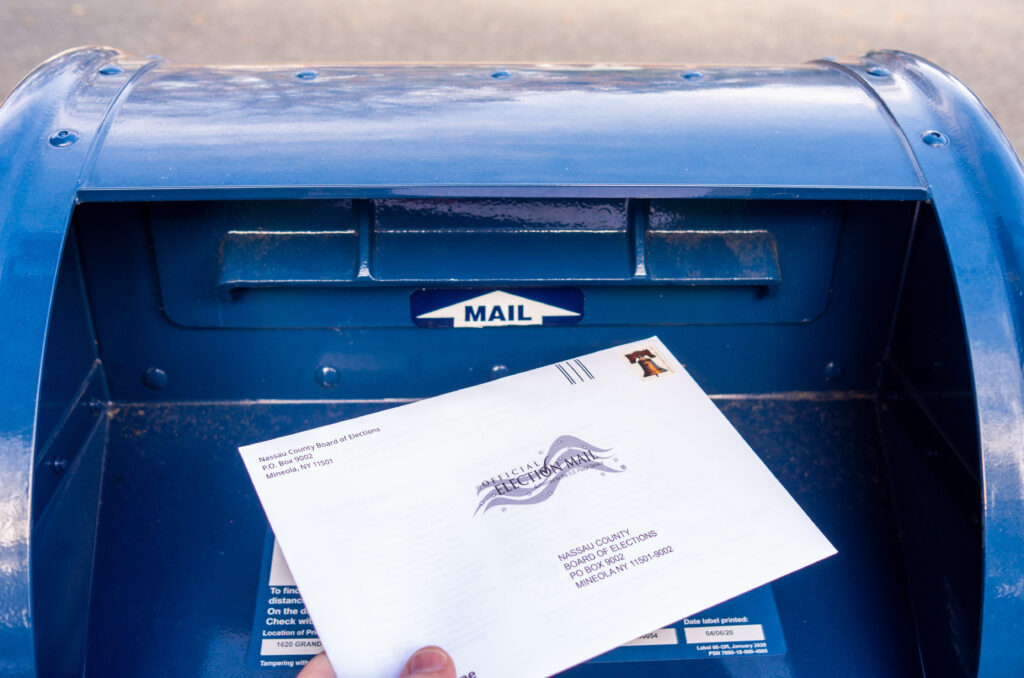
As they’ve sought to implement President Donald Trump’s executive order attacking mail voting, the Department of Justice (DOJ) and the U.S. Postal Service (USPS) have maintained that the restrictions would not apply to U.S. citizens voting from abroad, including military service members stationed outside the country.
But now a nonpartisan network of former military and civilian leaders is warning that hundreds of thousands of overseas voters could be disenfranchised if a new USPS rule based on the president’s order is allowed to stand.
That rule “provides no plausibly effective procedures by which USPS can ensure that ballots mailed to or returned” by voters under the Uniformed and Overseas Citizens Absentee Voting Act (UOCAVA) “will not be rejected as noncompliant under the Final Rule’s barcode-and-enrollment policy,” the National Security Leaders for America (NSLA) wrote in a brief filed Tuesday in support of plaintiffs challenging the USPS rule.
Those voters would still be disenfranchised, NSLA argued, despite the administration’s claims to the contrary.
The fate of the USPS rule currently hangs in the balance before the 1st Circuit Court of Appeals and the U.S. Supreme Court. The League of Women Voters of Massachusetts (LWVM) and other pro-voting groups urged the 1st Circuit to reject the government’s request to lift U.S. District Judge Indira Talwani’s preliminary injunction that bars USPS from enforcing its new mail voting rules before the midterms.
Get updates straight to your inbox — for free
Join 350,000 readers who rely on our daily and weekly newsletters for the latest in voting, elections and democracy.
Issued in March, Trump’s executive order directed USPS to establish new standards for sending mail ballots to voters. The Postal Agency then drew up a new rule, which was officially published last month. It requires states to submit data from voters requesting mail ballots into a USPS portal, which USPS will use to determine which ballots will be delivered to voters.
The rule also forces states to redesign mail ballot envelopes with a new election logo and barcodes so the federal government can track ballots more easily. The Postal Service would reject mail ballots from state election officials that don’t use compliant envelopes.
Officially, ballots sent to military and overseas voters aren’t subject to the envelope redesign requirement. But NSLA emphasizes that the new rule does not establish any way to differentiate between ineligible ballots without a barcode and overseas ballots that don’t have a barcode.
“USPS established no processing procedures to ensure outbound UOCAVA ballots are delivered to voters despite the new delivery restrictions the Final Rule imposes on all other federal election mail,” the organization’s brief states. “Nor does USPS have any stated method to ensure that return ballots from UOCAVA voters will be delivered for tabulation when those ballots would be rejected for other mail-in voters due to the absence of machine-readable markings on their return envelopes.”
In a statement, Daniel C. Schwartz, chair of NSLA’s legal advisory committee, said military members already “face extraordinary challenges casting ballots from distant duty stations and overseas posts,” and the new USPS rule will add even more barriers.
“USPS now proposes to introduce an untested system just weeks before an election, without a workable process to ensure UOCAVA ballots are properly identified and delivered,” Schwartz added. “Americans serving their country should never lose their vote because of bureaucratic confusion or an avoidable failure in the mail system.”